
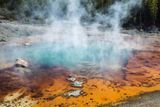
Yellowstone National Park’s hundreds of thermal geysers spew water into the sky with dramatic ferocity. Nowhere in the park is this effect more obvious than in the highly active Norris Geyser Basin, which houses the world’s tallest active geyser, Steamboat Geyser.
In the last few days at the start of March 2026, however, the spotlight has moved to another region of the basin, where Echinus Geyser, a rare acidic geyser, has started erupting for the first time in six years, according to a release from the U.S. Geological Survey (USGS).
Echinus sprays a plume of liquid at roughly the acidity of orange juice up to 30 feet into the air.
Dwindling Eruptions at Echinus Geyser
Echinus’s geyser pool is around 60 feet across, and during the latter half of the 20th century, it was a regular crowd-pleaser, erupting regularly every 40 to 80 minutes throughout the 1970s. These impressive plumes continued into the 1980s and 1990s, reaching up to 75 feet in height.
After the turn of the century, however, the geyser’s activity waned. A monitoring system installed in 2010 recorded just over a dozen eruptions over three months from October 2010 to January 2011.
The geyser then stayed largely dormant until a flashpoint in October and November 2017, when eruptions occurred every couple of hours. Echinus then decided to take a break, and there have been no eruptions from the acidic spout since December 2020.
Last month, that all changed.
Read More: Yosemite’s Rare Firefall Returns This February — but the Fiery Glow Will Last Only Minutes
The Geyser Event Returns
In early February 2026, the geyser pool’s surface started to froth and released water into nearby runoff channels. Then, on Feb. 7, 2026, Echinus erupted.
Since Feb. 16, 2026, the geyser has erupted every two to five hours. These blasts, which last between two and three minutes, cause the geyser pool’s water level to noticeably drop before refilling over the next hour. The geyser’s activity mimics that seen in 2017. The geyser’s temperature hits about 158 degrees Fahrenheit (70 degrees Celsius) during eruptions.
Acid geysers like Echinus are uncommon because the low pH of their waters can erode the rock that houses them. Echinus’s acidity is driven by a mix of acidic gas and neutral water, which means the overall acidity is not strong enough to break down the rock. The geyser’s chemistry produces a red color, from arsenic, iron, and aluminum in the water, around the rim of the geyser pool.
What You Should Know About Echinus
The geyser was originally named for the spiny rocks, covered in silica, which surround it. When mineralogist Albert Charles Peale visited the geyser in 1878, he thought these rocks made it resemble a sea urchin, a type of echinoderm.
Echinus is just one of between 500 and 700 geysers in the park that are active. The thermal jets are a surface sign of the huge Yellowstone volcano under the park. The heat from the volcano warms the area’s groundwater, which then bubbles up to the park’s hydrothermal features, which include hot springs, geysers, gooey pools called mud pots, and ultra-hot steam vents called fumaroles.
It’s unclear at this point how long the geyser’s eruptions will last, although the plume’s recent history suggests they are unlikely to sustain into the summer. It seems that if you’re keen to see Echinus blow, now is the time to visit Yellowstone.
Read More: Yellowstone Is One of the World’s Largest Magmatic Systems – And It May be Missing a Key Volcanic Gas
Article Sources
Our writers at Discovermagazine.com use peer-reviewed studies and high-quality sources for our articles, and our editors review for scientific accuracy and editorial standards. Review the sources used below for this article:


