There are 2 venomous snakes in Mass. How to spot them, what to do if you get bit

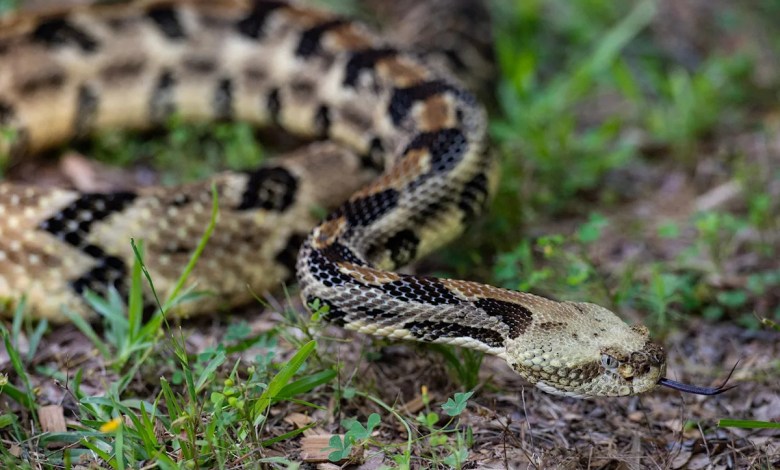
Most snakes in Massachusetts are relatively harmless.
You leave them alone, and they will leave you alone, while keeping your garden’s ecosystem in balance (think fewer rodents).
But there are two species – only two – that are venomous and their bites are said to pack a punch: the timber rattlesnake and the copperhead.
Neither species is particularly common, but it does happen. In 2024, for example, two hikers spotted two timber rattlesnakes fighting in Massachusetts’ Blue Hills Preserve.
The good news is that for both species, the bite is unlikely to be fatal, although it will require prompt medical attention.
Snakes typically begin waking up from their winter brumation in March, according to MassWildlife. Here’s where timber rattlesnakes and copperheads are most commonly found in Massachusetts and how to identify them.

Timber rattlesnakes are rare in Massachusetts.
How to identify: The timber rattlesnake has “large, heavy-bodied vipers with broad, triangular heads and extremely variable color patterns. Some are almost jet black. Others appear sulfur yellow with black, brown, or rust-colored spots, which are separated by crossed bands on the back and sides,” according to MassWildlife.
The best gift, however, is the rattle. While other species of snakes in Massachusetts may try to imitate a rattle, the timber rattlesnake is the only one that should have one. The other easy thing to look for is a triangular shaped head.
Where they are most often found: MassWildlife estimates that timber rattlesnake populations in the state number only in the hundreds because the species is endangered. They are found primarily in the western counties of Massachusetts and only “scattered on a handful of ridges, hills, and mountains that provide the required winter habitat of rocky, fractured slopes with open southern or western exposures.”
What to do if you are bitten: This should go without saying, but try to avoid getting bitten in the first place by giving the timber rattlesnake a respectful space. But if the encounter goes wrong and you get bitten, the good news is that a bite, while painful, is rarely fatal, according to MassWildlife.
Wood rattlesnake bites have antivenom. If you are bitten, move away from the snake, remove items like rings, bracelets and watches and call for help. Ideally, health experts recommend that you go to the hospital with antivenom within an hour of the bite.
What health experts don’t recommend is trying to cut the bite, suck out the venom, or create a tourniquet.
Copper head

Mike Zaborowski shares a photo of a copperhead, one of two species of venomous snakes found in Massachusetts.
How to identify: Copperhead snakes have a distinctive hourglass pattern on their markings and a thick body and head. These three characteristics can help distinguish them from the much more common and non-venomous Eastern Milksnake.
Copperheads have “broad, triangular heads and vertically elliptical pupils. Their body has dark brown or reddish hourglass-shaped crossbands, which appear narrower in the middle of the body and wider at the sides. Belly colors range from tan to tan,” according to MassWildlife.
They can grow 24 to 40 inches long.
Where they are most often found: In Massachusetts, copperheads have small populations found almost exclusively in Norfolk and Hampden counties, according to MassWildlife.
They live primarily in deciduous forests and “prefer moist habitats as well as traprock (basalt) ledges with extensive rock slides underneath,” MassWildlife said.
But you can spot one outside a forest.
“Habitat often also includes stands of red cedar, pine and hemlock, as well as cool, moist meadows,” MassWildlife said. “Summer grounds are located near wetlands, forested swamps and swamps, or lakes and reservoirs. During this time, copperheads may also inhabit fields and meadows, damp forests, and quarries.
What to do if you are bitten: Copperhead bites are rare and rarely fatal.
If you are bitten, experts give the same advice as for the timber rattlesnake. Move away from the snake, remove any tight jewelry, and consult a medical professional. Washing it with soap and water can help.
As with the timber rattlesnake, do not use a tourniquet or try to suck out the venom.
This article was originally published on Telegram & Gazette: MA has 2 venomous snakes. Here’s where they live, how to spot them


