Theropods like Spinosaurus and Allosaurus Had Large Skulls but Weak Bites


Not all giant theropods had a good bite, and the evolution of the skull played a major role on this subject.
A new study in Current biology analyzes the skulls of 18 large prehistoric predators, including Tyrannosaurus rexThe spinosaurs and the allosaurs, and found that just because they were similar, that did not mean that they all had strong bites.
“Carnivorous dinosaurs have taken very different paths as they play in giants in terms of food biomechanics and possible behaviors,” Andrew Rowe of the University of Bristol said in the United Kingdom in a press release.
“Tyrannosaurs have evolved skulls designed for force and crushing bites, while other lines had relatively lower but more specialized skulls, suggesting a diversity of food strategies even with massive sizes. In other words, there was not a “better conception of the skull to be a giant predator; Several conceptions worked perfectly. »»
Evolution of theropod skulls
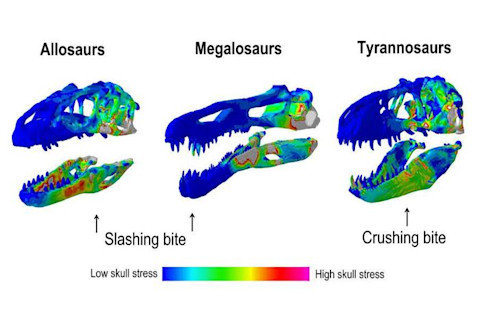
Illustrations of dinosaurs bites. (Image credit: Rowe and Rayfield, current biology)
Rowe and Rayfield, current biology
Massive theropods, as T. Rex And Spinosaurus, are popular among fans of dinosaurs, especially when represented on the silver screen in films like Jurassic Park. Rowe and the co-author of the Emily Rayfield study are also fans of these giant bipedal dinosaurs. Thanks to their study, they aimed to determine how to be biped can have influenced the evolution of theropod skulls and their food techniques.
Although they can compete on the big screen, most of these giant theropods lived in different parts of the world and for different periods, and therefore probably never interaci. And although they are of similar size, these predators also have very different forms of skull. For this reason, the study team wanted to know if the different forms of skull also meant different skull functions.
Find out more: Massive and dead dinosaurs may have made the recovery irresistible
Scan theropod skulls
For this study, the research team analyzed the size of the body and the biomechanics of the skull of dinosaurs. They used computed tomography (computed tomography) and other 3D technologies to measure bite resistance, quantify power performance and analyze skull mechanics.
According to the study, the research team assumed that they would notice differences between all the skulls, but they were surprised to find a clear biomechanical divergence.
“Tyrannosaurides like T. Rexhad optimized skulls for high bite forces at the price of higher skull stress, “Rowe said in the press release.” But in some other giants, as Giganotosaurus We have calculated the constraint models suggesting a relatively lighter bite. He explained at home how evolution can produce several “solutions” in life as a large carnivorous two -way. »»
The largest does not mean stronger
The results of the study also revealed that the stress of the skull did not necessarily increase the size. Some smaller theropods had a stronger bite force than greater theropods due to the increase in muscle volume. The larger skulls did not mean stronger bites. For example, howeverSpinosaurus AndAllosauruswere greater theropods, the results of the study revealed that they would not have had a strong bite force; Instead, they would probably have torn and torn the flesh.
“I tend to compareAllosaurusTo a modern komodo dragon in terms of food style, “Rowe said in a press release.” The great skulls of Tyrannosaurus were rather optimized as modern crocodiles with high bite forces that crushed prey. This biomechanical diversity suggests that dinosaurs’ ecosystems have supported a wider range of giant carnivorous ecologies that we often assume, with less competition and more specialization. »»
Find out more: The fossilized teeth offer clues to the favorite foods of dinosaurs about 150 million years ago
Article Sources
Our writers of Discovermagazine.com use studies evaluated by peers and high quality sources for our articles, and our publishers examine scientific precision and editorial standards. Review the sources used below for this article:


