These 70 dusty galaxies at the edge of our universe could rewrite our understanding of the cosmos

When you purchase through links on our articles, Future and its syndication partners may earn a commission.

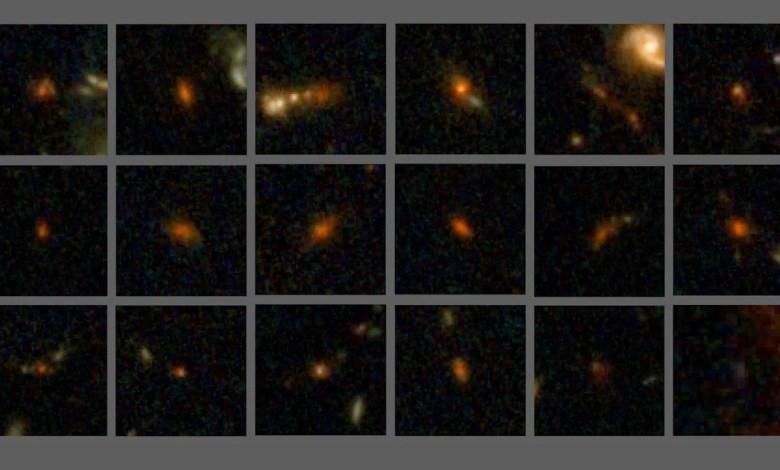
18 dusty “missing link” galaxies seen by JWST and ALMA. | Credit: UMass Amherst
Using the James Webb Space Telescope and the Atacama Large Millimeter/Submillimeter Array, astronomers studied 70 dusty, star-forming galaxies at the edge of the universe. These galaxies, seen as they were less than a billion years after the Big Bang, could change everything we know about cosmic evolution.
It seems that these galaxies were already rich in “metals,” a term used by astronomers to describe elements heavier than hydrogen and helium, although they existed before current models predicted that the current generation of stars could have forged and distributed these heavy elements.
“Dusty galaxies are massive galaxies containing large amounts of metals and cosmic dust,” said team leader Jorge Zavala of the University of Massachusetts Amherst. said in a statement. “And these galaxies are very old, meaning the stars formed at the beginning of the universe, earlier than our current models predict.”
Research on these galaxies began when Zavala and his colleagues used the Atacama Large millimeter/sub-millimeter array (ALMA), an array of 66 radio antennas located in the Atacama Desert region of northern Chile, to identify a population of 400 bright, dusty galaxies.
Further investigation with the James Webb Space Telescope (JWST) narrowed these down to 70 faint, dusty candidate galaxies at the very edge of the cosmos, the majority of which had never been seen before. By combining observations from JWST and ALMA, the researchers then confirmed that these galaxies had formed 500 million years ago after these galaxies first appeared. Big Bang.
This not only suggests that our cosmic history needs to be revised, but it also connects these galaxies to two other strange galaxy families. These include extremely bright, star-forming galaxies discovered in the early universe by JWST and older galaxies that have “died” and no longer form stars.
“It’s like we now have snapshots of the life cycle of these rare galaxies,” Zavala said. “Ultraluminous galaxies are young galaxies, quiet galaxies are old, and the ones we found are young adults.”
Further research will be needed to connect these three galaxy populations. However, if they are connected, it is clear that something is missing in our understanding of galactic evolution, and that star development must begin earlier in the cosmos than is currently theorized.
The team’s results were published Tuesday February 17 in Letters from the astrophysical journal.


