The Quadrantid meteor shower peaks tonight, but will the full ‘Wolf Moon’ outshine the show?

When you purchase through links on our articles, Future and its syndication partners may earn a commission.

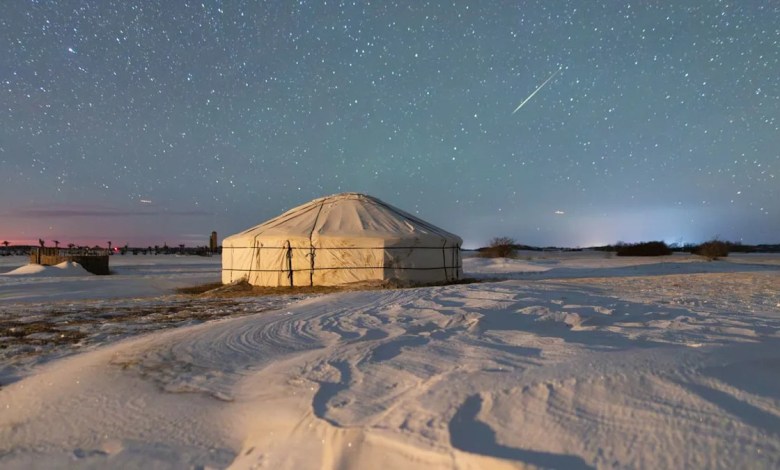
A Quadrantid meteor captured brightening China’s skies. | Credit: Photo by VCG/VCG via Getty Images
Your first big opportunity to spot bright shooting stars and fireballs in 2026 arrives tonight with the peak of the Quadrantid meteor shower, although only the brightest members may be visible, as the annual event crescendos in the bright light of the full moon.
THE Quadrantid meteor shower is active from December 26, 2025 to January 16, 2026, with a narrow peak lasting approximately six hours occurring in the predawn period on January 4. according to EarthSky.org. The shower owes its brief heyday to near perpendicular angle to which Earth crushes the thin trail of debris left by asteroid 2003 EH1. Shooting stars appear when fragments of ancient comets And asteroids collide with Earth, burning in a fiery spectacle as they are overcome by friction.
Quadrantid meteor showers are capable of producing impressive shows, with up to 200 shooting stars visible every hour in dark sky conditions around the summit. Unfortunately, shower 2025-6 comes to a head in light of a full moonwhose brilliance will obliterate all but the brightest meteors. NASA predicts an hourly rate of just 10 meteors per hour on the night of the peak. The January full moon is often called “Wolf Moon“, in reference to the predators that were heard screaming on the Earth’s satellite during the scarcity of winter.
The meteors associated with the Quadrantid shower appear to come from a part of the sky close to the “handle” of the famous Big Dipper asterism in the constellation the Great Bear – a circumpolar constellation that never sets for stargazers in the northern hemisphere. As such, the shower is best viewed from locations north of 51 degrees latitude.
The shower takes its name from a constellation created by French astronomer Jérôme Lalande in 1795, known as Quadrans Muralis, which occupies this space near the Big Dipper, according to NASA. The constellation was, however, not chosen as one of the 88 constellations officially recognized by the International Astronomical Union (IAU).
The radiant will remain low on the northern horizon after sunset, but will rise very high during peak pre-dawn viewing hours. Quadrantid meteors can appear in any part of the sky, although it is best not to look exactly in the direction of the radiant, where the trails will be shortest.
Want to immortalize your vision of the Quadrantids? So don’t forget to check out our guide to photographing shooting stars and if you want to improve your equipment, consult our selection of best cameras And lenses for astrophotography. .
Editor’s Note: If you capture an image of a Quadrantid meteor and would like to share your astrophotography with Space.com readers, please send your photo(s), comments, and your name and location to spacephotos@space.com.


