NOAA predicts quieter Atlantic hurricane season for 2026—but the Pacific is another story


May 21, 2026
2 min reading
 Add us on GoogleAdd SciAm
NOAA predicts a quieter Atlantic hurricane season for 2026, but the Pacific is a different story
The El Niño phenomenon expected this year could slow down hurricanes in the Atlantic but worsen them in the central and eastern Pacific.
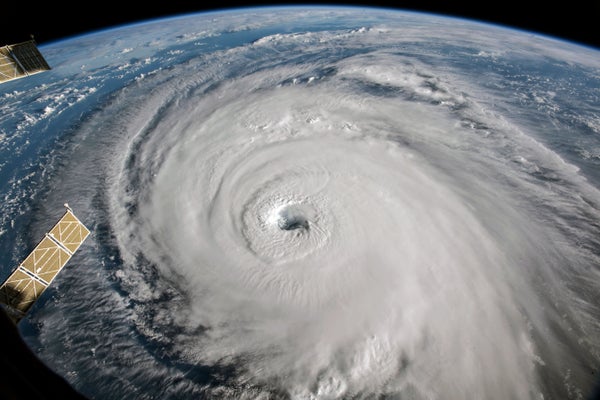
Hurricane Florence in the Atlantic Ocean off the coast of the United States in 2018, as seen from the International Space Station.
This year’s Atlantic hurricane season will likely be “below normal,” according to the U.S. National Oceanic and Atmospheric Administration, with approximately one to three “major hurricanes” brewing in the Atlantic Ocean.
The Atlantic hurricane season runs from early June to late November. During that time, there will be about a 55 percent chance that hurricane season conditions will be “below normal,” a 35 percent chance that conditions will be “near normal” and only a 10 percent chance that conditions will be “above normal,” NOAA Administrator Neil Jacobs said during a news conference Thursday. That amounts to eight to 14 “named storms” — both tropical storms and hurricanes — including between one and three “major hurricanes,” Jacobs said. These are hurricanes classified as Category 3, 4 or 5, which are storms with sustained winds reaching or exceeding 111 miles per hour.
At Thursday’s news conference, officials repeatedly stressed the importance of preparing for hurricanes, regardless of the forecast. “Don’t let words like ‘below,’ ‘average’ — don’t let all those words change how prepared you are,” said Ken Graham, director of the National Weather Service. “Even ‘below average’ [years]even if you have two storms, they could be large. We must be ready. In other words, it’s not so much the number of storms that matters but where they hit.
On supporting science journalism
If you enjoy this article, please consider supporting our award-winning journalism by subscription. By purchasing a subscription, you are helping to ensure the future of impactful stories about the discoveries and ideas shaping our world today.

NOAA Outlook for the 2026 Atlantic Hurricane Season.
The low number of storms expected in the Atlantic is partly explained by the expected return of El Niño, a cyclical weather event that can influence wind patterns across the world. El Niño can add more “vertical wind shear” – a change in wind speed from low to high levels of the atmosphere – in the Atlantic, making it more difficult for hurricanes to form in that area.
The Pacific is another story. There, El Niño tends to reduce vertical wind shear, Jacobs said, making it easier for hurricanes to form. This year, NOAA predicts a 70% chance of “above normal” activity in the central and eastern Pacific, including 15 to 22 named storms in the eastern Pacific and between five and nine major hurricanes.
Of course, at the root of all this is climate change. Warmer ocean temperatures fuel hurricanes and can make them more intense. A 2024 analysis, for example, estimated that climate change was responsible for increasing the wind speeds of all Atlantic hurricanes that season, including pushing Hurricanes Milton and Beryl into Category 5 storms.
The last time NOAA predicted a below-normal season was 2015, NOAA hurricane forecaster Matt Rosencrans said at the same press event.
It’s time to defend science
If you enjoyed this article, I would like to ask for your support. Scientific American has been defending science and industry for 180 years, and we are currently experiencing perhaps the most critical moment in these two centuries of history.
I was a Scientific American subscriber since the age of 12, and it helped shape the way I see the world. SciAm always educates and delights me, and inspires a sense of respect for our vast and beautiful universe. I hope this is the case for you too.
If you subscribe to Scientific Americanyou help ensure our coverage centers on meaningful research and discoveries; that we have the resources to account for decisions that threaten laboratories across the United States; and that we support budding and working scientists at a time when the value of science itself too often goes unrecognized.
In exchange, you receive essential information, captivating podcasts, brilliant infographics, newsletters not to be missed, unmissable videos, stimulating games and the best writings and reports from the scientific world. You can even offer a subscription to someone.
There has never been a more important time for us to stand up and show why science matters. I hope you will support us in this mission.


