Kast Presidency begins, as Chile shifts to far-right : NPR

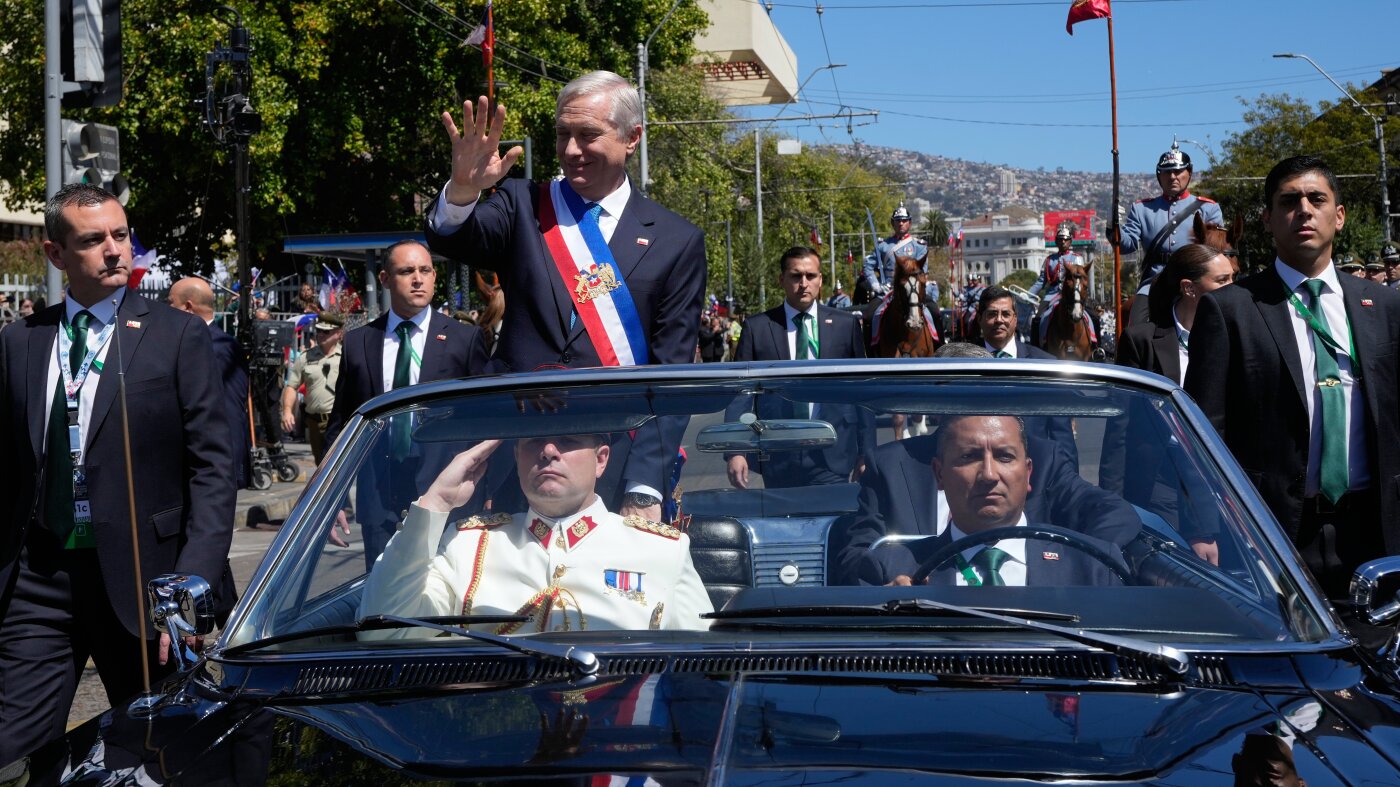

Chilean President José Antonio Kast greets supporters as he leaves Congress after his inauguration ceremony in Valparaiso, Chile, Wednesday, March 11, 2026. (AP Photo/Gustavo Garello)
Gustavo Garello/AP
hide caption
toggle caption
Gustavo Garello/AP
SANTIAGO, Chile — José Antonio Kast was sworn in as Chile’s new president today during a ceremony in the coastal city of Valparaíso. This far-right politician built his career opposing liberal values on the fringes of Chilean politics.
Kast won a resounding victory against his left-wing rival in the December runoff, winning 58% of the vote thanks to his tough approach to public security and illegal immigration.
His assumption of the presidency marks a sharp departure from the progressive agenda of leftist Gabriel Boric, whose four-year term ended today.
“There are certain issues that Kast will emphasize first, like immigration,” said Claudio Fuentes, a political scientist at Diego Portales University in Santiago.
“He will take a very strong stance on border control, where he will likely increase the military presence. Dealing with this situation will be key to his success.”
During the election campaignKast, the ultraconservative Catholic father of nine, avoided any mention of the uncompromising moral agenda with which he has been synonymous during a more than 30-year political career, first as a local councilman and then as a congressman.
Even though Chilean society liberalized after the return to democracy in 1990 following the dictatorship of General Augusto Pinochet, Kast maintained his far-right stance, voting against the limited legalization of abortion – and even divorce legislation – during his time in Congress.
Kast begins a four-year term that he has called an “emergency” government, citing what he sees as a growing security and economic crisis – even as Chile remains one of the safest and most prosperous countries in Latin America.
Throughout his career, Kast has often attracted controversy due to his extreme views, including his defense of the Pinochet dictatorship, which he campaigned to keep in power when the issue came up for a crucial plebiscite in 1988.
In 2016, he left the right-wing Unión Demócrata Independiente party after 20 years and three terms in Congress, saying he had strayed too far from his founding principles as a defender of the legacy of dictatorship.
He ran for president the following year as an independent, winning 8% of the vote, and in 2019 founded the Republican Party on the basis of “defending human life from conception”, family values and the market economy.
During his 2021 presidential campaign, where he won the first round but was convincingly defeated by the leftist Boric in the second round, he said that if General Pinochet were still alive, the dictator’s vote would have gone in his favor.
In his hometown of Paine, a quiet farming town just south of Santiago, some locals remember the Kast family fondly as a pious clan that built a successful meat and restaurant business.
Kast’s father, Michael Kast, was born in Germany and fought in the Wehrmacht. A member of the Nazi party, he left post-war Europe for Argentina before settling in Chile.
But others in Paine – where 70 people disappeared under Pinochet’s dictatorship, more than in any other municipality in Chile – are less optimistic that a supporter of the regime will come to power.
“Our work, our memorials, our history, everything is in danger,” said Gerson Ramírez Guajardo, whose father was kidnapped and disappeared by soldiers shortly after the 1973 coup.
“I think we’re all concerned about what’s going to happen.”