The Race to Find Leonardo da Vinci’s DNA Just Took a Major Twist


January 7, 2026
3 min reading
 Add us on GoogleAdd SciAm
The race to find Leonardo da Vinci’s DNA has just taken a major turning point
Scientists have discovered genetic evidence that they believe could be linked to the Renaissance master, but some experts are more skeptical.
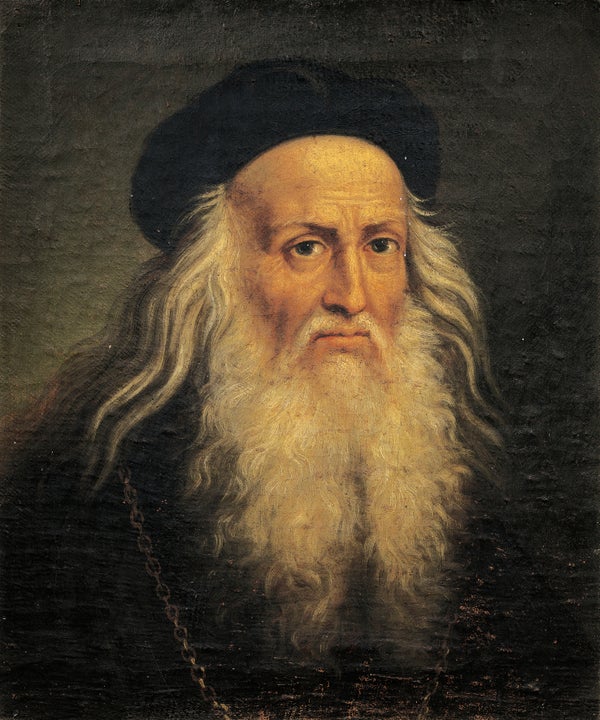
Portrait of Leonardo da Vinci, by Lattanzio Querena (1768-1853)
Photo by DeAgostini/Getty Images
Scientists searching for the DNA of famous Renaissance artist and scientist Leonardo da Vinci claim to have made a breakthrough, but some experts warn against interpreting the results as irrefutable proof.
As first reported Science On Tuesday, researchers with the Leonardo da Vinci DNA Project, housed at the J. Craig Venter Institute in Rockville, Maryland, reported tracing male DNA in samples taken from Holy Childa chalk drawing attributed by some to Leonardo, as well as other artifacts. The findings are detailed in a preliminary paper published on the preprint server bioRxiv, and they still need to be peer-reviewed.
Leonardo’s genome is an elusive target. His remains could not be verified after being disturbed during the French Revolution. Many of his direct parents’ remains are still under investigation and he had no known children. All of this makes identifying its DNA extremely difficult, if not impossible, says David Caramelli, an anthropologist and ancient DNA specialist at the University of Florence in Italy, who is a member of the Leonardo da Vinci DNA Project but was not involved in the new study.
On supporting science journalism
If you enjoy this article, please consider supporting our award-winning journalism by subscription. By purchasing a subscription, you are helping to ensure the future of impactful stories about the discoveries and ideas shaping our world today.
To try to get around these limitations, Norberto Gonzalez-Juarbe, assistant professor of cell biology and molecular genetics at the University of Maryland, and his colleagues on the project analyzed several samples taken from various artifacts. They found plant traces and other environmental signatures that corresponded to times and places in the mathematician’s life, as well as male DNA with Tuscan lineage that could, they speculate, point to Leonardo himself.
Manuel Porcar Miralles, an applied microbiologist at the University of Valencia in Spain, who was not involved in the work, says the work is “spectacular” and appears “technically robust.”
The effort is somewhat comparable to solving a modern serial killer mystery by searching for the same DNA at different crime scenes, says John Hawks, an anthropologist and professor at the University of Wisconsin-Madison, who also was not involved in the study.
“If you could find the same DNA pattern in paintings, drawings or even places linked to Leonardo,” he says, “you would be confident that you were looking at his genome, even without being able to find genealogical relatives today.”
Yet the reality is more complicated: Leonardo’s works have been covered in the DNA of an unknown number of people – from the man’s contemporaries himself to artisans working in museums today – presenting an obvious challenge for researchers.
“I think the work hasn’t quite arrived yet,” Hawks says.
Porcar Miralles, who is also CTO of Darwin Bioprospecting Excellence, a microbiology start-up, agrees: tracing male DNA to Tuscany does not guarantee that it belonged to Leonardo. It’s entirely possible that the DNA belongs to one of the “dozens, if not hundreds, of people in the area who might have touched the works once if they were finished,” including after the painter’s death, he says.
For Hawks, that might not be such a bad thing. The information gleaned from the analysis still helps to paint a picture of Leonardo’s environment and his community.
“What’s compelling is that every piece of art and object in history can have traces of DNA, all of which adds up to a picture of the network of people connected to these objects,” says Hawks.
The study authors attempted to flesh out some of these stories: Traces of citrus found in some samples could be linked to the gardens of the powerful Medici family, which ruled Florence for hundreds of years and employed Leonardo.
But while it’s a fascinating story, the researchers were unable to authenticate the age of the DNA, which is a significant limitation of the study, Caramelli says.
Indeed, Gonzalez-Juarbe admits that the researchers were limited by the small size and fragmentary nature of their data set, as well as how little DNA they were able to extract from each sample. Still, he says, the methods presented in the paper could serve as a basis for future research.
The results could become “more robust,” Porcar Miralles says, if researchers can find confirmed remains of Leonardo da Vinci or if they can collect DNA from one of his living relatives that matches the samples they found.
“I hope we can test several cultural artifacts from the [Leonardo da Vinci] lineage and combine our findings with those of living descendants,” says Gonzalez-Juarbe.
It’s time to defend science
If you enjoyed this article, I would like to ask for your support. Scientific American has been defending science and industry for 180 years, and we are currently experiencing perhaps the most critical moment in these two centuries of history.
I was a Scientific American subscriber since the age of 12, and it helped shape the way I see the world. SciAm always educates and delights me, and inspires a sense of respect for our vast and magnificent universe. I hope this is the case for you too.
If you subscribe to Scientific Americanyou help ensure our coverage centers on meaningful research and discoveries; that we have the resources to account for decisions that threaten laboratories across the United States; and that we support budding and working scientists at a time when the value of science itself too often goes unrecognized.
In exchange, you receive essential information, captivating podcasts, brilliant infographics, newsletters not to be missed, unmissable videos, stimulating games and the best writings and reports from the scientific world. You can even offer a subscription to someone.
There has never been a more important time for us to stand up and show why science matters. I hope you will support us in this mission.