This fossilized vomit is older than the dinosaurs


February 18, 2026
3 min reading
 Add us on GoogleAdd SciAm
This fossilized vomit is older than dinosaurs
Vomit is disgusting, but 290 million year old vomit is a scientific marvel
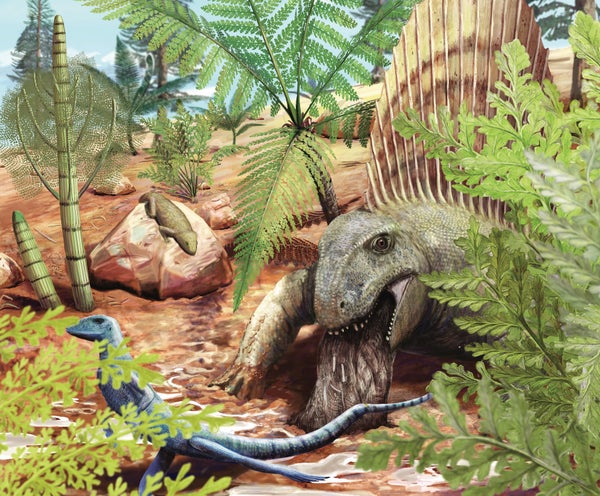
An artistic representation of Dimetrodon teutonis vomiting; two of the smaller reptilian animals found in regurgitation are also depicted in the scene.
Fossils are remarkable for their ability to viscerally connect us to long-lost life. Most of a Tyrannosaurus rex skull, the biting point of a shark’s tooth, the surprising familiarity of a hominid footprint—and then there’s the charm inherent in any sample of regurgitality, the paleontological term for fossilized vomit.
Okay, the charm may be exaggerated, but for the good scientist, rare discoveries are “little treasures,” explains research doctor Arnaud Rebillard. candidate in paleontology at the Natural History Museum in Berlin. Let’s take the example of regurgitation which is the subject of research published by Rebillard on January 30 in Scientific reports—the oldest known regurgital from a terrestrial ecosystem.
Found in 2021, the specimen comes from a 290 million year old German site called Bromacker. During a century of digging, paleontologists saw a valley full of conifers that were apparently teeming with vegetarians, says Amy Henrici, retired paleontology collection manager at the Carnegie Museum of Natural History, who was not involved in the new research.
On supporting science journalism
If you enjoy this article, please consider supporting our award-winning journalism by subscription. By purchasing a subscription, you are helping to ensure the future of impactful stories about the discoveries and ideas shaping our world today.
Amid the loose fossils and remarkably preserved skeletons that characterize the site, the regurgital was uninteresting until the process of cleaning the fossils and a computed tomography (CT) scan provided a clearer view. This process digitally extracted a group of 41 small bones that turned out to belong to three distinct species: two small reptiles and a larger reptile-like animal.

Image of regurgitation (top left), a digital analysis showing the location of bones within the fossil (bottom left), and an image showing these bones separated (RIGHT).
“It was clearly something that was eaten and then ejected from an animal,” Rebillard says. The following questions were obvious: what extremity did the fossil come from and what type of animal had expelled it?
The most famous counterparts of regurgitites are coprolites, or fossilized excrement. (There are also gastrolites and cololites, which preserve the contents of the digestive tract in place in the stomach and intestines, respectively. Together, these types of fossils are known as bromalites.) The distinction between coprolites and regurgitates is “actually not always very obvious,” Rebillard says.
In this case, two pieces of evidence led Rebillard and his colleagues to conclude that the remains had been vomited: The leg bones of the larger prey remained connected to each other, suggesting that the limb had not passed through an entire digestive system. And the material directly surrounding the bones was low in phosphorus, which is abundant in fossils that were once poop.
As for who the scientists were thinking about, there are two known species at the Bromacker site that would have been large enough to eat animals of the size found in the regurgitation: Dimetrodon teutonis (a small member of a group of sailing animals that are often confused with dinosaurs) and Tambacarnifex unguifalcatus. Both contenders are synapsids, or members of a group including mammals and their extinct relatives, and would have been about 20 to 30 inches long without their tails.
Regardless of the predator involved, Henrici notes that the regurgitation confirms that one of these animals nibbled extensively on the small creatures around it and could vomit up indigestible material, much like modern owls and Komodo dragons do today. For Rebillard, the fossil is also proof that the three prey species not only lived together at the same geological time, but also died together within the same week or even day.
It’s time to defend science
If you enjoyed this article, I would like to ask for your support. Scientific American has been defending science and industry for 180 years, and we are currently experiencing perhaps the most critical moment in these two centuries of history.
I was a Scientific American subscriber since the age of 12, and it helped shape the way I see the world. SciAm always educates and delights me, and inspires a sense of respect for our vast and beautiful universe. I hope this is the case for you too.
If you subscribe to Scientific Americanyou help ensure our coverage centers on meaningful research and discoveries; that we have the resources to account for decisions that threaten laboratories across the United States; and that we support budding and working scientists at a time when the value of science itself too often goes unrecognized.
In exchange, you receive essential information, captivating podcasts, brilliant infographics, newsletters not to be missed, unmissable videos, stimulating games and the best writings and reports from the scientific world. You can even offer a subscription to someone.
There has never been a more important time for us to stand up and show why science matters. I hope you will support us in this mission.


