Fresh Icelandic Lava Reveals How Life Takes It’s First Footsteps — On Earth and Beyond


Catastrophic events like major volcanic eruptions can wipe out all life in an area, leaving a blank slate behind. But because nature always finds a way to turn back the clock, researchers are increasingly curious about what that recovery actually looks like, starting at the microscopic level.
Understanding how bacteria first colonize fresh soil not only teaches us how plants and animals eventually return. It also offers clues about how life may have arisen on Earth and how it might appear on other planets shaped by volcanism.
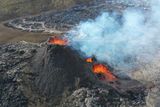
To answer these questions, a team of scientists from the University of Arizona took advantage of a rare natural experiment: a series of eruptions from Iceland’s Fagradalsfjall volcano between 2021 and 2023. The researchers sampled the lava flows almost immediately after they cooled, making the study published in Nature Communications Biology the first to closely track how microbes move to an entirely new habitat at the very moment of its formation.
Studying lava opens a window into early childhood
Volcanic eruptions offer something researchers rarely get in nature: a truly barren starting point.
“The lava coming out of the ground is over 2,000 degrees Fahrenheit, so it’s obviously completely sterile,” first author Nathan Hadland, a doctoral student at the University of Arizona’s Lunar and Planetary Laboratory, said in a press release. “It’s a blank slate that essentially provides a natural laboratory to understand how microbes colonize it.”
Although previous research has examined how organisms recover from disturbed environments, most of these studies focus on plants and animals, not microbes. This new work focuses instead on primary succession at the microbial level, observing the arrival of life while the habitat itself is still forming. Unlike previous studies that sampled lava months after an eruption, Hadland’s team collected material within hours of solidification.
They collected DNA from freshly formed lava, as well as rainwater and airborne aerosols. Using advanced statistical and machine learning techniques, the team identified which organisms appeared first, how these tiny ecosystems developed, and where the microbes came from.
Learn more: Potential biosignatures on Mars could reflect ancient life in mineral-rich rocks
Fresh lava invites resistant bacteria
Conditions on the new lava flows are extreme. Although Iceland receives a lot of rain, the freshly deposited lava holds little water and contains almost no organic nutrients. As a result, these sites are among the lowest biomass environments on Earth, comparable to Antarctica or the Atacama Desert in Chile.
Despite this, single-celled organisms colonized the lava with surprising speed. Microbial diversity increased steadily during the first year after an eruption and then declined sharply after the first winter.
“It seems like the first colonizers are these ‘badass’ microbes, for lack of a better term,” Hadland said, “the ones that can survive those initial conditions, because there’s not a lot of water and very few nutrients.”
Over the following months and seasonal changes, the microbial community began to stabilize as other organisms arrived via rainwater or spread from neighboring areas. One of the study’s most striking findings is the outsized role that rain played in shaping these early ecosystems.
“We find that most of the microbes come from rainwater, and that’s a pretty interesting result,” Hadland said.
Knowing that rainwater is not sterile, because microbes can float freely in the atmosphere or hitch a ride on dust particles, the extent of the seasonal changes surprised the team.
“Seeing this huge change after winter was quite astonishing,” co-author and associate professor Solange Duhamel said in the release, “and the fact that it was so repeatable and consistent across the three different eruptions – we didn’t expect that.”
What this means for life beyond Earth
“For the first time, we are beginning to gain a mechanistic understanding of how a biological community became established over time, from the very beginning,” Duhamel said. This knowledge could extend well beyond Iceland.
Beyond our own planet, we know that much of Mars’ surface is basaltic and shaped by volcanic processes similar to those on Earth. Although Martian volcanism has largely ceased, past eruptions may have created short-lived windows of habitability.
Understanding how microbes colonize fresh lava on Earth helps scientists predict how life might have arisen on Mars or any other planet and what biosignatures future missions should look for.
Learn more: As glaciers retreat, powerful volcanoes could erupt more frequently across the planet
Article sources
Our Discovermagazine.com editors use peer-reviewed research and high-quality sources for our articles, and our editors review the articles for scientific accuracy and editorial standards. See the sources used below for this article:


