Hawaii under tsunami warning, Japan issues tsunami alert after 8.8 earthquake off Russia


A powerful earthquake of magnitude 8.8 The Kamchatka peninsula in RussiaI encourage the Japanese meteorological agency to issue a tsunami alert and the National Weather Service to issue Tsunami warning on Wednesday for Hawaii and Alaska.
Tsunami’s opinion was also issued for parties of Alaska And the entire west coast, extending from the California-mexic border to the border of Alaska-British Columbia.
The Japanese meteorological agency said that the earthquake had taken place at 8:25 a.m. on Wednesday, and had recorded a preliminary scale of 8.0, later adjusted by the US Geological Survey at 8.8 and that the USGS said that the earthquake had occurred at a depth of 13 miles.
CBS News 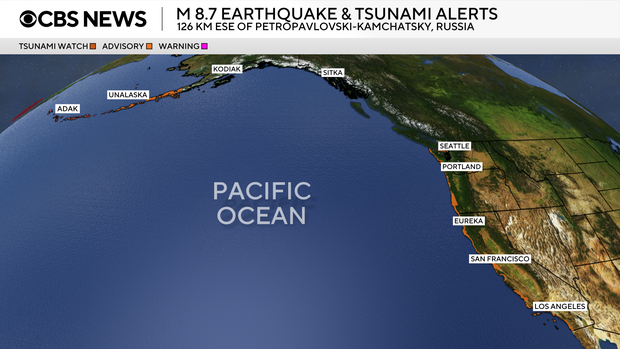
The Japanese meteorological agency said that a first wave of tsunami about 30 centimeters, or about 1 foot, reached Nemuro on the eastern coast of Hokkaido.
The first wave of tsunami struck the severo-kurilsk coastal area, the main colony of the Kuril Russian islands in the Pacific, according to local governor Valery Limarenko. He said residents were safe and stayed on high terrain until the threat of a repeated wave has disappeared.
The Pacific Tsunami warning center said that waves of 1 to 3 meters, about 3 to 10 feet, above the tide was possible along certain coastal areas of Hawaii, Chile, Japan and the Solomon Islands. Waves of more than 3 meters were possible along certain coastal areas of Russia and Ecuador.
Tsunami’s warning sirens took Honolulu on Tuesday and people moved on higher ground.
“If you are in a safe place, stay there, and if you are not, do something. Go to higher field,” said the mayor of Honolulu, Rick Bangiardi, at a press conference on Tuesday evening.
“A tsunami has been generated that could cause damage along the coasts of all the islands in the state of Hawaii. Urgent measures should be taken to protect lives and goods,” the National Weather Service said in an alert. The arrival of the first wave was scheduled around 7:17 p.m. local time, around 1:17 am.
Hawaii governor Josh Green has signed an emergency proclamation in response to potential floods and damage.
“The danger can continue for many hours after an initial wave when the following waves arrived,” said NWS. “The heights of the tsunami cannot be predicted and the first wave may not be the greatest. Tsunami waves wrap around the islands. All the banks are in danger regardless of the direction they face.”
CBS News 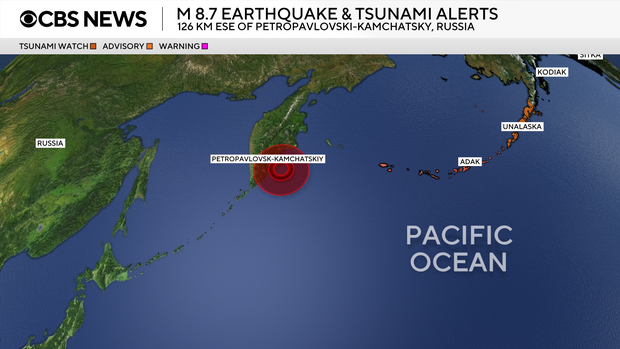
In response to Tsunami warnings, President Trump wrote in a social media position on Tuesday evening to “stay strong and stay safe!”
The earthquake was around 160 miles from Hokkaido, north of Japan, the four major islands in the country, and was only felt slightly, according to NHK Television of Japan.
The Russian news agency Tass reported in the largest city near the epicenter, Petropavlovsk-Kamchatsky, which many people ran in the street without shoes or outdoor clothes. The cabinets overturned inside the houses, the mirrors were broken, the cars were sworn in the street and the balconies on the buildings were essentially shaken.
Tass reported power failures and defaults of mobile telephony services in the capital of the Kamchatka region. The news agency also cited a local Russian official saying that residents of Sakhalin Island were being evacuated and that emergency services worked at full capacity.
Geophysical service of the Russian Academy of Sciences via AP 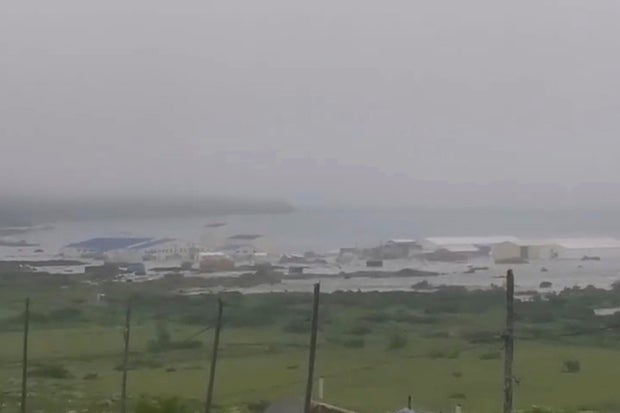
The earthquake seemed to be the strongest in the world since the earthquake in March 2011 in the northeast of Japan which was 9.0 and caused a massive tsunami which sparked collapses in a nuclear power plant in Fukushima. Only a few stronger earthquakes have ever been measured in the world.
The New Zealand authorities have issued “strong and unusual currents and unpredictable overvoltages” along the country’s coasts. The alert of the Emergency Government Management Agency said people should leave water, beaches and areas on the ground, and far from ports, marinas, rivers and estuaries. New Zealand is in the South Pacific and about 6,000 miles from the epicenter.
More than a week ago, Five powerful earthquakes – The largest with a magnitude of 7.4 – hit the Kamchatka peninsula in Russia. And earlier this month, a tsunami opinion for AlaskaThe southern peninsula was delivered after a major earthquake with a preliminary magnitude of 7.3 hit the region of the Aleutian islands.
On November 4, 1952, an earthquake of magnitude 9.0 in Kamchatka caused damage, but no death sparked waves of 9.1 meters (30 feet) in Hawaii.
How are tsunami levels classified?
There are four tsunami alert levels: warning, opinion, surveillance and reporting, according to the National Weather Service. A tsunami warning is the most serious alert, which means that residents should take measures due to a tsunami which can cause generalized floods.
Tsunami’s opinion has the potential of “currents or strong waves dangerous for people in or very close to water”, according to the NWS. A tsunami watch advises those to prepare because a distant earthquake has occurred and a tsunami is possible.
The lowest alert level is a tsunami information declaration of the NWS, which advises those of “relaxing” because an earthquake occurred, but there is no threat or it was very far.
It is a story in development. Come back for updates.


