This odd vine contradicts long-standing evolutionary theory


A small tropical flower challenges an ancient model of plant evolution. A strange member of the lip vine family has evolved to attract more pollinators, according to researchers at the Field Museum in Chicago. Before spread to other parts of the world, not the other way around.
“It was really exciting to get these results, because they don’t follow conventional ideas about how we would have imagined the species evolved,” explained Jing-Yi Lu, a botanist and co-author of a study published today in the journal New plant scientist.
Most lipstick vines look just like their name: long plants with bright red tubular flowers. Identifiable throughout Southeast Asia, their nectar primarily attracts long-billed sunbirds, which in turn help spread pollen for propagation. In Taiwan, however, a species of lipstick vine known as Aeschynanthus acuminatu seems radically different from his parents. Instead of purple flowers, A. acuminatu has much shorter and wider flowers with a greenish-yellow coloring.
“Compared to the rest of its genus, this species has strange and unique flowers,” Lu said.
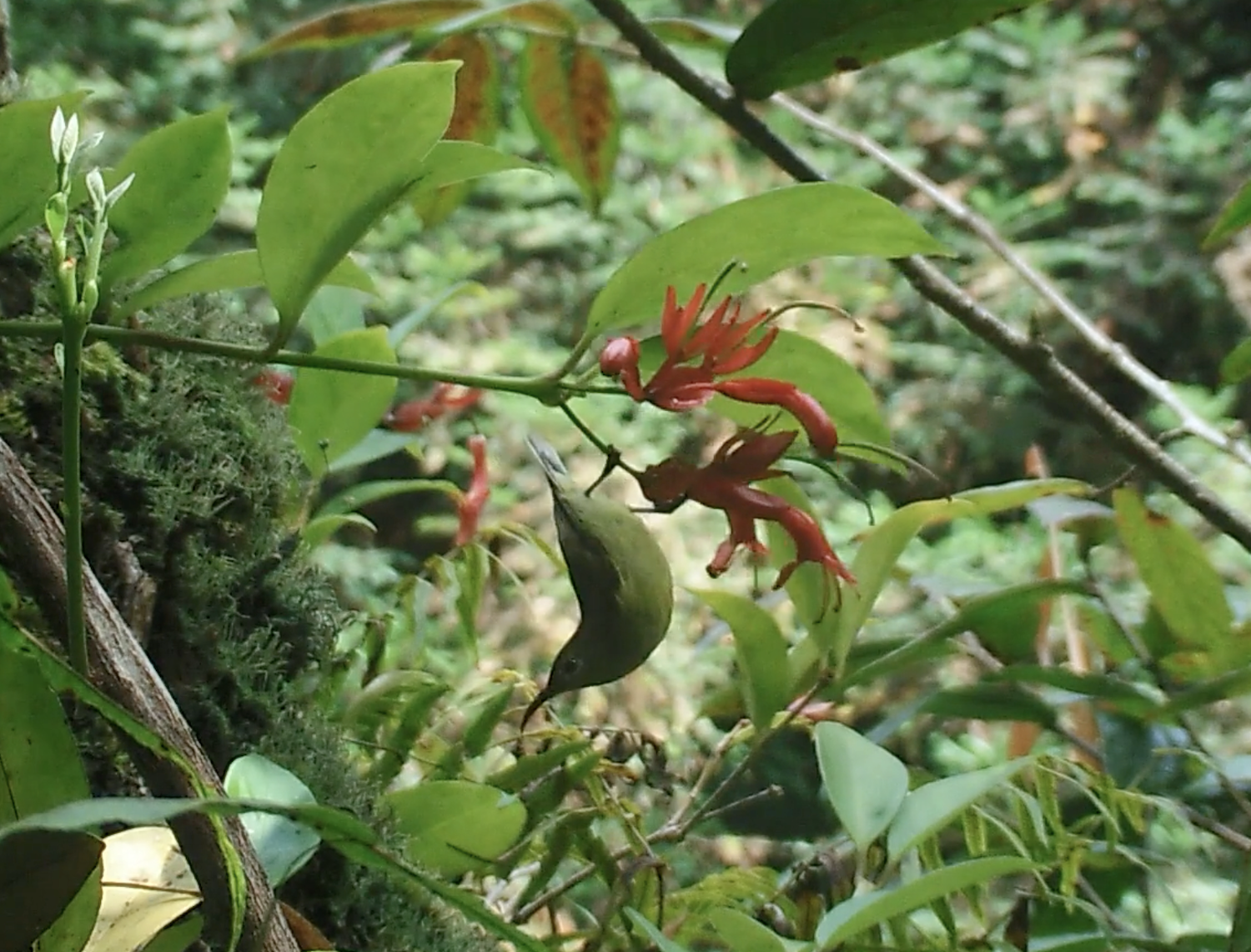
Because of this, A. acuminatu is much more suited to the shorter-billed birds of Taiwan. This is also a good thing: sunbirds are not found anywhere on the island. That said, yellow-green lipstick vines are Also found on the continent. Knowing this, Lu and his colleagues began to wonder where the plant had first evolved.
“At the heart of our study is the question of the origin of species,” said Rick Ree, study co-author and curator of the Field Museum’s Negaunee Integrative Research Center. “There must have been a change when this species evolved, from narrow flowers for sunbirds to wider flowers for more generalist birds. Where and when did the change occur?”
Many botanists might assume that the answer lies in the Grant-Stebbins model. Used in the field for more than half a century, the Grant-Stebbins model states that plants generally evolve into different species after migrating to new regions with different types of pollinators. With this in mind, it stood to reason that A. acuminatus originated in Taiwan to accommodate the island’s short-billed birds. However, researchers were surprised by what they saw after using lipstick vine DNA samples to assemble a series of family trees.
“The branching models on the family trees that we carried out revealed that the A. acuminatus Taiwan plants descended from others A. acuminatus mainland plants,” Ree said.
This means that, for some reason, the shorter, greener lipstick vines evolved in a region teeming with sunbird pollinators. If true, it contradicts the Grant-Stebbins model, but researchers have a theory for how this could happen.
“Our hypothesis is that at some point in the past, sunbirds ceased to be optimal or sufficient pollinators for some plants on the continent,” Ree explained. “There must have been circumstances in which natural selection favored this transition toward generalist passerines with shorter bills as pollinators.”
Ree pointed out that their unexpected conclusions were only reached after botanists like Lu took the time to go into the field themselves.
“This study shows the importance of natural history, discovering nature and observing ecological interactions,” he said. “It takes a lot of human effort that can’t be replicated by AI, and it can’t be accelerated by computers – there’s no substitute for going out into the field like Jing-Yi did…”

The best new PopSci 2025 releases


