This robot ‘cannibal’ can consume other smaller robots — watch it grow bigger and stronger


To watch
Scientists have created a robot prototype that can develop, heal and improve by integrating the equipment of your environment or by “consuming” other robots. It is a big step forward in the development of robot autonomy, according to the researchers.
The researchers invented the term “robot metabolism” to describe the process which allows machines to absorb and reuse the parts of its environment. Scientists published their work on July 16 in the journal Scientific advances.
“True autonomy means that robots must not only think for themselves, but also maintain themselves physically”, the main author of the study Philippe Martin Wyderengineering professor at Columbia University, said in a statement.
“Just as organic life absorbs and integrates resources, these robots develop, adapt and repair using their environmental materials or other robots.”
The robots are made from “trellis bonds” – six -sided lying stems with magnetic connectors that can contract and develop with other modules.
These modules can also be assembled and disassembled. The magnets allow robots to form increasingly complex structures in what their manufacturers hope may be an “self -sufficient machine ecology”.
In relation: Watch a human robot with stammering muscles as it contracts, increases their shoulders and cleans his fists in a frightening video
There are two rules for robot metabolism, scientists said in the study. First, a robot must develop completely alone or be assisted by other robots with similar components. Second, the only external provisions granted to farm connections are materials and energy. Trellis links use a mixture of automated and controlled behavior. Robots that change shape, cannibalise
“Bad sci-fi scenarios”
In a controlled environment, scientists have laid trellis links in an environment to observe how the robot connects with other modules.
The researchers noted how farm connections met for the first time in 2D forms, but then joined new parts to become a 3D tetrahedron that could navigate the uneven test field. The robot did it by integrating an additional link to use as a walking stick, the researchers said in the study.
“The minds of robots have advanced giant in the past decade through automatic learning, but the bodies of robots are always monolithic, non-adaptive and non-gypsy. Biological bodies, on the other hand, are all a question of adaptation-life forms can develop, cure and adapt”, author of the study, co-study, Hod LipsonPresident of the Mechanical Engineering Department of Columbia University, said in the press release.
“In large part, this capacity stems from the modular nature of biology which can use and reuse modules (amino acids) from other life forms,” added Lispon. “In the end, we will have to get robots to do the same – to learn how to use and reuse the parts of other robots.”
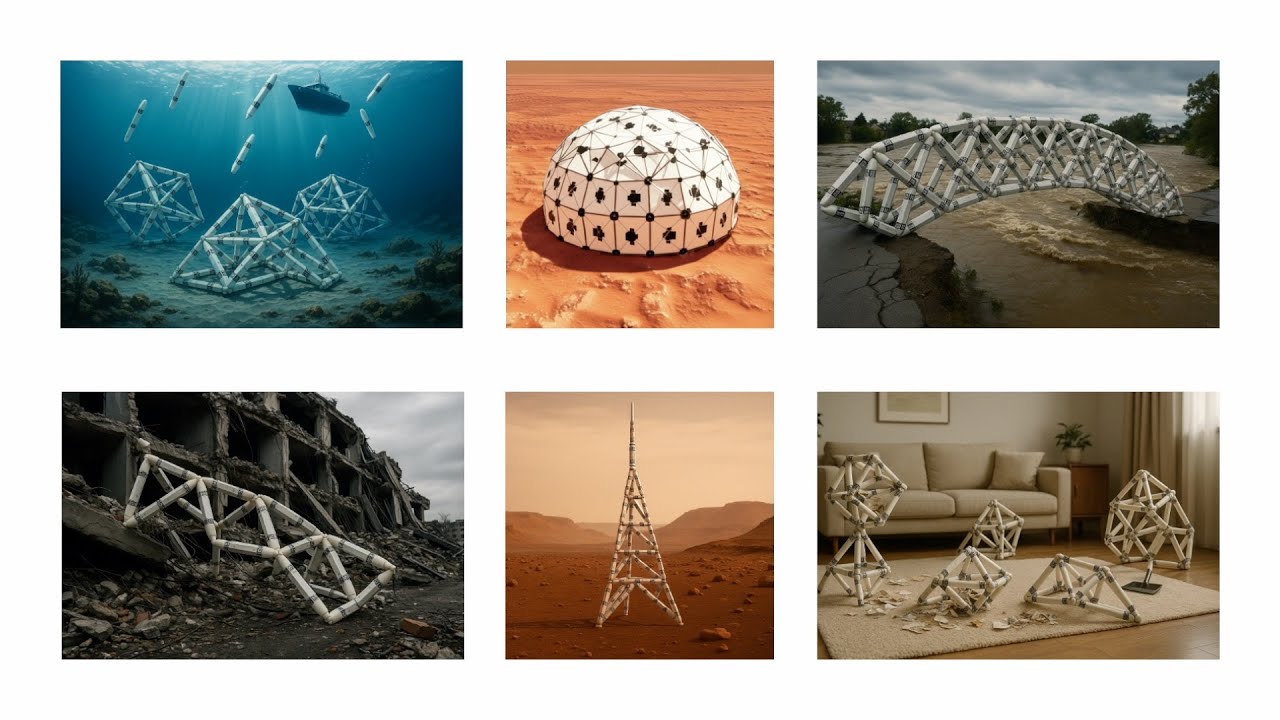
Researchers said they were considering a future in which machines can be maintained, without the help of humans. By being able to develop and adapt to different tasks and environments, these robots could play an important role in recovering devices and space exploration, for example.
“The image of self-reproductive robots evokes some bad science fiction scenarios,” said Lipson. “But the reality is that, while we are increasingly transmitting our lives to robots, driver-free cars with automated manufacturing, and even exploring defense and space. Who will take care of these robots? We cannot count on humans to keep these machines. Robots must finally learn to take care of themselves.”


