This Turtle Study Says Reefs and Routes Matter Too

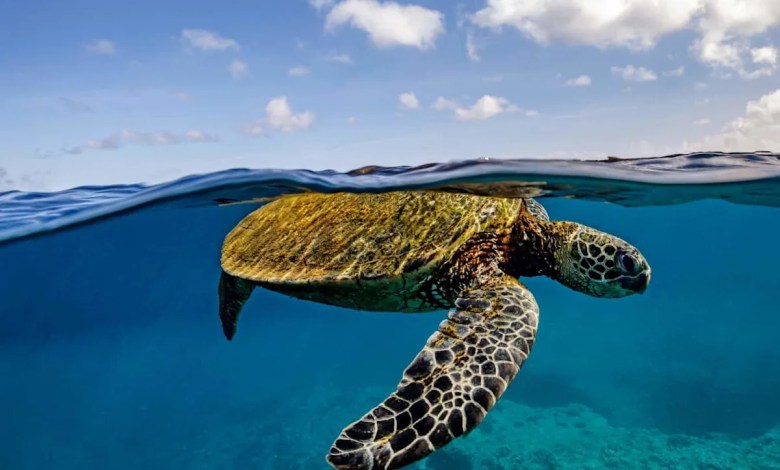
The article Conservation Isn’t Just About Saving Beaches: This Turtle Study Says Reefs and Roads Are Important Too appeared first on AZ Animals.
Quick take
-
Protect sea turtle populations requires more than just preserving nesting beaches.
-
A recent study followed female green and hawksbill turtles which nested on the islands of the Red Sea.
-
Satellite-tagged turtles ranged up to several hundred kilometers from their nesting areas during feeding migrations.
-
The six feeding areas identified in the Red Sea included coral reef and seagrass habitats.
-
Maintain species survival requires ensuring that sea turtles secure routes and access to coastal feeding areas.
Three species of sea turtles are regularly observed in the Red Sea, which is a bay in the Indian Ocean: hawksbill turtles, green turtles and loggerhead turtles. A set of islands off the coast of Saudi Arabia provide nesting habitat for hawksbill turtles (Eretmochelys imbricata), which are classified as critically endangered, and the greens (Chelonia mydas), which are doing relatively well, according to the IUCN Red List assessment. Turtles come to nest on several of the 39 islands of the archipelago, favoring those which are always above sea level.
A Saudi development project, NEOM, whose aim is to “support the diversification of the Kingdom’s economy and provide urban solutions so that people and the planet can prosper in harmony”, plans to create sustainable human communities in the northeastern Red Sea coastal region, which includes the islands’ nesting beaches. A planned “NEOM nature reserve” promises to ensure the conservation of its nature, including sea turtles.
To date, most research on these Red Sea turtle species has focused on their nesting habitats, with limited understanding of their location between nesting events. Yet their migration routes and nesting areas may be essential to their long-term survival. Since sea turtles cannot feed on land, their nutrition depends on finding suitable ocean feeding grounds, such as seagrass beds. Coastal waters are subject to many human impacts from activities such as offshore mining, commercial fishing, shipping, and recreation.
A recent study published in Scientific reports examined where female sea turtles go after laying eggs on Red Sea islands. Researchers from King Abdullah University of Science and Technology (KAUST) collaborated with NEOM Nature Reserve planning staff to track 17 female turtles (six green and 11 hawksbill turtles) during the 2022 and 2023 nesting seasons. Turtles were found nesting or resting near the shore and fitted with satellite tags designed to track their movements on land and the surface of the ocean. Green turtles have been found on Walah Island, while hawksbill turtles have been found on several islands: Shushah, Walah and Delajala.
What stands out most is the extent of the journeys made by some hawksbill turtles after nesting…several individuals have traveled hundreds of kilometers across the Red Sea to reach their feeding grounds.
Hector Barrios-Garrido, KAUST Senior Marine Megafauna Specialist

Hawksbill turtles, like the one at Elphinstone Reef in Egypt’s Red Sea, feed on coral reefs.
©Derek Keats/CC-BY-2.0 – Original / License
(Derek Keats/CC-BY-2.0)
Satellite data was plotted to map turtle nesting, nesting and feeding areas. Between nesting events, green turtles have traveled as little as 21.6 miles and as much as 312 miles into the Red Sea to feed. The hawksbill turtles were feeding between 84 miles and 150 miles from their nesting sites. The researchers identified six distinct foraging areas in the Red Sea: four in Saudi waters used by both green turtles and hawksbill turtles, and two in Egyptian waters used by green turtles. Sea turtles, of course, ignore political boundaries, but conservation programs do not. A coordinated international effort is needed to protect the Red Sea’s feeding grounds, which include reef ecosystems.
“What stands out most is the extent of the travel some hawksbill turtles make after nesting. While these turtles lay their eggs on relatively small islands in the NEOM region of Saudi Arabia, several individuals traveled hundreds of kilometers across the Red Sea to reach their feeding grounds,” says study lead author and KAUST senior marine megafauna specialist Hector Barrios-Garrido in an email.
The study found that hawksbill turtles have a larger home range, varying from about two to seven square miles. These large areas increase the likelihood that turtles will encounter human activities such as boating, fishing and snorkeling. The researchers therefore argue for a broader conservation strategy that includes both the islands’ nesting beaches (which account for 95% of marine turtles nesting in the northeast Red Sea) and neighboring reefs.
“In some cases, they have moved from Saudi waters to Egyptian waters, near the entrance to the Suez Canal, which is an area with intense human activity, including shipping and coastal development,” says Barrios-Garrido. “Seeing how far these turtles travel – and how much their final destinations overlap with areas heavily used by humans – really highlighted how exposed they can be once they leave their nesting beaches.”

To successfully reproduce, sea turtles like these green turtles from Vietnam need protected beaches.
©El Paco 33/Shutterstock.com
(El Paco 33/Shutterstock.com)
While the conservation objective extends to all natural areas and resources used by sea turtles, the protection of their nesting beaches remains essential. If NEOM’s emerging vision for ecologically sustainable communities proves successful, it could be applied to other areas. A 2022 article published in PeerJ Life & Environment identified sea turtle nests at all sites visited in the central Red Sea, including two coastal beaches and three nearshore islands.
“A large-scale survey of all islands off the Red Sea coast for evidence of nesting and migration corridors will help us identify priority areas,” study author and then-KAUST doctoral student Kirsty Scott said in a press release.
As a species requiring both terrestrial and aquatic resources along coastlines, sea turtles are considered “umbrella” species whose habitats support a range of other species, from aquatic plants to terrestrial mammals that consume sea turtle eggs. Therefore, conservation actions aimed at preserving sea turtles in the Red Sea will also benefit other sea turtle populations and a wide range of additional species.
“Our role at KAUST Beacon Development is to generate and share this type of scientific data with our partners and clients, helping them understand…how development can be planned in a way that reduces risks to these endangered species,” says Barrios-Garrido.
The article Conservation Isn’t Just About Saving Beaches: This Turtle Study Says Reefs and Roads Are Important Too appeared first on AZ Animals.


