Why your ‘2TB’ drive only shows 1.8TB


Have you ever installed a new drive or bought a new phone, only to find that you are missing a few gigabytes in your storage. Granted, it’s only a few gigabytes: you’ll get 476 GB of the 512 GB you’re supposed to have. But it’s a big enough difference to ignore.
So what’s going on?
Decimal or binary

The difference is actually not because whoever made your SSD or HDD is evil and wants to rip you off, but rather a technicality in how storage is actually calculated versus how it is marketed. Humans naturally count according to a decimal system, also known as base 10, which relies on powers of ten. In this system, prefixes like “kilo” strictly represent thousand. Therefore, for a hard drive manufacturer adhering to the International System of Units (SI), a kilobyte is exactly 1,000 bytes, a megabyte is 1,000,000 bytes, and a terabyte is 1,000,000,000,000 bytes. When you buy a 2TB drive, the manufacturer physically provides you with two trillion bytes of storage space, making its labeling physically and technically correct.
However, computers do not operate in Base 10. They operate using binary code, or Base 2, where data is processed in powers of two. In the early days of computing, it was convenient to map binary 2 to the power of 10 (which equals 1024) to the metric prefix “kilo”, because 1024 is relatively close to 1000. This convention has stuck, meaning that for your computer’s operating system, particularly Windows, a kilobyte is actually 1024 bytes.
This seemingly small difference of 24 bytes grows exponentially as you move up the scale to gigabytes and terabytes. By the time you reach the terabyte level, the operating system calculates a terabyte not as a trillion bytes, but as 1,099,511,627,776 bytes (1,024 to the power of 4). Because the computer uses this larger divisor to calculate the total number, the final number appears smaller. When the two trillion bytes provided by the manufacturer are divided by the computer’s definition of a gigabyte, the result is approximately 1,862 gigabytes, or approximately 1.81 terabytes, creating the illusion of missing space.
Why is this important?
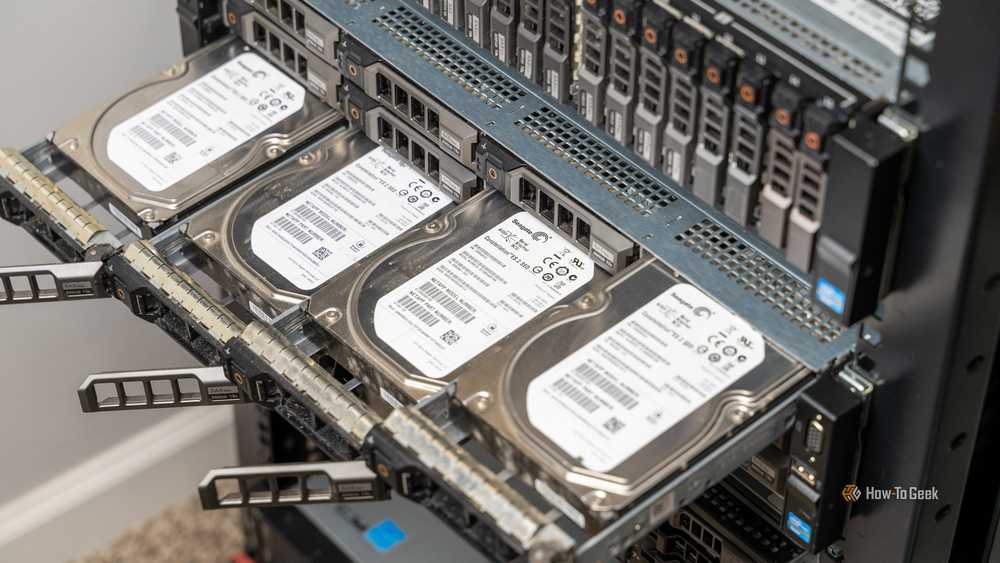
Even though the math behind the conversion is simple, the implications for the consumer are significant and often frustrating. Certainly, for many this is quite confusing. Because it is. In almost all other industries, standardized units are absolute; a kilogram of flour has the same weight, no matter who weighs it. In the storage industry, however, the same terminology describes two distinctly different values depending on the context. This ambiguity allows manufacturers to market their products using the decimal system, which produces larger, more attractive numbers, while software that uses hardware reports lower capacity. As storage requirements have grown from megabytes to petabytes, this gap has widened from a negligible margin of error to a substantial deficit.
On a 2TB drive, the “missing” space is approximately 186 gigabytes, enough to hold several modern high-definition video games, tens of thousands of photos, or a full backup of a standard laptop. This gap becomes a practical logistical problem for IT professionals and data archivists who need to plan storage capacity. If a system administrator calculates backup requirements based on the decimal figure of 2 TB but the server’s operating system reads the volume as 1.8 TB, the resulting overrun can lead to backup failures or data corruption. Additionally, this naming convention creates a legal and ethical gray area. While manufacturers often include warnings on packaging stating that “actual formatted capacity may be less”, the average consumer rarely understands that this is due to a mathematical definition rather than software overhead of the drive.
How can we solve this problem?

The solution here is to try to correctly explain to users that Base 2 is not the same thing as Base 10. The most scientifically accurate solution is the wider adoption of the International Electrotechnical Commission (IEC) standards, which were introduced to eliminate this ambiguity. The IEC created binary-specific prefixes to distinguish base 2 from base 10 calculations. Under this system, the familiar “kilobyte” (KB) remains 1,000 bytes, while 1,024 bytes is renamed “kibibyte” (KiB). Similarly, a “megabyte” (MB) is different from a “mebibyte” (MiB), and a “terabyte” (TB) is different from a “tebibyte” (TiB).
If operating systems like Windows adopted these units, your screen would correctly display that you have approximately 1.81 TB of space, which matches mathematical reality without contradicting the manufacturer’s claim of 2 TB.
Software developers can also choose to align their reports with the decimal system used by manufacturers. Apple made this change starting with macOS Snow Leopard (version 10.6). On a modern Mac, a 1000-byte file is reported as 1 KB, and a 2 TB drive is shown as having a total capacity of 2 TB. This approach prioritizes usability and consistency of physical labeling over the traditional binary calculation favored by computer scientists.
Finally, if you are stuck in the middle of these warring standards, the immediate solution is awareness and buffer zone planning. When purchasing storage, one must instinctively calculate that the usable binary capacity will be approximately 93% of the advertised decimal capacity. Until the industry unifies under a single standard (either by universally adopting binary prefixes or by switching software reporting to decimal format), consumers must treat disc labels as estimates rather than absolutes.


