Thousands of guns are found at crime scenes. What do they tell us? : NPR

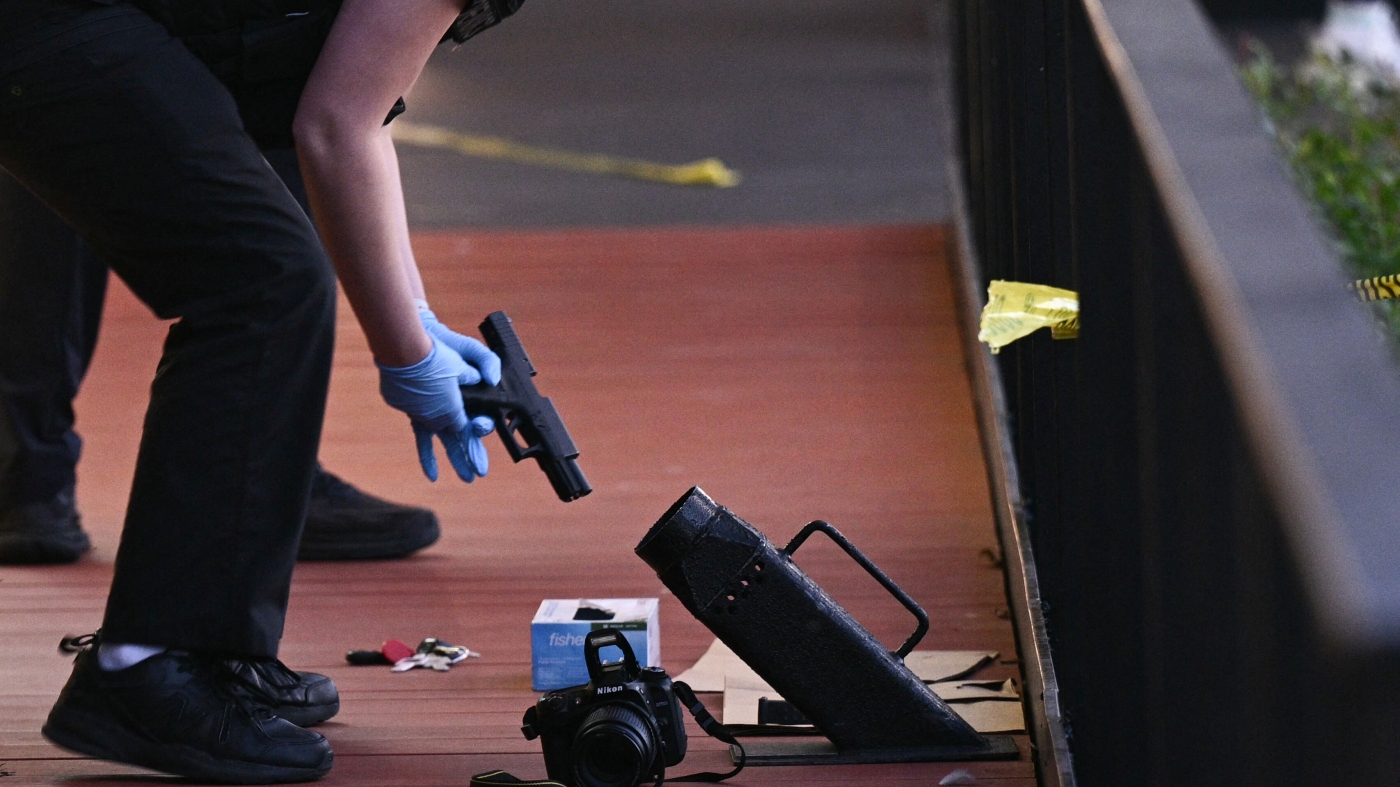

A law enforcement officer inspects a handgun at the scene of a shooting in Washington, DC, on October 2.
Brendan Smialowski/AFP via Getty Images
hide caption
toggle caption
Brendan Smialowski/AFP via Getty Images
The number of 3D-printed guns recovered from crime scenes has increased significantly in recent years, according to a report released Wednesday by gun control advocacy group Everytown For Gun Safety.
The report analyzes data obtained from local police departments on the characteristics of nearly 350,000 guns used in crimes in more than 50 U.S. cities from 2020 to 2024, including where the guns came from and how those origins have changed over time.
“The public deserves to know this, policymakers deserve to know this, activists deserve to know this, and people in communities affected by gun violence deserve to know this information,” said David Pucino, legal director of the Giffords Law Center to Prevent Gun Violence, who was not involved in the study.
Here are three key takeaways from the Everytown report, which provides an updated look at guns used in crimes since the federal Bureau of Alcohol, Tobacco, Firearms and Explosives released similar data in 2023.
3D printed weapons, a growing problem
In the report, Everytown identified 20 cities with five years of data on the recovery of 3D-printed guns, which can be made at home and are generally untraceable because they lack serial numbers. In 2020, these cities recovered 32 firearms printed at crime scenes. In 2024, the number of people recovered increased to 325, an increase of 1,000%. Although 3D printed weapons represent only a small number of weapons found at crime scenes, the growth in their use in crimes is concerning.

An ATF official holds a 3D printed weapon in the National Firearm Reference Vault, which contains thousands of weapons, at the Bureau of Alcohol, Tobacco, Firearms and Explosives (ATF) National Service Center in Martinsburg, West Virginia, September 4, 2024.
Saul Loeb/AFP via Getty Images
hide caption
toggle caption
Saul Loeb/AFP via Getty Images
“This has been a less significant phenomenon so far in jurisdictions where guns are easier to obtain,” Pucino said. “It’s in the places where we have the strictest gun laws that we’re seeing the fastest growth.”
New York, for example, has some of the strictest gun laws in the country. In 2023, New York City authorities recovered 33 3D printed weapons from crime scenes. By 2024, that number increased to 123, according to the Everytown report. Last spring, Manhattan District Attorney Alvin Bragg urged businesses who sell 3D printers to act to stem the flow of these weapons into the city.
Gun control advocates say there are strategies to regulate the printing of these firearms. Companies that make 3D printers could, for example, develop algorithms to block the printing of firearms, or states could prohibit the publication of plans for 3D printing a firearm.
“I think what makes sense is to explore all (the strategies) right now, have all the approaches and move them forward,” Pucino said, “because it’s such a new area and it’s such a worrying threat.”
Most crime guns come from major manufacturers
The Everytown report also looked at which gun manufacturers were found at crime scenes. Although the United States has over 20,000 gun manufacturersjust four companies — Glock, Taurus, Smith & Wesson and Ruger — accounted for more than half of the guns recovered from crime scenes across the country last year, according to the report.
The results are not surprising, given that all four companies are among the nation’s largest gunmakers. Glock, for example, makes about a quarter of the pistols produced in a given year, according to Everytown, and Glock guns account for nearly a quarter of the crime guns recovered in the group’s data set.
Nick Suplina, senior vice president of law and policy at Everytown, said manufacturers bear the blame.
“The fact that there is a correlation between that size of market share and the number of recoveries just goes to the point where these companies are gaining market share by selling guns that end up in crimes and then washing their hands of those crimes,” Suplina said. “The breadcrumbs go directly back to the manufacturers.”
Glock, Taurus, Smith & Wesson and Ruger did not respond to NPR’s request for comment.
The federal government adopted a law in 2005 which grants gun manufacturers broad immunity from civil liability when their guns are used in a crime. The law does, however, have exceptions, such as if the manufacturer knowingly violated laws relating to the marketing or sale of the weapon.
Some states also passed laws allow people to sue gun manufacturers if they don’t implement safeguards to ensure their products don’t fall into the wrong hands.
From legal purchase to crime scene
Everytown also analyzed a larger ATF dataset from 2019 to 2023. It found that half of the nearly 2 million guns traced by the agency were purchased legally but ended up at a crime scene within three years. A period known as “time to crime” less than three years is generally considered an indicator the weapon was purchased with the intention of being trafficked and used for criminal purposes.
Pam Hicks, former chief attorney for the ATF, said the data underscores the need to conduct rigorous federal inspections of gun dealers to ensure proper sales protocols are followed. The agency is however faced with drastic budget cuts next year which should have an impact on its inspection capacity.

Handguns are displayed at a store during the Rod of Iron Freedom Festival October 9, 2022 in Greeley, Pennsylvania.
Spencer Platt/Getty Images
hide caption
toggle caption
Spencer Platt/Getty Images
“There’s a lot at stake because one of ATF’s primary law enforcement roles is to determine and prosecute where crimes have been committed in this movement from lawful commerce to illegal use,” said Hicks, who left the agency in February.
Another way legally purchased guns end up being used in crimes is through theft, said Bill Brooks, retired police chief of Norwood, Mass., and chairman of the International Association of Chiefs of Police’s firearms committee.
Gun owners have a role to play in combating this problem, he said.
“We all know there are more guns than there are people in the United States, what if everyone who owned a gun kept it locked away?” » said Brooks.
“What would happen to the number of suicides of family members, accidental discharges among children, people picking up a parent’s gun and then going somewhere and committing a mass shooting or homicide?”


