Three Chinese astronauts stranded on Tiangong space station after debris hits their return capsule


Three Chinese astronauts, or taikonauts, were temporarily stranded in space after their return capsule was struck by a suspected piece of “space debris” hours before departure. Authorities are investigating exactly what happened, but so far there is no indication of how much damage the craft suffered or when the crew will return to Earth.
The trio of taikonauts – Wang Jie, Chen Zhongrui and Chen Dong, collectively known as the Shenzhou-20 crew – live on the Chinese coast. Tiangong Space Station since April 24. They were due to return to Earth on Wednesday November 5 after a successful transfer period with the crew of Shenzhou-21, which arrived at the station on Halloween (October 31). However, earlier on Wednesday, around 10:30 a.m. local time, representatives of the China Human Space Mission Agency (CMSA) announced that the astronauts’ return had been postponed, via a statement posted on Chinese social media site Weibo.
The potentially damaged spacecraft is likely still docked at the Tiangong space station, where it has remained since the Shenzhou-20 crew was delivered to the station in April. It is composed of three detachable sections: a power and propulsion module, crew living quarters and a parachute-assisted return module, according to Ars Technica.
If any of these sections are deemed unsafe, the spacecraft will likely be ejected and returned to Earth without the astronauts. In this case, the CNSA guidelines suggest that the Shenzhou-20 crew will return to Earth aboard the Shenzhou-21 return module, which will in turn be replaced by another spacecraft that the CMSA maintains on standby, according to Reuters.

During the current mission, Shenzhou-20 Commander Chen Dong broke the record for the most cumulative days in space by a Chinese astronaut, having now passed more than 400 days orbiting our planet. This record will now be further extended by this delay. (The current record for the most non-consecutive days spent in space is held by Russian cosmonaut Oleg Kononenko, who accumulated 1,111 days in space.)
Dong’s situation is reminiscent of that of NASA astronaut Frank Rubio, who inadvertently broke the record for longest spaceflight by an American (371 days) in September 2023, after its return module was irreparably damaged by a meteorite impact, while docked with the International Space Station (ISS).
In March, NASA astronauts Butch Wilmore and Suni Williams also made headlines when they returned to Earth. nine months after the start of their initial one-week mission. The couple’s extended stay aboard the ISS is the result of several technical problems with their Boeing Starliner capsule.
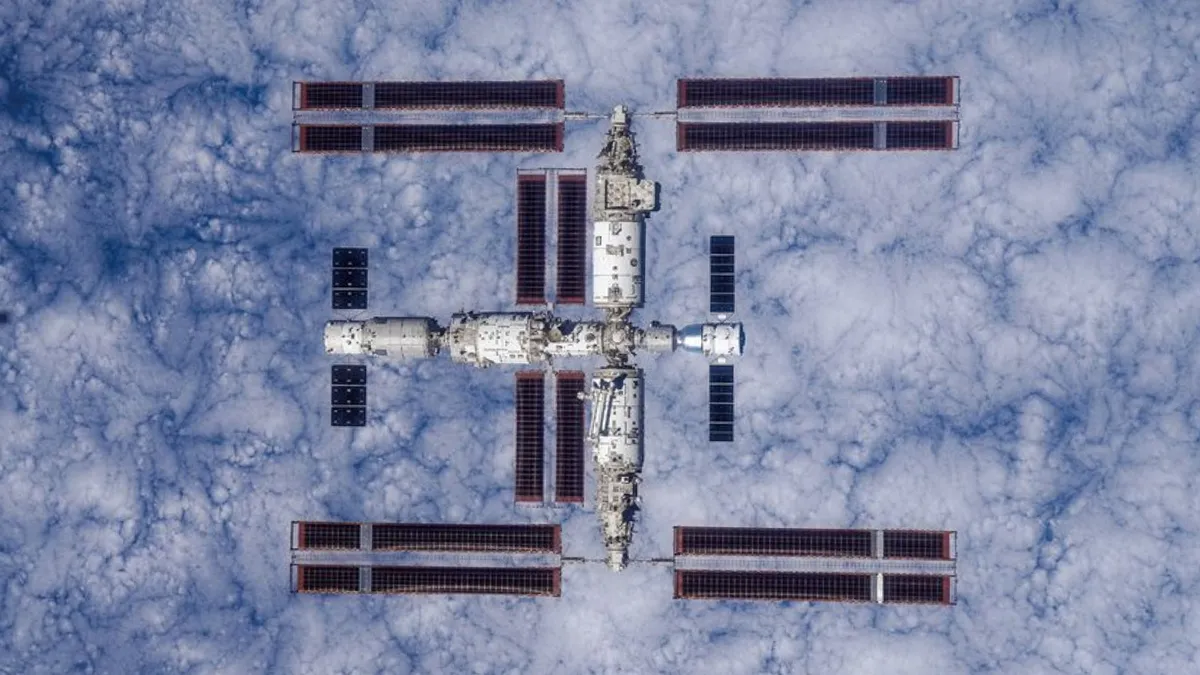
This is not the first time that the Chinese space station has been hit by space debris: One of the station’s solar panels was struck by debris in 2023, triggering a partial power outage, according to Ars Technica. As a result, additional shielding has been added to parts of the station’s exterior during recent spacewalks.
The ISS is also susceptible to space debris and must be constantly repositioned to avoid large debris. Parts of the space station, such as the Canadarm2 robotic arm, have damage sustained by collisions of smaller debris over the years.
The amount of space debris orbiting Earth is increasing rapidly, along with the increasing number of spaceships around our planet. Some experts fear that if this continues, we could reach a point of no return where a chain reaction of collisions will render low Earth orbit unusable. This theoretical scenario is known as “Kessler syndrome.”
Meanwhile, national space agencies and private companies testing various space debris mitigation strategies.


