Three Heliophysics Spacecraft Observe Interstellar Comet 3I/ATLAS


NASA’s Solar Terrestrial Relations Observatory (STEREO), NASA/ESA SOHO (Solar and Heliospheric Observatory), and NASA’s PUNCH (Polarimeter to Unify the Corona and Heliosphere) missions have the unique ability to observe areas of the sky close to the Sun, which allowed them to track 3I/ATLAS as it passed behind our Sun as seen from Earth.
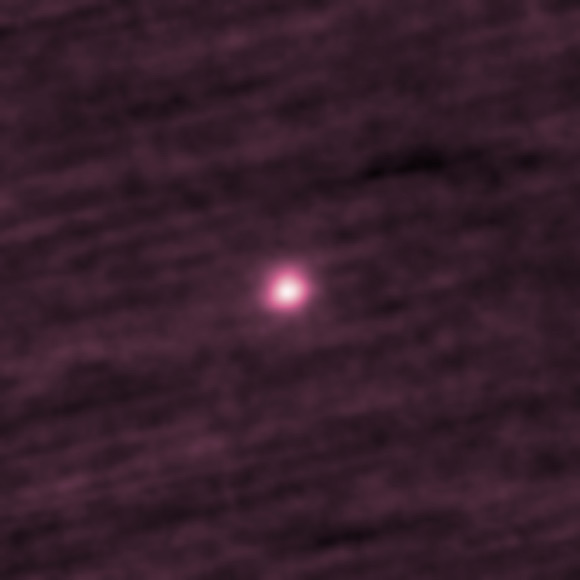
Traveling through our solar system at a staggering speed of 209,000 km (130,000 miles) per hour, 3I/ATLAS was made visible using a series of colorized stacked images from September 11 to 25, 2025, using the Heliocentric Imager-1 instrument, a visible-light imager installed on NASA’s STEREO-A spacecraft. Image credit: NASA / Lowell Observatory / Qicheng Zhang.
STEREO observed the interstellar comet 3I/ATLAS from September 11 to October 2, 2025.
Designed to study the Sun’s activity and its influence across the solar system, the mission is part of a fleet of NASA spacecraft observing the comet, together providing more information about its size, physical properties and chemical composition.
It was initially expected that comet 3I/ATLAS would be too faint for STEREO’s instruments to see, but detailed image processing and superposition (or “stacking”) of the telescope images using the Heliospheric Imager-1 instrument, a visible light telescope, made it possible to see 3I/ATLAS.
Stacking and aligning multiple exposures ultimately generated several images in which the comet appears as a faint brightening in the center.
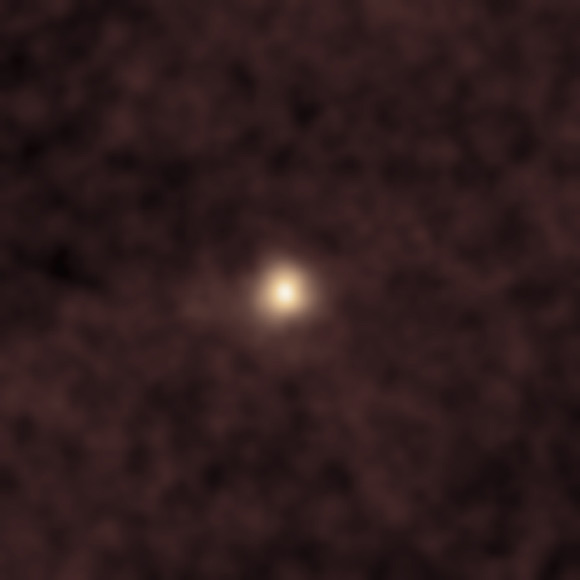
This 3I/ATLAS image combines observations from the NASA/ESA SOHO mission between October 15 and 26, 2025. Image credit: NASA / ESA / Lowell Observatory / Qicheng Zhang.
The SOHO spacecraft sighted 3I/ATLAS from October 15 to 26, 2025.
During this period, SOHO’s LASCO (Large Angle and Spectrometric Coronagraph) suite of instruments spotted the comet crossing its field of view at about 358 million kilometers (222 million miles), more than twice the distance from Earth to the Sun.
SOHO orbits Sun-Earth Lagrange point 1, a region of gravitational equilibrium located about 1/6 million km (one million miles) closer to the Sun along the Sun-Earth line.
SOHO team members also used the stacking method to generate the 3I/ATLAS image.
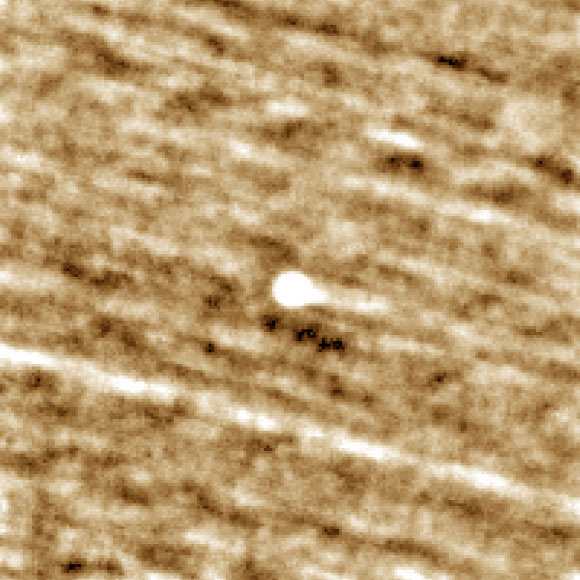
3I/ATLAS appears as a bright object near the center of this image, made from the combination of NASA PUNCH mission observations taken from September 20 to October 3, 2025. Image credit: NASA / Southwest Research Institute.
The PUNCH mission observed 3I/ATLAS from September 20 to October 3, 2025.
Observations revealed the comet’s tail, visible as a slight elongation at the bottom right.
The comet was very faint during these observations, so the PUNCH team wasn’t sure the spacecraft would be able to see it clearly, because the spacecraft is designed to study the Sun’s atmosphere and solar wind, not comets.
However, the stacking of several PUNCH observations brought out 3I/ATLAS and its tail.
“We’re really pushing the limits of the system,” said Dr. Kevin Walsh, a planetary scientist at the Southwest Research Institute who led PUNCH’s observations of the comet.


