What Is a Quasar? The Answer Depends on Your Point of View


October 16, 2025
5 min reading
When a galaxy erupts, what we see depends on How We see it
Ravenous supermassive black holes illuminate the cores of “active” galaxies across the universe. How we see them, however, is a matter of perspective.
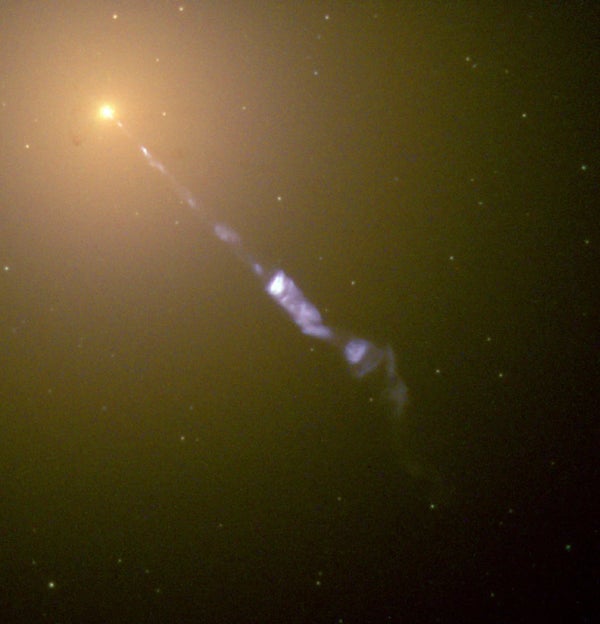
A jet of subatomic particles propelled by a black hole erupts from the heart of the active galaxy M87 in this image taken by NASA’s Hubble Space Telescope.
NASA/Hubble Heritage Team (STScI/AURA)
Standing on Earth and looking up at the night sky, you might think that our galaxy, the Milky Way, is relatively calm. Of course, there are occasional supernovas and a bit of commotion when huge clouds of gas collide and start forming stars. But as a whole, the vast cosmic district in which we live seems majestic. Most of the nearby galaxies we can see also look like this, quietly going about their cosmic activities. Calm.
But this is not the case for all galaxies. Centaurus A is an overenthusiastic eccentric located about 13 million light years from Earth. It appears to be an elliptical galaxy shaped like a rounded cotton ball, but with a striking dark stripe down the middle. In the 1940s, astronomers discovered that it was inexplicably emitting radio waves from its core. Subsequent studies over the following decades showed that its center also emitted high-energy X-rays and even gamma rays. Clearly, there’s a lot more to Centaurus A than meets the eye. Observers eventually discovered many other similar objects, which collectively received the catch-all name Seyfert galaxies (after American astronomer Carl Seyfert, who discovered several of them).
Then, in the 1960s, things got stranger. Astronomers began to discover objects that emitted powerful radio waves but, unlike most Seyfert galaxies, were very faint in visible light. Many of these new objects were incredibly distant and therefore extremely luminous, but looked so much like stars that they were dubbed quasi-stellar radio sources, or quasars for short. Deep images taken with large telescopes revealed that each observed quasar was an extraordinarily bright central point of light, significantly outshining a much fainter surrounding galaxy.
On supporting science journalism
If you enjoy this article, please consider supporting our award-winning journalism by subscription. By purchasing a subscription, you help ensure the future of impactful stories about the discoveries and ideas shaping our world today.
As astronomers pondered the mysteries of quasars, another galaxy exhibiting different strange behavior caught their attention: BL Lacertae (or BL Lac for short). Nearly a billion light years away, it’s also a ridiculously bright powerhouse, but surprisingly its brightness also changes dramatically over short periods of time, sometimes just a few hours. It was the first in a class of galaxies called blazars, a clever triple portmanteau of BL Lac, blaze and quasar. Like Seyferts and quasars, the majority of their light comes from their very center. Together, the three flavors are grouped into a broad category called active galactic nuclei, or AGN for short.
It didn’t take astronomers long to figure out what could be powering such an intense and concentrated emission of energy: a supermassive black hole gobbling up a lot of matter. Yet if this is the driving force behind all AGNs, why do quasars, Seyferts and blazars all seem so different from each other?
In the 1990s, astronomers had a brilliant idea to unify these disparate features. Although there is some physical diversity between these galaxies, the majority of their different properties could be explained more by how we see them.
I mean this literally: the angle at which we view their centers greatly affects the resulting light we see. Understanding why this essentially comes down to what exactly is happening near this central supermassive black hole.
Far from the black hole, thousands or tens of thousands of light years away, is a relatively normal galaxy, not too different from the Milky Way. But closer, where black hole gravity reigns, things are very different.
Immediately around the monster black hole is a flat disk of material (called an accretion disk) that it feeds on. This accretion disk can extend several billion kilometers, or a decent fraction of a light year, and it is hot. Matter very close to the black hole orbits at speeds close to that of light, but further away, matter moves much more slowly. This creates immense friction in the disk that can heat the material up to millions of degrees. At this temperature and density, the material is incredibly bright and can easily outshine all the stars in the galaxy.
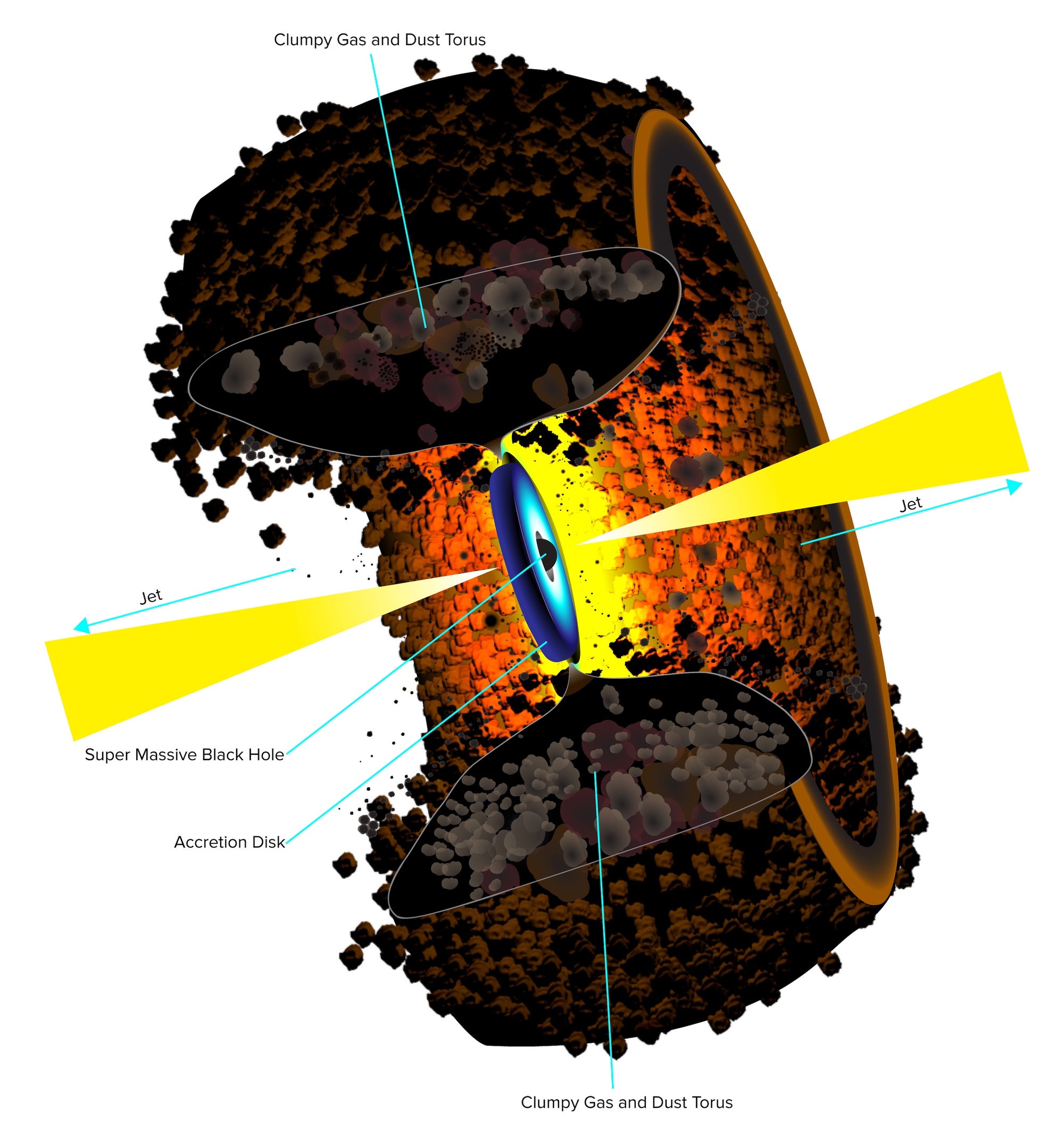
Concept art of an active galactic core, showing how intrinsically similar astrophysical objects can have very different appearances to external observers based on different viewing angles.
The disk contains an intense magnetic field. As material in the disk approaches the black hole and increases its orbital speed, the built-in magnetic field can wrap itself like a thread around a spool. This further strengthens the magnetic field, which can become so powerful (associated with a bizarre effect called frame dragging in which the rotation of the black hole itself drags the fabric of space-time around it) that matter is forced out of the disk and thrown into a pair of beams called jets. These jets are highly concentrated and incredibly powerful, and they can create immense internal shockwaves which, in turn, release torrents of gamma rays, the most energetic form of light in the cosmos. The jets can span hundreds of thousands of light years in some cases, extending far beyond the galaxy itself.
Importantly, further away from the accretion disk and jets, on a scale of tens to several hundred light years in some cases, is a dust torus, a donut-shaped cloud composed of tiny grains of rock and carbonaceous material. This substance is dense and opaque to visible light and, if thick enough, can also block higher energy forms of radiation.
In the unified AGN model, the angle from which we view these structures explains almost everything we see. If the jets are pointed more or less toward Earth, we see light coming from across the electromagnetic spectrum, from gamma rays to radio waves. These are the blazars. If we see an AGN at a slightly lower angle, then the jet is directed far away and we miss the beam-like gamma-ray emissions, but we can still detect high-energy X-rays; these are quasars.
At even lower angles, the dust torus begins to block the most energetic light from reaching us. In these cases, much of an AGN’s emission is so attenuated that the galaxy around it is more easily visible. These are the Seyferts, and they tend to be bright in radio and infrared waves because their dust is heated by the hellish brew closer to the center, producing infrared thermal radiation.
The situation is a bit like the parable of the blind men and the elephant: what we think we see depends on what part we see, and it is only by putting the pieces together that the true picture emerges. For active galaxies, the unified model explains well the large differences between the classes of galaxies observed.
To be fair, though, the Unified Model doesn’t explain everything and it can struggle to reproduce many of the details we see. But this is not surprising: any the model will be incomplete and will not explain everything in each observation. The idea is to have a general idea of the processes and structures involved to explain the majority of what is seen. Extensions of the model can then be introduced to explain the outliers.
And what about our own Milky Way? We have a supermassive black hole at the heart of our galaxy, but like many of our galactic neighbors, it is quiescent, meaning it is not currently feasting on matter. The key word here is “currently”: it is likely that in the distant past, the central black hole of the Milky Way also episodically gorged itself on matter, each time erupting in the form of an AGN. And since we tend to see AGN at great distances – when the universe was younger – this implies that most large galaxies have similarly tumultuous youths. But fortunately, for now, we are at peace.