Titan submersible imploded due to poor engineering, say US officials


OceanGate’s Titan submersible imploded during its journey to the wreck of the Titantic due to poor engineering and multiple failures during testing of the ship, according to an official report.
Titan imploded in June 2023, killing all five passengers on board, including the CEO of OceanGate.
The US National Transportation Safety Board (NTSB) ruled that the engineering process behind the vehicle was “inadequate”, leading to defects that meant it did not meet strength and durability requirements.
The NTSB said that because the company had not adequately tested Titan, it did not know its true strength. He was also unaware that it was damaged and should have been decommissioned before its final voyage.
Titan disappeared in the North Atlantic while attempting to dive for the wreck of the Titanic which is located approximately 372 miles from St. John’s in Newfoundland and Labrador, Canada.
In August, the U.S. Coast Guard released a damning report on the implosion, which concluded the incident was “preventable” and criticized OceanGate’s “seriously flawed” safety practices.
Stockton Rush, CEO and co-founder of OceanGate, piloted the Titan on its final voyage.
The passengers, who paid up to $250,000 each to take part in the dive, are deep-sea explorer Paul-Henri Nargeolet, Shahzada Dawood and her son Suleman Dawood, 19, and Hamish Harding.
Designed and built by OceanGate, the Titan was 6.7 m (22 ft) long with a carbon fiber cockpit, with titanium used in its domes and some other segments.
The doomed submersible that imploded at a depth of 3,363 m (11,033 ft) – the wreck of the Titanic is located at 3,880 m – was the second version of the craft. OceanGate condemned the first version following tests.

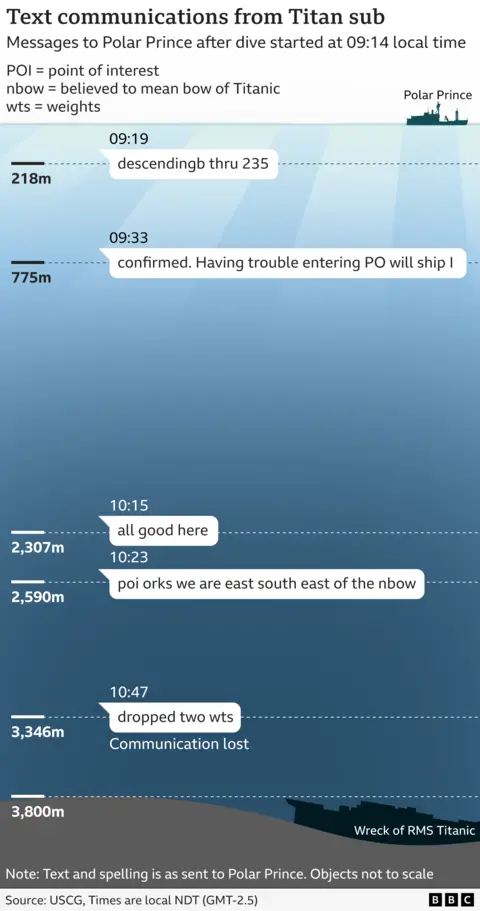
During its investigation, the NTSB discovered problems with the safety culture at OceanGate.
While some employees said safety was a priority, others, including a former marine operations director and a technician, pointed to an environment “where safety issues, particularly design issues, were ignored.”
A technician at the company expressed concern about OceanGate’s business model, particularly in accepting paying customers as “mission specialists” rather than passengers.
Under US regulations, it is illegal to transport passengers in an experimental submersible.
The technician told the NTSB that he informed Mr. Rush, “…you can’t just change a person’s title when you receive compensation.”
In a later conversation on the same subject, the technician said Mr. Rush said: “If the [US] The Coast Guard has become a problem…he would buy a congressman and make him disappear.”
OceanGate has permanently shut down its operations since the incident.
In its report, the NTSB found that a contributing factor to the implosion was that U.S. and international voluntary guidelines and U.S. regulations on small passenger vessels “were insufficient to ensure that OceanGate adhered to established industry standards.”
The NTSB recommended that the U.S. Coast Guard commission a study on how pressure vessels that carry people are evaluated and, if changes are suggested, the regulations be updated.


