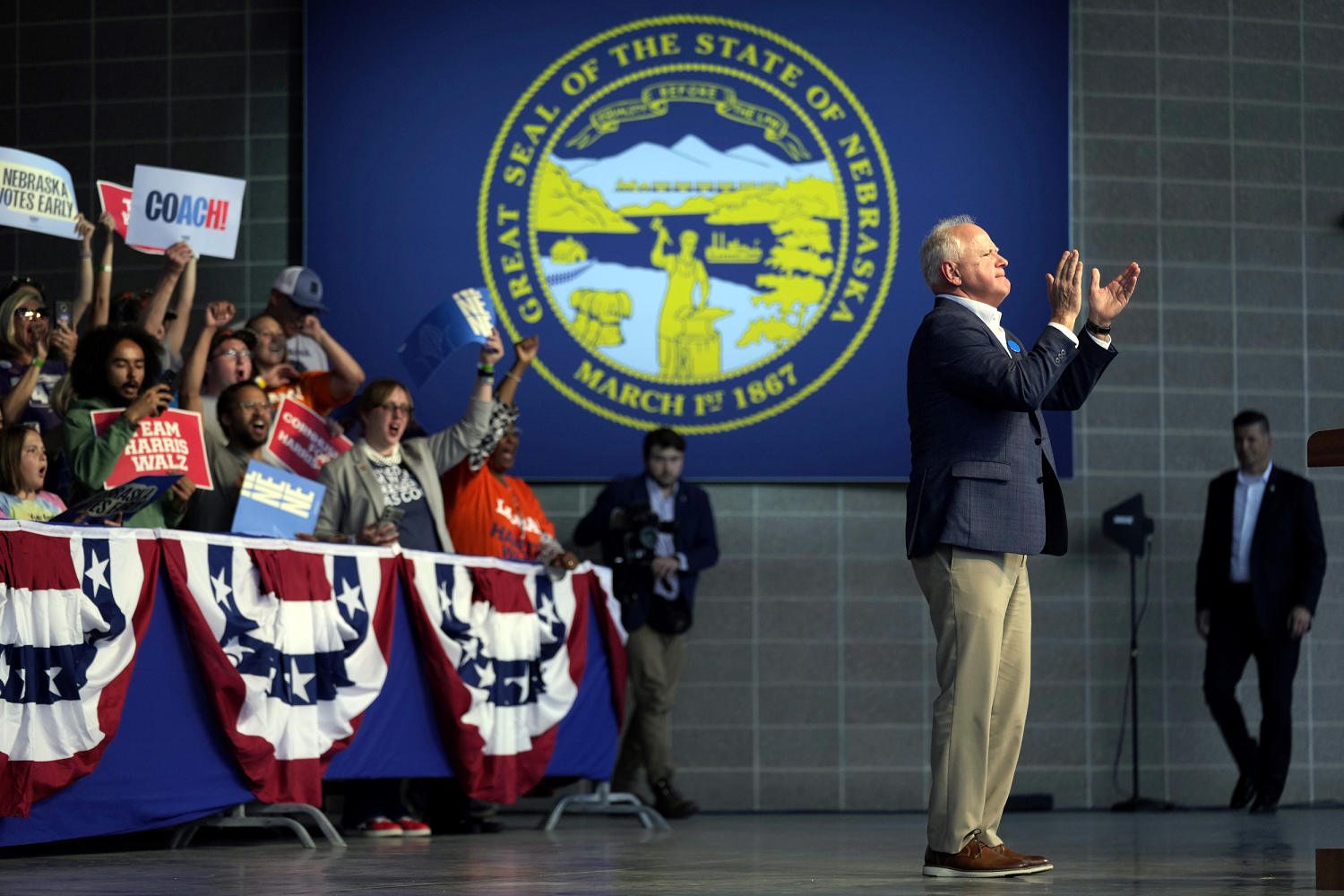
The future of Nebraska’s ‘blue dot’ electoral vote becomes an issue in one key midterm race


Cavanaugh defended his candidacy, telling NBC News that he expects Democrats to pick up more seats in the Legislature in November, which would expand their minority enough that a single victory for his seat would not have the effect Rhoades predicted.
If he wins the primary and general elections, “I won’t resign until after the January election, and at that time we will have already had the opportunity to elect more Democrats to the Legislature,” Cavanaugh said.
Omaha City Councilman Danny Begley, who supported Cavanaugh, agreed. Begley, who is also vice president of the International Brotherhood of Electrical Workers Local 1483, added that he thinks other candidates are raising the “blue dot” issue “to dissuade people from voting for John.”
Rhoades disagrees, saying the margins in legislative districts on this year’s ballot are too high for Democrats to count on overturning.
Rubin, the nonpartisan strategist, acknowledged that this “blue dot” issue seems niche and shaky, but added that Democratic voters in the Omaha area are particularly attentive to how this issue could affect the future of their representation in the Electoral College.
“It’s a legitimate argument to make in a Democratic primary, because there’s a real factor of unintended consequences,” he said, adding that maintaining the “blue dot” is an issue that “Democratic primary voters are very passionate about.”
While Rhoades repeatedly criticized Cavanaugh during the primary for the impact his candidacy could have on the state, political organizer Denise Powell, another leading candidate, said she still ranks behind on traditional policy issues.
“It’s definitely something people bring up to me,” Powell said. “But at the end of the day, when I speak, 99.9 percent of people tell me about their health care costs and the cost of groceries.”
Cavanaugh and Powell are leading the pack in fundraising — each having raised more than $300,000 in the final quarter of 2025 — and in national attention. Cavanaugh touts support from Reps. Ro Khanna, D-Calif.; Pramila Jayapal, D-Wash.; and Jamie Raskin, D-Md., and the Congressional Progressive Caucus PAC.
Powell, meanwhile, was endorsed by Rep. Emily Randall, D-Wash., former Rep. Annie Kuster, D-N.H., the Congressional Hispanic Caucus BOLD PAC and EMILY’s List, a national organization that works to elect Democratic women.
“This seat is a lot more competitive without Bacon, but Democrats can’t take anything for granted. If we don’t get this one, we won’t flip the House,” a Democratic national strategist supporting Powell told NBC News.
Across the aisle, Republicans cleared the field for Omaha City Councilman Brinker Harding, who was supported by Bacon, Pillen and Republican Senators Pete Ricketts and Deb Fischer.
Although the seat has been in Republican hands for nearly a decade and Harding is already gearing up for the general election, he faces an uphill battle in the general election, two years after Harris won the district by about 5 points.
The Democratic primary so far has focused on each candidate’s plan to resist President Donald Trump’s agenda and cut costs.
“Affordability and health care are important,” Powell told NBC News in an interview about the concerns she hears from voters in the district. “People [are] Worried about how they will make ends meet, life is becoming more and more difficult for people. And along with that, I think we’re all witnessing a lot of abuse of power by this administration. »
Several national Democratic operatives supporting Powell praised her response to Immigration and Customs Enforcement raids across the country, noting that Powell is Latina and the daughter of immigrants.
“Voters aren’t looking for the same thing. They want authentic leaders who understand the challenges they face and who will fight back against the chaos they see in the news,” Jessica Mackler, president of EMILY’s List, told NBC News in a statement.
In his campaign, Cavanaugh touted his work serving parts of the district during his two terms as a state lawmaker.
“I’m someone who gets things done for my constituents and passes laws that actually improve economic conditions for Nebraskans,” Cavanaugh said in an interview.
Evan Brown, executive director of the CPC PAC, told NBC News that Cavanaugh’s record in the state Legislature was part of the reason the group decided to support him in this race.
“Someone like John, who can focus on kitchen table issues, can win a critical, strategic seat like this, and he’s also just built a lot of trust in the community, and that’s what we’re seeing on the ground, in the polls and in fundraising, showing that he is the strongest candidate in this race,” Brown said.
Cavanaugh’s candidacy is bolstered by his family heritage in Omaha. In the 1970s, Cavanaugh’s father represented the 2nd District in Congress and his sister, State Senator Machaela Cavanaugh, also serves in the Statehouse.

:max_bytes(150000):strip_icc()/GettyImages-1198660415-0aef78799c924e759ef3cb976e8257a5.jpg?w=390&resize=390,220&ssl=1 "What Is Wind Energy? Definition and How It Works")


