To tackle e-waste, teach kids to be responsible consumers


Credit: Pixabay/CC0 Public domain
The world is experiencing rapid electronification and digital transformation, which is reshaping the way we live. Many of us have numerous electronic devices around us at any given time, from smartphones and watches to our appliances and cars.
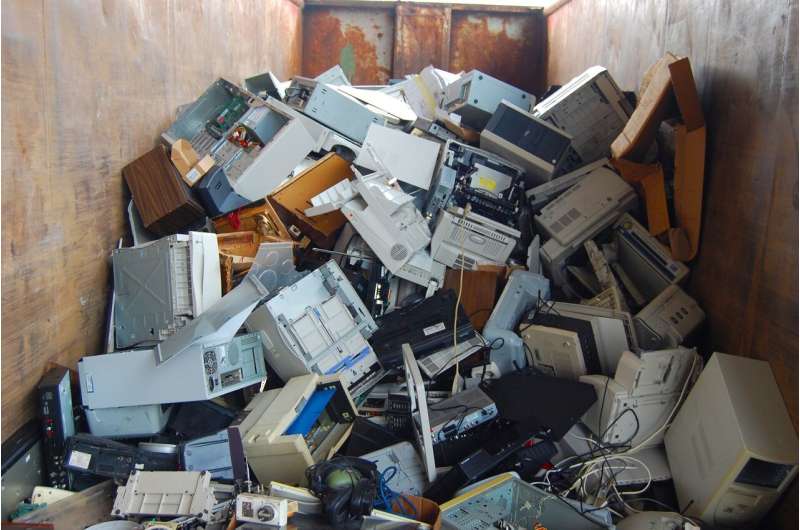
A sharp increase in electronic waste has accompanied the rise of electronic equipment. In 2022, 62 million tonnes of electronic waste were produced worldwide.
Canada’s e-waste tripled between 2000 and 2019 and is expected to reach 1.2 billion kilograms by 2030. These statistics demonstrate an urgent environmental crisis that demands new ways of thinking and educating future generations.
A key part of solving the problem is educating people about it. As educators, we need to expand school education to include resource recovery, sustainability, and pro-environmental behaviors to inform students about what to do with their old gadgets.
The language and techniques we use to communicate about this topic in classrooms play an important role in helping children understand and engage in safe e-waste management.
Schools and educators must equip young people of all ages with the values, attitudes, knowledge and skills to manage e-waste responsibly.
Gaps and limitations
My research uses machine learning tools to develop effective circular economy policies focused on e-waste management in Canada, with insights reflecting Ontario’s evolving practices.
In Ontario, schools are failing to provide comprehensive and consistent education about e-waste, leaving a dangerous gap in our students’ environmental knowledge.
Environmental education in Ontario introduces students to the concept of environmental management and the provincially mandated curriculum includes it in an interdisciplinary manner. However, due to a decrease in priorities and budget cuts, attention to e-waste and resource conservation is absent.
According to a 2024 report from EcoSchools Canada, there are a number of barriers to successful e-waste management in schools, such as COVID-19, provincial inconsistencies, disconnection of programs, custodian involvement, low school engagement, and lack of key infrastructure and information.
The Ontario government and municipalities have made efforts to revise the school curriculum, with non-profit organizations stepping in to help fill the knowledge gap.
For example, in municipalities like Peel Region, resources for teachers include a multitude of interactive online activities and lesson plans focused on the 3Rs and proper sorting, as well as additional workshops, events, games and other resources for students in grades K-8.
Likewise, Durham Region offers a specific presentation, including one for grades 7 and 8 entitled “Electronic waste: the hidden impact of our gadgets”, allowing students to discover the possible environmental, social and economic consequences of the devices.
Several schools also actively participate in the EcoSchools program, a certification initiative originally developed by the Toronto District School Board to promote environmental education and action.
The program provides opportunities for student-led projects such as e-waste collection drives and awareness campaigns, providing meaningful experiential learning.
While these are useful and necessary, the direction and scope of these initiatives are often left to the discretion of teachers and schools, leading to an uneven and often limited understanding of the e-waste problem. Although laudable, these programs represent a patchwork rather than a coherent province-wide strategy.
Additionally, much waste education tends to emphasize recycling. While recycling is an important part of the solution, comprehensive e-waste education should also focus on reducing consumption, repairing and reusing electronic devices, and understanding the principles of a circular economy. Educational institutions and educators must equip students to be able to critically question our throwaway culture.
The way forward
Educational institutions can play an important role in designing initiatives that will help future generations gain fundamental knowledge about sustainable e-waste management.
At Montgomery School in Saskatoon, students participated in a project that allowed them to take apart old electronic devices to learn about e-waste, its materials and proper disposal. As part of one initiative, students are going through school trash to see what could be reused.
The project connects classroom learning with Saskatchewan’s Grade 6 and 7 curriculum aimed at understanding the social effects of sustainability issues, such as waste management, and encouraging students to think critically about the use of technology and environmental responsibility. The students successfully made keyrings from old circuit boards which they sold at a school event to raise money for future projects.
Provincial ministries of education must take the lead by integrating clear learning expectations into their provincial curriculum in subjects such as science, technology, geography, social studies and civics. This will ensure that all students, regardless of school or location, will receive a preliminary understanding of this growing problem.
Cross-sector collaboration between provincial governments, school boards, municipalities and environmental organizations will be essential to the development of high-quality educational materials linked to school programs.
Other initiatives may include organizing school visits to recycling facilities or setting up e-waste collection campaigns to allow students to see the impact of sustainable activities.
Schools can also invite guest speakers to give students the opportunity to learn from front-line environmental experts who have first-hand knowledge of e-waste sorting.
Integrating knowledge about e-waste into the school curriculum is a crucial step towards creating a more sustainable future. This will involve much more than just teaching students where the recycling bin is. It’s about providing them with the know-how that will help them challenge our throwaway culture and giving them the means to become responsible consumers.
Provided by The Conversation
This article is republished from The Conversation under a Creative Commons license. Read the original article.
Quote: To fight electronic waste, teach children to be responsible consumers (November 12, 2025) retrieved November 13, 2025 from https://phys.org/news/2025-11-tackle-kids-responsible-consumers.html
This document is subject to copyright. Except for fair use for private study or research purposes, no part may be reproduced without written permission. The content is provided for informational purposes only.

:max_bytes(150000):strip_icc()/Health-GettyImages-1199861252-867e73ff11994a7ea2a7a1dd542d2086.jpg?w=390&resize=390,220&ssl=1 "What Happens to Your Body When You Eat Yogurt Every Day")


