ISS astronaut evacuation shouldn’t interfere with upcoming Artemis 2 moon mission, NASA chief says

When you purchase through links on our articles, Future and its syndication partners may earn a commission.

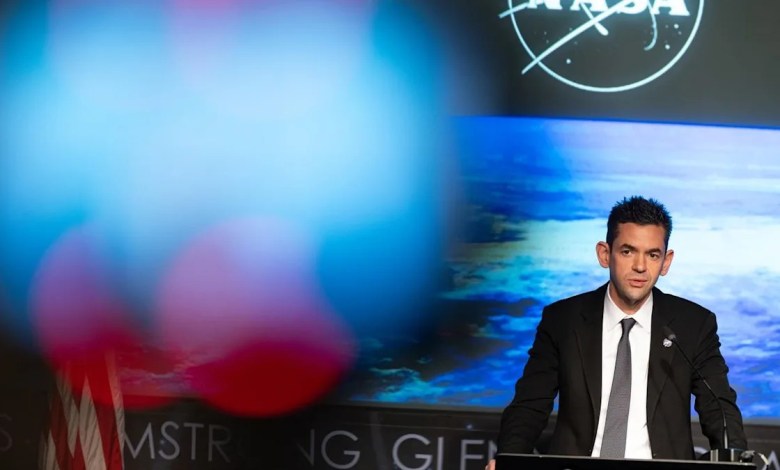
NASA Administrator Jared Isaacman provides an update on the International Space Station and its crew January 8, 2026, in the NASA Mary W. Jackson Headquarters Building in Washington. . | Credit: NASA/Joel Kowsky
NASA will return some of the crew aboard the International Space Station (ISS) to Earth sooner due to medical issues with one of the astronauts.
This should not delay the agency’s deployment and launch preparations. Space Launch System (SLS) rocket for Artemis 2 — the first crewed mission to the Moon in more than 50 years — NASA Administrator Jared Isaacman said on Thursday (January 8).
“They would be completely separate campaigns at this point,” Isaacman said at a Jan. 8 news conference to provide an update on NASA’s decision to end Crew-11 prematurely. “There is no reason to believe, at this point, that there would be an overlap where we would need to resolve a conflict.”
His assurance on the timeline for Artemis 2, which is expected to arrive on the launch pad for liftoff no earlier than February 5, comes amid NASA’s decision to abort a SSI crew rotation due to medical issues for the first time ever.
On Wednesday, January 7, NASA officials announced that they had decided to cancel an upcoming spacewalk due to a medical issue with an undisclosed crew member. A few hours later, the agency indicated that it did not rule out an early end to the Crew-11 missionand confirmed that the unnamed crew member was in stable, non-emergency condition. NASA officials finalized the decision to bring the astronauts home in an announcement Thursday, January 8.
NASA astronauts Zena Cardman and Michael Fincke, Japanese Kimiya Yui and Oleg Platonov of the Russian space agency Roscosmos launched towards the ISS atop a EspaceX Falcon 9 rocket lit August 1, 2025. Transported to the ISS aboard SpaceX Crew Dragon Endeavor, Crew-11 astronauts were scheduled to complete a six-month stay before replacement astronauts for SpaceX’s upcoming Crew-12 mission arrived.

The crew of NASA’s SpaceX Crew-11 mission poses for a photo during a training session before its launch to the International Space Station. From left to right: Oleg Platonov, Mike Fincke, Zena Cardman and Kimiya Yui. Credit: SpaceX | Credit: SpaceX
Crew-12 is currently scheduled for a mid-February launch, with Crew-11 already scheduled to depart within days of its arrival. Their early departure, however, has raised questions about NASA’s ability to manage the logistics of sandwiching the return of Crew-11 and the launch of Crew-12 around what is arguably NASA’s largest mission in more than 50 years.
Artemis 2 is NASA’s second opus Artemis Programwhich aims to bring back astronauts the moon to establish a permanent presence on the lunar surface. The first launch of the program, Artemis 1, launched in November 2022and flew an uncrewed Orion spacecraft into lunar orbit on a mission that lasted about a month.
Artemis 2 will be Orion’s first adventure into space with astronauts on board and will fly humans around the Moon for the first time since 1972 and the end of NASA’s space age. Apollo missions. The spacecraft will carry NASA astronauts Reid Wiseman, Victor Glover, Christina Koch and Canadian Space Agency astronaut Jeremy Hansen on a roughly 10-day mission around the Moon and back, and set the stage for Artemis 3, the mission to return astronauts to the Moon’s surface.
Both missions have faced multi-year delays, and NASA’s ambitious goal of launching Artemis 2 during its first window of opportunity is not thwarted by recent events aboard the ISS.

NASA’s Space Launch System rocket sits at Launch Complex-39A ahead of the launch of Artemis 1 in November 2022. | Credit: Space.com / Josh Dîner
Ideally, just as with a nominal crew rotation, NASA would prefer to launch Crew-12 before Crew-11 departs. Such overlaps have been standard procedure since the station’s continuous occupation during more than two decades of operation. And although the SLS deployment is expected in the next two weeks, NASA is studying the possibility of moving the Crew-12 launch forward in the schedule to avoid crew shortages in low Earth orbit.
“We are still evaluating what earlier dates would be feasible, if any, for Crew-12,” Isaacman said. “We will look at… our entire standard process for preparing Crew-12, and look for opportunities if we can implement it while simultaneously conducting our Artemis Two campaign.”