Tom Homan says he will scale back federal agents in Minnesota — if they have access to jails

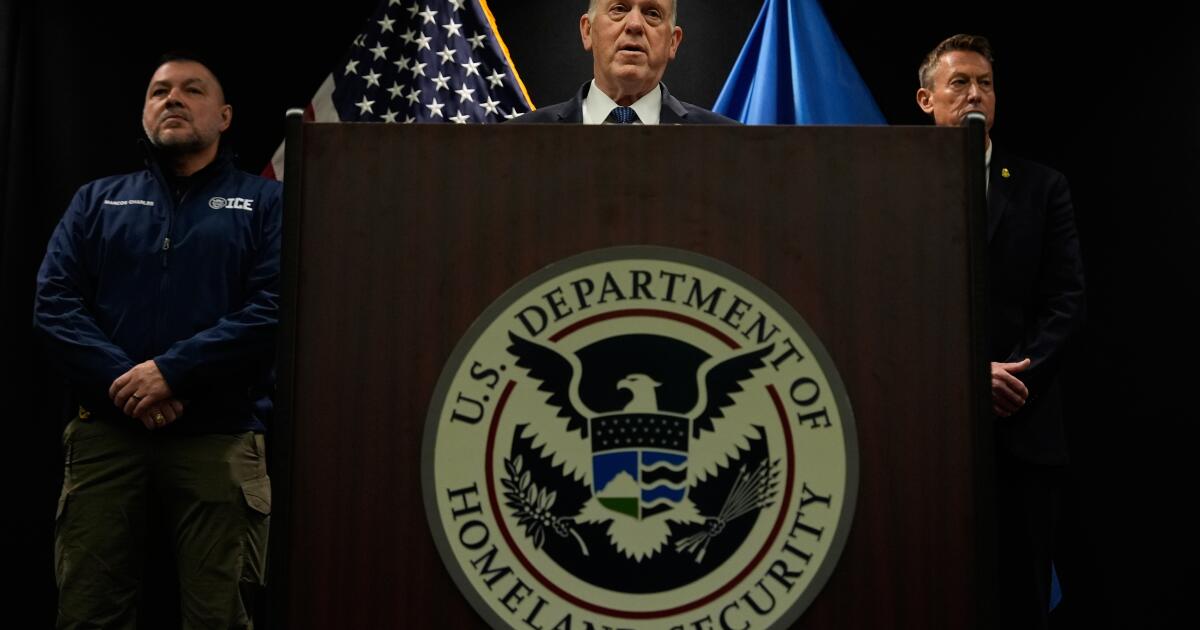
In his first news conference since taking charge of federal immigration operations in Minnesota following the killings of two U.S. citizens, border policy adviser Tom Homan said street operations in the state would end if agents were allowed into local jails.
“The withdrawal of police resources here depends on cooperation,” Homan said Thursday. “As we see this cooperation come to fruition, redeployment will take place.”
Homan, whom Trump deployed to Minnesota this week to lower the political temperature after Border Patrol agents fatally shot Alex Pretti on a Minneapolis street, said the federal government is not backing down on its aggressive immigration agenda.
“We are not abandoning our mission at all,” he said. “We are not abandoning the president’s mission on immigration control: let’s be clear.”
Homan’s focus on prisons is not a new position for the Trump administration. He and other top officials have long argued that they would not target immigrants in communities in Democratic-run cities if local authorities allowed federal immigration agents access to their jails.
“Sanctuary cities keep us out of prisons,” Homan told ABC News last January, just after Trump took office.
On Saturday, the day federal immigration agents shot Pretti, Attorney General Pam Bondi sent a letter to Minnesota Gov. Tim Walz saying he could “end the chaos” in his state by, among other things, repealing sanctuary city policies and allowing federal agents to enter local jails.
Data from last year shows that Republican-led states, such as Texas and Florida, have higher numbers of immigrant arrests than Democratic-led states, especially when measured by population. This is because they have worked directly with ICE longer and are more engaged in collaboration.
In red states, local law enforcement officers tend to work with federal agents, either assuming ICE functions through what are called 287(g) agreements or by identifying undocumented immigrants who are incarcerated and letting ICE into their jails.
Although blue states, like California, cooperate with federal immigration, sharing information with ICE about undocumented immigrants who have committed serious crimes, they do not allow federal agents access to those who have committed less serious offenses. Red states, however, are more likely to share information about offenses that may not be as serious, such as traffic violations.
President Trump announced Monday that he was sending Homan to Minnesota, sidelining Border Patrol Commander Gregory Bovino who led operations in the state, as public outrage grew over the killing of Pretti, a 37-year-old nurse in an intensive care unit.
Pretti is the second U.S. citizen shot and killed by federal agents in Minneapolis in recent weeks. On January 7, a federal officer fatally shot U.S. citizen Renee Good, a 37-year-old mother of three.
“I’m not here because the federal government has fulfilled this mission perfectly,” Homan said Thursday. “Nothing is ever perfect and everything can be improved. And what we have been working on is making this operation safer and more efficient, within the rules.”
Homan said, “President Trump wants this fixed, and I’m going to do it. »
Since Homan arrived in Minnesota, he has met with a number of Democratic officials, including Walz, Minneapolis Mayor Jacob Frey and Minnesota Attorney General Keith Ellison.
“At the end of the day, you can’t solve problems without talking,” Homan said. “I came here to look for solutions and that’s what we’re going to do.”
Homan said Ellison agreed that county jails “may notify ICE of release dates for criminal risks to public safety” so ICE can take them into custody. If local authorities agreed to allow ICE access to prisons, Homan said, the Trump administration would deploy fewer agents into communities.
“More officers in jail means fewer officers on the street,” Homan said. “This is common sense cooperation that allows us to reduce the number of people we have here. »
Immigration and Customs Enforcement has a long history of conducting targeted operations against criminals. However, during the first year of Trump’s second term, federal agents began to broaden their scope, carrying out sprawling raids that arrested non-English speakers and brown people in Home Depot parking lots, at car washes, or card tapping vendors on the streets.
Positioning himself as a moderate, Homan, former acting director of Immigration and Customs Enforcement under Trump, said he has been calling for de-escalation for months.
“I don’t want to see anyone die, not the officers, not the community members, not the targets of our operations,” Homan said.
“I said in March that if the rhetoric didn’t stop there would be bloodshed, and there was,” he said. “I wish I wasn’t right. I don’t want to see anyone die, not officers, not members of the community, not the targets of our operations.”
The Trump administration faced a harsh rebuke this week from top Minnesota judges, who accused federal immigration agencies of repeatedly violating court orders.
On Wednesday, Patrick J. Schiltz, Minnesota’s chief federal judge and a George W. Bush appointee, accused ICE of defying more court directives in the past month than “some federal agencies have violated in their entire existence.” He introduced the agency’s acting director, Todd Lyons. with a list of 96 court orders that ICE had ignored and warned Lyons that he could be found in contempt unless the agency began following the court’s rulings.
“ICE is not a law unto itself,” he wrote.
Meanwhile, another federal judge on Wednesday ordered the agency to stop the expulsion of Minnesota refugees who had legal status in the country. The Trump administration said it would reevaluate thousands of refugee cases granted legal status under the Biden administration.
“Refugees have the legal right to be in the United States, the right to work, the right to live in peace,” the Clinton-appointed judge wrote, “and, most importantly, the right not to be subjected to the terror of being arrested and detained without warrant or cause at home, on the way to church services, or while shopping for groceries.” »
On Thursday, Homan said federal immigration agents were performing their duties in a difficult environment and “trying to do it professionally.”
“If they don’t, they will be dealt with,” he said. “Like any other federal agency, we have standards of conduct.”
Homan said he also urged local law enforcement officials to work with the federal government to ensure the safety of immigration agents.
“The chiefs I spoke with are committed to responding to 911 calls when protesters become violent, officers find themselves in a dangerous situation and assaults occur,” Homan said. “They are committed to ensuring public safety and meeting the needs not of enforcing immigration law, but of maintaining the peace. »
Homan said Minneapolis residents threatened and assaulted federal agents. “If you don’t like what ICE is doing, go protest Congress,” he said.
More than 3,000 federal immigration agents are working in Minnesota as part of the Trump administration’s aggressive Operation Metro Surge.
Homan spoke as an internal memo reviewed by Reuters showed ICE agents operating in the state were ordered Wednesday to avoid engaging with “agitators” and to target only “aliens with criminal histories.”
“DO NOT COMMUNICATE OR ENGAGE WITH AGITATORS,” Marcos Charles, a senior official in ICE’s Enforcement and Removal Operations division, asked agents via email, according to Reuters.
Times Staff Writer Michael Wilner contributed to this report.


