‘Triple conjunction’ 2025: See the moon, Venus and the bright star Regulus in an ultraclose alignment in the sky tomorrow


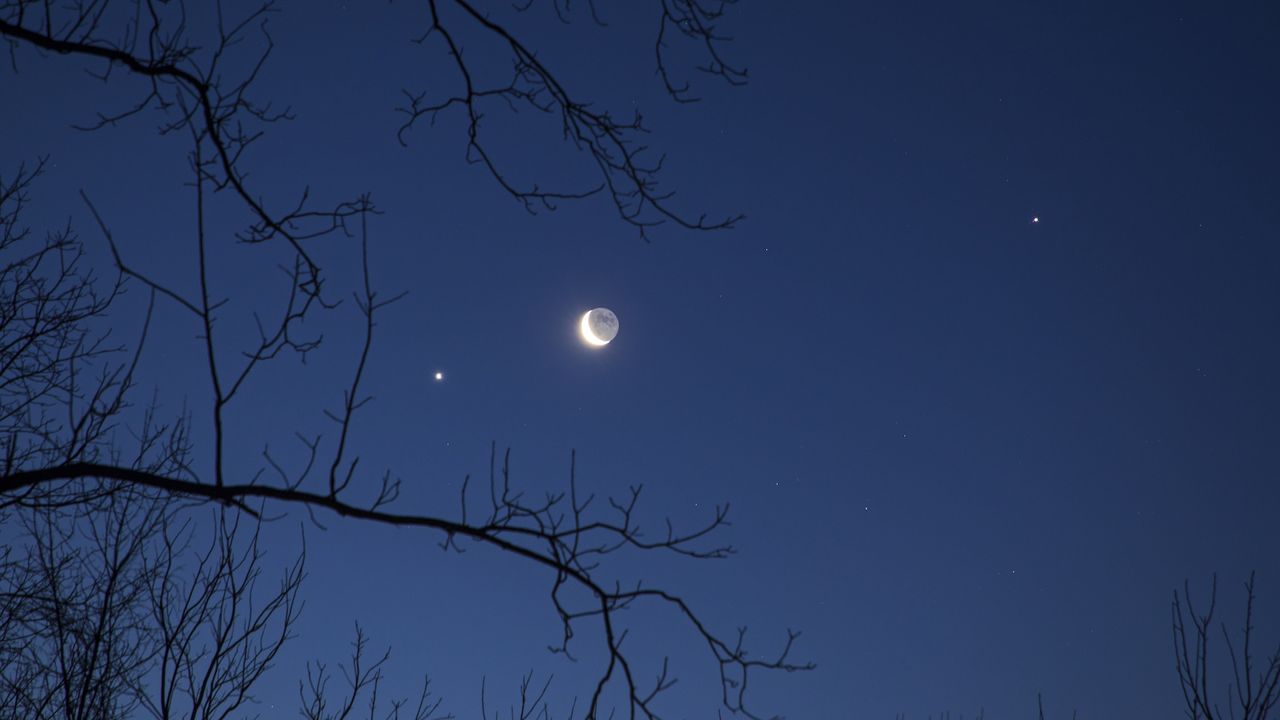
One of Best views of stars with bare eyes of the year is offered in Skywatchers this week – if you can get up before the sun Friday September 19. Just before sunrise, Crescent Moon, the brilliant planet Venus and Bright Star Regulus (the brightest star of the Constellation Leo) will come together on the east-north-east horizon.
There will be barely half-degree between each of the three objects, which is lower than the width of a little finger held against the sky. This triple conjunction of objects with bare eyes is a rare spectacle that is worth trying to see.
Visible low in the oriental sky about 90 minutes before sunrise, the decreasing crescent will be illuminated at around 6%. The thin moon itself will be a magnificent spectacle, thanks to the “Earthshine” bonus – the sunlight reflecting on the earth on the moon to light its dark side. The dazzling view will be visible both to the naked and simple eye Star binocular.
Venus and Regulus will be nearby, although their exact locations in the sky depend on your point of view. For example, on the east coast of North America, Stargazers will see an almost perfect alignment of the Moon Crescent, Venus and Regulus in a straight line barely covering a degree of sky. On the west coast of North America, it will be more a narrow grouping, with a vague triangle formed by the Moon, Venus and Regulus.
In terms of light, there will be a distinct hierarchical order. The moon will eclipse from afar everything, followed by the dazzling Venus then of Regulus, which will seem weak in comparison. In fact, Venus (magnitude -3.8) will be about 110 times brighter than Regulus (magnitude 1.3). (In astronomy, a weak or negative magnitude corresponds to a brighter object.)
Those in northeast Canada, Greenland, Western Europe and North Africa will see an even closer conjunction, the blackout moon (moving in front of the block) Venus for a short period. According to In—sky.orgThe position of these three objects will vary according to the location of the observer because the moon will be so close to the earth that its position in the sky will vary up to 2 degrees around the world. This also means that lunar occultations are only visible from part of the earth surface at any time.
In the days following the fence, the crescent moon will shrink and become a new invisible moon on September 21, causing a Partial solar eclipse which will be visible from New Zealand, Antarctica and the Southwest Pacific. On September 22, the Fall equinox Will bring about the day and night to the whole globe, announcing the arrival of longer nights for suffocating in the northern hemisphere. Venus will remain a brilliant “morning star” for the rest of the month.


:max_bytes(150000):strip_icc()/Health-GettyImages-2200597336-4c043b94edbd472da67ecf6ea2b560ad.png?w=390&resize=390,220&ssl=1 "8 Foods With More Vitamin A Than Carrots")

