Tropical Bush Cricket’s Hot-Pink Phase May Be Nature’s Perfect Disguise


Entomologists in Panama have observed a species of leaf-masking katydid that begins life bright pink before turning green a few days later, a change that can mimic rainforest leaves that turn red or pink before maturing — an adaptive camouflage strategy previously mistaken for a rare genetic anomaly.
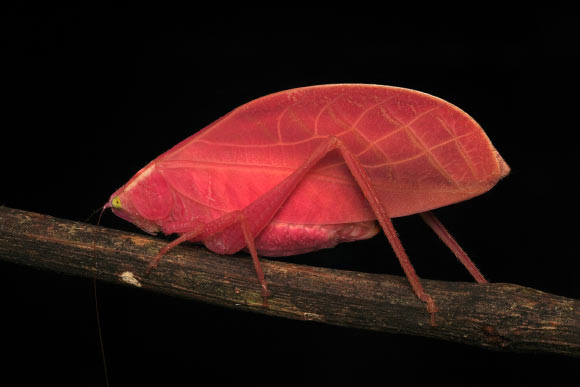
Intense bright pink form of an adult female Arota Festivals photographed on March 27, 2025 on Barro Colorado Island, Panama. Image credit: Zeke W. Rowe.
Also known as the bush cricket, Arota Festivals is a species of medium-sized katydid (body length – 2.7 cm; body mass – 1 g) native to Panama, Colombia and Suriname.
It is usually a non-sexually dimorphic light green color with broad, rounded forewings that generally resemble early growth vegetation.
On March 27, 2025, Benito Wainwright, an entomologist at the University of St Andrews, and his colleagues spotted an intense bright pink female of Arota Festivals at the Smithsonian Tropical Research Institute field station on Barro Colorado Island, Panama.
“Finding this individual was a real surprise,” Dr. Wainwright said.
“Because it was so rare, we kept it in natural conditions and found that it changed color from bright pink to green.”
“Rather than a genetic quirk, this may actually be a finely tuned survival strategy that follows the life cycle of the leaves of the rainforest that this insect is trying to resemble.”
The researchers raised the individual in captivity at natural ambient temperature and humidity for 30 days.
After four days in captivity, they noticed that the intensity of its pink hue had faded to a lighter pastel pink.
They then monitored this individual’s coloring more closely by taking photos every 24 hours with a camera.
After another seven days, on April 7, 2025, the insect had turned completely green and could not be distinguished from the more common green morph individuals.
Pink katydids have been documented in the scientific literature since 1878, but were generally considered a rare and disadvantageous mutation.
This appears to be the first recorded case of a katydid performing a complete color change during a single life stage.
“Rainforests are extraordinarily complex environments, and this discovery shows how well some animals have evolved to exploit them,” said Dr Matt Greenwell, a researcher at the University of Reading.
“You would think that a bright pink insect in a mostly green forest would stand out from predators like a worker wearing a high-visibility jacket.”
“The idea that an insect can gradually change color to follow the rhythm of the leaves it imitates shows how dynamic the rainforest can be and is a remarkable example of camouflage in action.”
The team’s results were published on March 7, 2026 in the journal Ecology.
_____
J. Benito Wainwright and others. 2026. Pink Cricket Club: dramatic color change in a katydid masking neotropical leaves (Arota FestivalsGriffini, 1896). Ecology 107 (3): e70333; doi: 10.1002/ecy.70333


