Trump administration to roll back fuel economy rules set under Biden


Natalie ShermanEconomic journalist

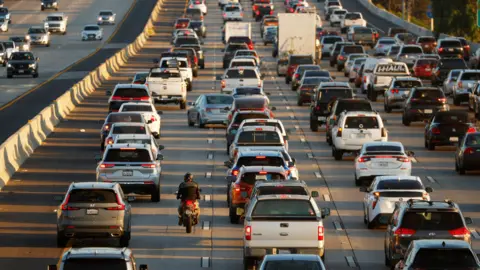 Getty Images
The United States is set to relax its fuel economy rules, reversing another Biden-era policy that was expected to lead to increased adoption of electric cars.
U.S. President Donald Trump announced the proposal at the White House, where officials said the previous standards were not realistically achievable and were driving up costs for buyers.
“They’ve done horrible things cost-wise — and in fact, they’ve made the cars much worse,” Trump said.
Ford Chief Executive Jim Farley, an auto industry leader on hand to celebrate the announcement, called the change a “victory for common sense,” while environmental groups criticized it as a step backwards for the industry and public health.
Transportation is the largest source of greenhouse gas emissions in the United States, accounting for more than 28% of the total in 2022, according to the Department of Energy.
The previous policy required automakers to achieve fleet-wide fuel efficiency of about 50 miles per gallon by the 2031 model year, compared to an industry average of about 27 miles per gallon today.
For passenger cars, this meant an increase in efficiency of around 2% per year.
Instead, the National Highway Traffic Safety Administration said it was proposing less stringent standards that would lead to fuel efficiency of about 34.5 miles per gallon by the 2031 model year.
He’s also moving to end a program that allowed automakers to pay more fuel-efficient rivals, like Tesla, for credits that would bring them into compliance — a policy the administration said had “artificially propped up the electric vehicle industry.”
Katherine Garcia, director of the Sierra Club Clean Transportation for All, said the changes would lead to more greenhouse gas emissions and higher fuel costs for families.
“This rollback would set the auto industry back, leaving polluting cars on our roads for years and threatening the health of millions of Americans, especially children and seniors,” she said in a statement.
But Ford’s Mr Farley said the new rules were “aligned with customer demand” and called the change “a good decision for many reasons”.
When it was announced last year, the Biden administration presented its plan as an effort to reduce dependence on foreign oil, help car owners save on fuel costs and combat pollution.
It is expected to avoid more than 700 million tonnes of carbon dioxide emissions by 2050.
Automakers were free to use whatever technology they wanted to meet the new standard.
However, in practice, achieving this goal would largely depend on increasing sales of electric cars.
That sparked reluctance from some automakers, which were already beginning to scale back some investments in electric cars in response to uncertain demand.
The Big Three U.S. automakers, Stellantis, General Motors and Ford, known for selling larger cars like trucks and SUVs, have the least fuel-efficient fleets in the industry, according to the Environmental Protection Agency.
If electric car sales didn’t increase enough, General Motors feared it would have to close factories making less efficient cars to comply with Biden-era rules, GM Chief Executive Mary Barra said Wednesday at a New York Times event.
The plan is still subject to a formal rule-making process.
Trump said his administration expects the change to save buyers about $1,000 on the price of a car. The Biden administration had estimated that its rules would save car owners about $600 in fuel costs over the life of their vehicle.
Kathy Harris, director of clean vehicles at the Natural Resources Defense Council, said the new plan would only benefit the oil industry.
“Cutting fuel economy under the guise of safety and affordability is a cruel joke on American drivers,” she said.


