Trump and Republicans head to 2026 with a redistricting edge : NPR

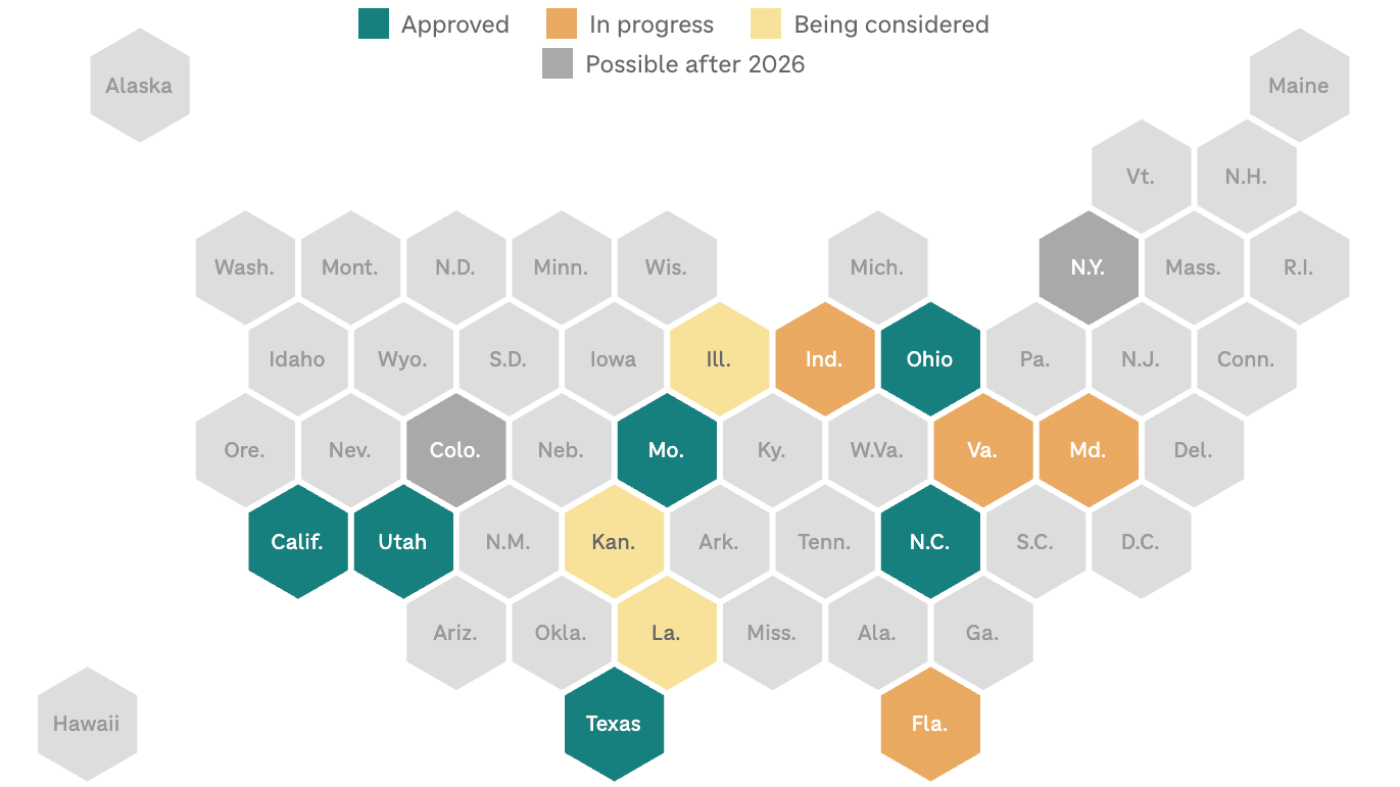
After the Supreme Court’s conservative majority ruled in favor of Texas lawmakers last week, Republicans enter the 2026 election year with an advantage in the redistricting fight launched by President Trump.
The court on Thursday authorized the advancement of the new Republican Congressional map – despite a lower court concluding that the Texas legislature had likely carried out a racial gerrymander.
The map could bring five additional seats to the GOP.
It’s the latest major twist in the race for national redistricting, from California to Florida, that Trump launched to help maintain Republican control of the House of Representatives.
If Democrats take control of the House, they could thwart the president’s legislative agenda and launch investigations into his administration.
The House is currently closely divided, with 220 seats held by the Republicans and 213 held by Democrats. The incumbent president’s party tends to lose seats in midterm elections.
At this point, it appears that the redistricting battle could tip about 12 or 14 seats in favor of the Republicans and that the Democrats could counter with about nine seats gained – but that all depends on the outcome of the ongoing legal challenges and state legislative votes. So there’s still a lot at stake.

Democratic state Rep. Matt Pierce spoke out against redistricting in the Indiana House last week.
Ben Thorp/WFYI
hide caption
toggle caption
Ben Thorp/WFYI
This week, Indiana lawmakers are meeting on redistricting. And in Missouri, petitioners face a deadline for collecting signatures, which could stall redistricting until a public vote is held.
It won’t be clear whether any of this will make a difference in the House until votes are counted in the Nov. 3, 2026, election.
Trump started the race in Texas, California countered
States typically redistrict at the beginning of the decade after the decennial census determines how many seats each state gets based on its population. While states frequently carried out redistricting 1800s and early 1900s, Trump’s efforts sparked a redistricting race not seen since the 1960s.
Last week’s decision in Texas follows drama that unfolded this summer after Trump called for the state to tilt five seats toward the Republican Party. Democrats I was gone for over two weeks delaying adoption of the maps, they argued, diluted the voting power of black and Latino communities.

California Democrats countered Texas by approving, through a special election, a map that could flip five Republican-held seats there.
Republicans in Missouri and North Carolina voted to pursue a Democratic-held seat in each of those states. Friday, the Indiana State House passed a new map it could help the GOP win two Hoosier seats. It will then be sent to the Senate, where Republicans are divided on the issue.
Some Indiana Republicans have been reluctant to follow Trump’s call, although he and Republican Gov. Mike Braun have threatened to back primary challenges against those who don’t rally. Several lawmakers have also faced anonymous threats against their families in recent weeks.
It is easier for Republicans to redistrict than for Democrats
Republicans have more redistricting options than Democrats. For starters, redistricting is done by state legislatures, and Republicans control more legislatures across the country than Democrats. Additionally, some of the Democratic-controlled states have legal barriers to partisan gerrymandering — that is, drawing lines to benefit one party — or have laws requiring special commissions to set boundaries.

Republican Gov. Mike Braun (with glasses, center left) and Lt. Gov. Micah Beckwith at the Indiana Capitol attend a pro-redistricting rally last week organized by Turning Point Action.
Zach Bundy/WFYI
hide caption
toggle caption
Zach Bundy/WFYI
that of Virginie The Democratic-led Parliament voted hold special elections that could amend the state constitution to allow redistricting. Another vote is needed in January so the elections can take place on time. If passed, redistricting could tip two or three seats in favor of Democrats.
The Democratic governor of Maryland formed a commission to make redistricting recommendations. But this state already has only one Republican seat to target.
Meanwhile, Florida Republican Gov. Ron DeSantis is urging Republicans who control the Legislature to redistrict this spring and give up to five seats to their party. A Florida House committee held its first meeting on redistricting last week.

But Florida has laws against partisan gerrymandering and could be limited by bans on racial gerrymandering in the federal Voting Rights Act. On the other hand, the Supreme Court currently considering VRA and could weaken it, allowing more redistricting that would likely work in favor of Republicans.
The VRA prohibits intentional attempts to weaken the voting power of minority communities by “dividing” them into new districts or “consolidating” them into a single district.


