California steps in as Trump skips global climate summit in Brazil

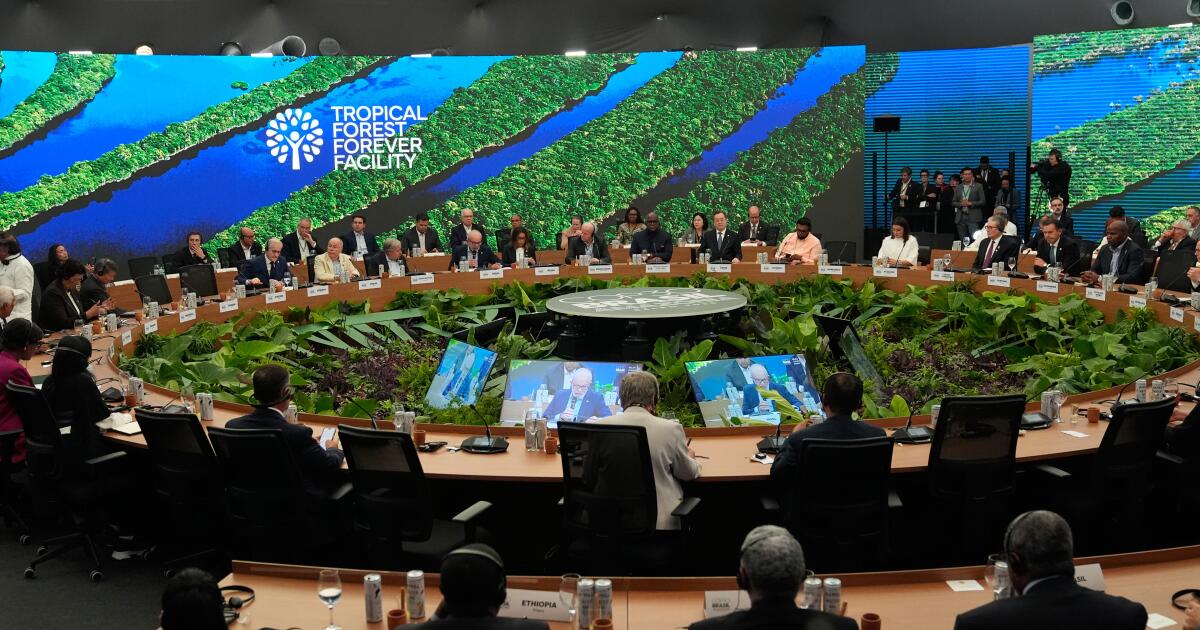
Nearly 200 countries are gathering this week in Belém, Brazil, to kick off the annual United Nations climate policy summit, with one glaring exception: The Trump administration is not sending any senior officials.
California hopes it can fill the void. The state, as it usually does, is sending a large delegation to the Conference of the Parties, including first-time attendee Gov. Gavin Newsom and top officials from the California Natural Resources Agency, the Department of Food and Agriculture, the Air Resources Council, the Public Utilities Commission and the Governor’s Office of Tribal Affairs.
The state aims to build on its reputation as a global climate leader, sharing its experience in clean energy technologies and job creation and showcasing its track record on climate deals with other countries and regions.
Newsom, who is positioning himself for a presidential run in 2028, told the Times that he “absolutely” views California as a proxy for the United States at this year’s conference, which is the main global venue for countries to strengthen their commitments to reducing greenhouse gases.
“California has a responsibility, but also a unique opportunity right now, to remind the world that we are here, that we think these issues are important, and that there is an opportunity here to strengthen existing alliances and develop new ones,” the governor said.
California’s strong presence at the COP also marks an escalation in the ongoing battle between Newsom and President Trump. The two men have clashed over immigration and climate, with the president’s energy and environmental agenda often targeting the state. The Trump administration this year defunded major clean energy projects such as California’s hydrogen hub and moved to revoke the state’s longstanding authority to set vehicle emissions standards tougher than those of the federal government.
But this year’s gathering, November 10-21, also comes at a critical time for the world. It is the 10th anniversary of the Paris Agreement, a founding treaty signed at the 2015 COP in which world leaders set a goal of limiting global warming to 3.6 degrees Fahrenheit (2 degrees Celsius) above pre-industrial levels, and preferably below 2.7 degrees F (1.5 degrees C), to prevent the worst effects of climate change.
Most experts and scientists agree that the 2.7 degree target is no longer within reach. The past ten years have been the warmest on Earth’s record, largely due to greenhouse gas emissions from the burning of fossil fuels.
“One thing is already clear: we will not be able to contain global warming below 1.5 degrees [C] in the coming years,” UN Secretary-General António Guterres said at a recent meeting of the World Meteorological Organization. “Overshoot is now inevitable.”
The UN’s annual emissions gap report, released at the conference, reveals that without immediate and aggressive action, the world is on track to warm between 4.14 and 5.04 degrees (2.3 and 2.8 degrees Celsius) this century.
Yet Trump withdrew the United States from the Paris Agreement on his first day back in office, a decision he also made during his first term as president. In a January executive order, he said the Paris Agreement and other international climate pacts place an unfair burden on the United States and divert U.S. dollars to other countries.
The United States’ withdrawal from the Paris Agreement is expected to add another 0.18 degrees to the latest warming projections, reversing a small gain made since last year, according to the UN report. It notes that every fraction of a degree of warming means more losses to people and ecosystems, higher adaptation costs, and greater reliance on uncertain techniques to remove carbon from the atmosphere.
However, the report highlights that the technology to significantly reduce emissions already exists, underscoring the meteoric development of wind and solar power, much of which is occurring overseas.
This is an area where California can lead, Newsom said, adding that the Trump administration has “doubled down on stupidity” by ceding so much ground to China. The Golden State has invested heavily in renewable energy, battery energy storage, and the electrification of buildings and vehicles. California has also set ambitious decarbonization goals and has reduced its greenhouse gas emissions by 21% since 2000, while its economy has grown 81%.
“We want to continue to tip the scales, and that’s about economic growth, jobs, and solving the other crisis of our time: affordability,” Newsom said. “When you talk about energy efficiency, you’re talking about affordability. When you talk about wind and solar, you’re talking about abundance and affordability.”
California has already helped spread many real technologies. The state’s aggressive emissions rules have played a crucial role in automakers’ push toward electric vehicles, with Toyota largely developing its Prius for the California market. The state was the first to mandate battery energy storage in its major utilities, helping to revive the modern grid battery market, while its cap and trade The carbon market program has been emulated around the world.
State leaders hope to highlight more than just their progress at home. In recent years, California has also entered into subnational agreements and partnerships with other regions and countries on issues such as providing clean transportation, reducing pollution, and developing hydrogen and renewable energy. Newsom is expected to sign additional agreements at COP this year, although his team has declined to provide insight into what they will entail.
Among the dozens of existing agreements there is a memorandum with the Mexican Energy Commission of Baja California focused on clean ports, zero-emission transportation and grid reliability; and memorandums with several Chinese provinces on pollution reduction and offshore wind energy. The California Department of Forestry and Fire Protection also has partnerships with several countries that share resources and best practices for managing vegetation and fighting wildfires.
Focusing on these actions at the national and regional levels has become a key part of COP conferences as the conversation becomes urgent and turns to deployment, according to Rachel Cleetus, senior policy director at the nonprofit Union of Concerned Scientists.
“The United States looks different: We have many subnational actors, including leading states and cities and forward-looking businesses, who will be at the COP to show the rest of the world that the United States understands that it is in both our country’s interest and the global interest to combat climate change,” Cleetus said.
California’s delegation to Brazil also includes Natural Resources Secretary Wade Crowfoot, who represented the state at the Local Leaders Forum in Rio de Janeiro this week.
“This year, our federal government is completely absent from the action … and the rest of the world needs to understand that America is still in this fight and we are moving forward,” Crowfoot said during a press briefing.
Crowfoot pointed to the carbon market partnership between California and Quebec and that with Denmark, which gave rise to groundwater monitoring technology that California uses today, among other examples of international efforts.
This year’s COP conference, taking place near the Amazon River Delta in northern Brazil, is heavily focused on forest restoration and nature-based solutions, which California is also focusing on through its 30×30 agenda to conserve 30% of the state’s lands and coastal waters by 2030, Crowfoot said. The Golden State already has deep ties to the region, stemming from its landmark 2019 Tropical Forest Standard program, which sets guidelines for carbon credits awarded to reduce deforestation.
Newsom said that at the COP he would highlight climate action as the defining economic opportunity of the 21st century. He is scheduled to speak at the Milken Institute’s Global Investor Symposium, a gathering of leading investors and business executives, about how California is showing that clean energy investments create jobs and profits. Green jobs now outnumber fossil fuel jobs in the state, 7 to 1.
“We’re not just talking about this from the perspective of trying to be good citizens,” Newsom said. “We are also trying to be competitive geopolitical players. We want to dominate the next big global industry.”
However, there is still much work to be done.
Every five years, parties to the Paris Agreement are required to submit targets for greenhouse gas emissions. So far, the targets have “barely made a difference,” according to the UN report, and those set this year are nowhere near aggressive enough.
“It’s devastating to see that we are now definitely going to exceed the 1.5°C mark,” said Cleetus, of the Union of Concerned Scientists.
“But world leaders still have the power to significantly reduce these emissions,” she said.