Trump lashes out at justices, announces new 10% global tariff

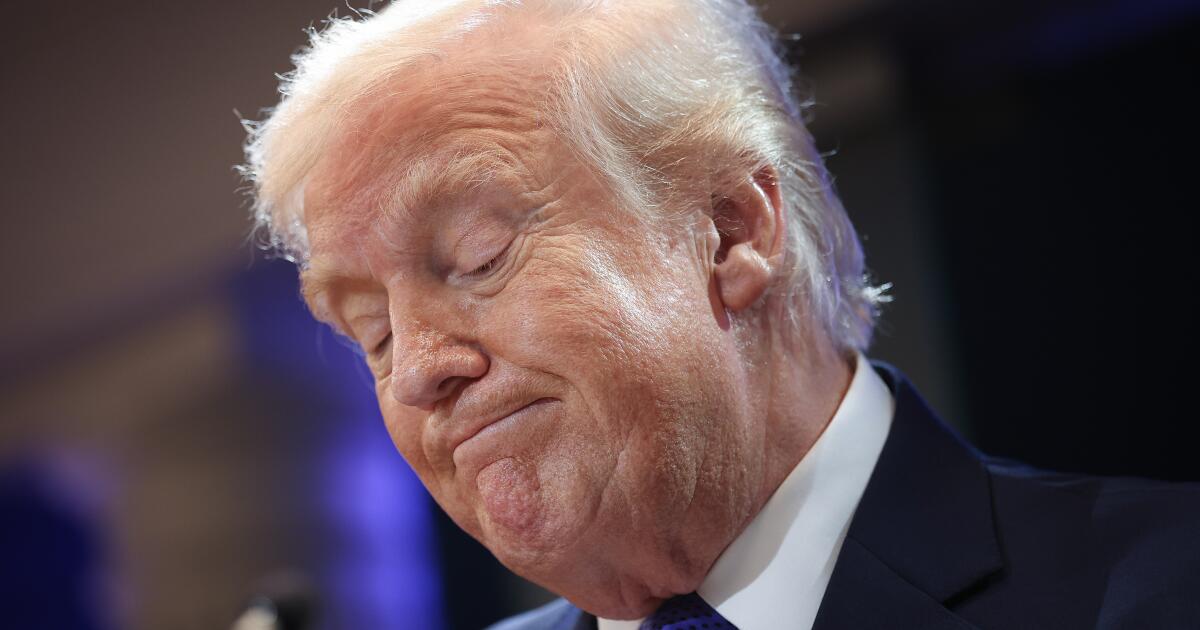
WASHINGTON- President Trump on Friday blasted the Supreme Court justices who struck down a key part of his tariff plan, calling them “fools” who made a “terrible, flawed decision” that he plans to circumvent by imposing new levies in a different way.
In a defiant appearance at the White House, Trump told reporters his administration would impose new tariffs using alternative legal means. He presented the decision as a technical, not permanent, setback for his trade policy, insisting that “the end result is going to make us more money.”
The president said he would sign an executive order Friday imposing a new 10 percent tariff under legal authority granted to him by a 1974 law. Under that law, the tariffs can last only 150 days. An extension would require congressional approval.
Asked by a reporter if he planned to impose 10% global tariffs for 150 days or indefinitely, Trump replied: “We have the right to do pretty much whatever we want to do.” »
This backlash underscores the extent to which central tariffs have impacted Trump’s economic and political identity. He presented the decision as yet another example of institutional resistance to his “America First” agenda and vowed to continue fighting to retain his trade authority despite the ruling by the nation’s highest court.
Trump said the decision was “deeply disappointing” and called the justices who voted against his policies — including Justices Neil M. Gorsuch and Amy Coney Barrett, whom he appointed to the court — “fools,” “pet dogs” and a “disgrace to our nation.”
“I’m ashamed of some of the members of the Court,” Trump told reporters. “Absolutely shameful that we don’t have the courage to do what’s right for our country.”
In an article for Truth Social, the president wrote that he believed the court’s opinion had been “influenced by foreign interests and political movement,” although he provided no evidence to support these claims.
“This was an important matter to me, more as a symbol of economic and national security than anything else,” Trump lamented in his message.
For years, Trump insisted that his tariff policies made the United States richer and gave his administration leverage to impose better trade deals, even as the The economic burden often falls on American businesses and consumers. During the election campaign, he turned to them repeatedly, launching massive levies as the economic engine of his administration’s second-term agenda.
Now, in the heat of an election year, the court’s decision blurs that message.
The decision by the nation’s highest court is a rude awakening for Trump at a time when his trade policies have already caused fractures among some Republicans and when public polls show a majority of Americans are increasingly concerned about the state of the economy.
But some of his top advisers say his trade agenda, as promised, will continue in a different iteration.
“Despite the misplaced jubilation of Democrats, the ill-informed media, and the very people who gutted our industrial base, the court did not rule against President Trump’s tariffs,” Treasury Secretary Scott Bessent said in a speech in Texas shortly after the ruling was released.
Bessent said the court simply ruled that it could not impose taxes on imports under the International Emergency Economic Powers Act, or IEEPA.
Before the November election, Republicans urged Trump to stay focused on an economic message to help them keep control of Congress. The president attempted to do so on Thursday, telling a crowd in northwest Georgia that “without tariffs, this country would be in big trouble.”
As Trump attacked the court, Democrats across the country celebrated the ruling — with some saying there should be a mechanism in place to allow Americans to recoup money lost because of the president’s trade policies.
“No Supreme Court ruling can undo the massive damage caused by Trump’s chaotic tariffs,” Sen. Elizabeth Warren (D-Mass.) wrote in an article on X. “The American people paid for these tariffs, and the American people should get their money back.”
California Gov. Gavin Newsom called the tariffs an illegal tax on consumers, ranchers, farmers and businesses, and said Trump was obligated to repay the $1,750 per family to offset cost increases brought on by the tariffs.
“The rule of law has prevailed,” Newsom said. “And what did Donald Trump do? He had a tantrum today and decided to tax you again, across the board, at 10%, under new authority. He is unbalanced.”
California Atty. Gen. Rob Bonta said the decision ends “months of chaos” that have hurt California farmers, manufacturers and other businesses.
While the Supreme Court’s decision Friday centered on a lawsuit brought by a private party, Bonta and Newsom filed a separate lawsuit last year challenging the tariffs.
California’s large economy meant the state bore the brunt of illegal tariffs, Bonta said, adding that the state faced projected losses of more than $25 billion.
The president’s flagship economic policy has long stagnated in the polls, by far. Six in 10 Americans surveyed this month in a Pew Research poll said they did not support tariff increases. Among this group, about 40% strongly disapproved. Only 37% of respondents said they supported the measures, with 13% expressing strong approval.
A majority of voters have opposed the policy since April, when Trump unveiled his sweeping trade agenda, according to Pew.
The court’s decision appears to be more than a political setback to Trump’s economic agenda.
It is also a rebuke of the style of government adopted by the president, who has often treated Congress less as a partner than as a body that can be circumvented by the executive branch.
Trump has long tested the limits of his executive power, particularly on foreign policy, where he has relied heavily on his emergency and national security powers to impose tariffs and acts of war without congressional approval. In the court’s decision, even some of its allies drew a clear line with this approach.
Gorsuch sided with the Court’s liberals in striking down the tariff policy. He wrote that while “it may be tempting to bypass Congress when pressing issues arise,” the legislative branch should be considered in major policies, especially those involving taxes and tariffs.
Despite the court’s ruling, Trump remained adamant that his trade policies would remain in effect. But now he’s turning to plan B.
This strategy would allow the White House to impose tariffs of up to 15% for 150 days on countries with a trade deficit with the United States, according to legal analysts. He also invoked a section of the Trade Act of 1930, which could authorize additional levies of up to 50% without time limit on countries that Trump says have discriminated against U.S. trade.
“This means that Trump’s tariffs will continue to weigh on the U.S. economy, even if alternative instruments are not as nimble or as broad as the IEEPA tariffs,” Kimberly Clausing, an economist at UCLA, said in a statement.
The president said the court’s decision would strengthen his trade policy.
“Now the court has given me the undisputed right to ban all kinds of things from coming into our country, to destroy foreign countries,” Trump said, lamenting that the court was limiting his ability to “collect fees.”
“How crazy is this?” » Trump said.
Times staff writers Dakota Smith and Phil Willon contributed to this report.


