When Fake Nuclear Disaster Fallout Reached Los Angeles



Explore
TToday, in 1965, a nuclear rocket engine exploded in the Nevada desert. Scientists deliberately set off the explosion, sparking a political controversy that persisted for decades.
The experiment coincided with the rise of the atomic bomb and the rise of the space age, as the United States and the Soviet Union competed to achieve cosmic supremacy. Four years earlier, the United States had launched its first spacecraft powered by nuclear power – the heat of a nuclear reaction sending a rocket hurtling into space. But the precise risks of a launch going wrong remain unclear.
“One of the enduring nightmares of the atomic age is the possibility that someday a nuclear reactor will spin out of control and explode on its own, like an overheated boiler of the steam age with its safety valve closed,” according to one report. Time article published January 22, 1965. “Reactor builders and developers insist this is highly unlikely, but the Atomic Energy Commission wants more facts, just in case.” »
ADVERTISEMENT
Nautilus members enjoy an ad-free experience. Log in or register now.
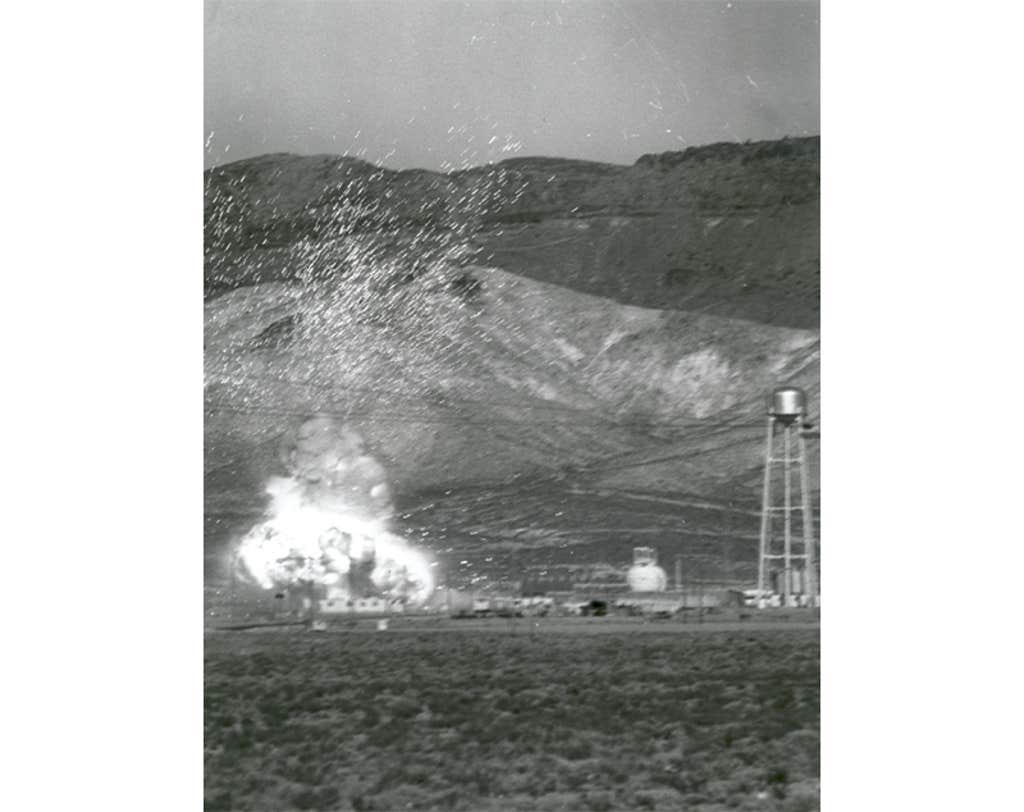
The U.S. Atomic Energy Commission oversaw the development of peacetime nuclear science and technology from 1946 to 1975. To provide clarity on potential rocket accidents, the commission vaporized part of a prototype Kiwi nuclear reactor core on January 12, 1965, at Jackass Flats, Nevada, by abruptly increasing the generator’s power. They aimed to observe the impacts on the reactor and the surrounding environment. Scientists placed the Kiwi on a railway carriage and placed test objects around him, including nuclear fuels and explosives.
The reactor reached temperatures above 8,000 degrees Fahrenheit – almost as hot as the surface of the sun – and hundreds of pounds of uranium fuel turned to steam.
ADVERTISEMENT
Nautilus members enjoy an ad-free experience. Log in or register now.
Then, “a cloud of gray smoke rose with a ball of fire at its heart; from there burst flashes of light like giant 4th of July sparklers.” Time reported. “Observers heard a loud detonation and felt a slight shock wave.”
Read more: »What nuclear war means for the ocean»
As the cloud dissipated, Air Force bombers arrived to collect air samples. Researchers hoped that the radioactive fallout would move away from populated areas of Nevada. But the explosion instead threw a radioactive cloud more than 200 miles southwest to Los Angeles.
ADVERTISEMENT
Nautilus members enjoy an ad-free experience. Log in or register now.
Technically, the test went off without a hitch: It matched the predictions of researchers at the Los Alamos Science Laboratory, and the results suggested that nuclear-powered rockets could be vaporized into small pieces in space at the end of their missions.
To assess impacts on surrounding populations, the U.S. Public Health Service monitored the nearby neighborhood and collected milk samples from parts of southern Nevada and California, covering more than 200 miles downwind of the testing site. The government also tracked the fallout from the cloud as it traveled across the sky. Ultimately, the tests found that “estimated radiation doses to humans beyond the test site were well below current limits set by the Environmental Protection Agency,” according to the Associated Press. reported.
There was, however, some political fallout. An Associated Press article publicizing the test prompted the Soviet Union government to question whether the United States was violating a treaty banning nuclear weapons testing, but the State Department informed the USSR that “the reactors are designed as stable energy sources and are inherently unsuitable for use as weapons.”
ADVERTISEMENT
Nautilus members enjoy an ad-free experience. Log in or register now.
In 1994, Massachusetts Representative Edward J. Markey released documents about the test, as part of a broader investigation into secret radiation experiments during the Cold War. “Elements of the nuclear-powered rocket program should be considered human experiments,” Markey wrote. He also insisted that these tests include “a public debate on radiation protection measures and planned doses for workers and the public,” according to the Associated Press.
In a 1986 report, Markey shared details of 31 nuclear experiments spanning from the 1940s to the 1970s, during which “approximately 695 people were exposed to radiation that provided little or no medical benefit to the subjects.” He called these participants “America’s nuclear guinea pigs” and demanded that those involved be compensated for damages – they later received a total of nearly $5 million from the government.
While the world avoided mass destruction during the Cold War, the Kiwi explosion and other tests Markey studied illustrate how close that impasse still hits.
ADVERTISEMENT
Nautilus members enjoy an ad-free experience. Log in or register now.
Enjoy Nautilus? Subscribe for free to our newsletter.
Main image: AEC-NASA / Wikimedia Commons.


