Teachers Value What They See and Hear Over Tests When Judging Student Success

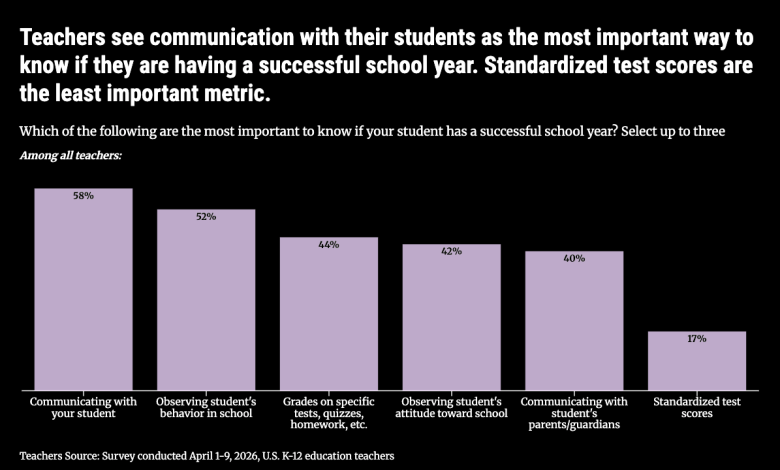
Teachers are much more likely to rely on their own communications and observations with their students than on quizzes or test scores to determine whether they have had a successful school year, with standardized tests coming in a distant second.
A new survey provided exclusively to The 74 by EdChoice, a school choice advocacy group, shows that 58 percent of teachers ranked communicating with students and 52 percent cited observing their behavior as the most important way to evaluate their performance in school. In contrast, 44% cited grades on tests, quizzes and homework and only 17% said they turned to standardized tests.
Get stories like this delivered straight to your inbox. Subscribe to the 74 newsletter
Teachers also believe that student thoughts and completed projects are the strongest evidence of well-developed life skills, such as teamwork and adaptability, while parents are more divided: They are twice as likely (24%) to value standardized test scores as a measure of success in this area.
“As a researcher, I believe … that standardized testing and maximizing grades are becoming less important now than soft skills, sustainable skills (and) social-emotional learning,” said Colyn Ritter, research analyst at EdChoice.
The organization’s annual survey released during Teacher Appreciation Week also found that while about half of teachers believe K-12 education is going well in their local school district, only a quarter feel optimistic about it nationally.

EdChoice partnered with Morning Consult to conduct an online survey of just over 1,000 K-12 teachers in April. The majority of respondents (about 80%) were traditional public school teachers, 13% worked in private or parochial schools, and 6% taught in charter schools.
When it comes to their view of the profession as a whole, more than two-thirds of teachers surveyed said they feel hope and a sense of purpose when thinking about the future. More than a quarter feel overwhelmed and only 22% would recommend teaching as a career to a friend or family member.
Exclusive: Survey reveals why 70% of early career teachers leave the classroom
This number varies widely depending on the type of school in which teachers work, with those in private schools twice as likely (35%) as those in public schools (18%) to recommend the profession.

“Overall, the conversation about K-12 education may be a little dark and teachers may feel the weight of that, but within their own classroom, they feel more positive,” Ritter said, adding that it makes sense to him that teachers may feel both a sense of purpose and fear.
“No one would be surprised to hear that a teacher is stressed or feeling overwhelmed, especially in today’s K-12 educational environment, where I think they’re just being asked to do too much,” he said, noting the increasing responsibilities teachers face, including student mental health, safety within their school buildings and the evolving role of technology and artificial intelligence.
In fact, about a third of teachers report that frequent behavioral and technological problems interrupt their lessons. While teachers are generally satisfied with their students’ use of technology in schools, those in public schools are much more likely to report that their children spend too much time on devices (48%) than those in private schools (27%).
Parents and schools clash over movement to abolish screens
Feelings toward technology vary widely by type: While nearly 90 percent of teachers support the use of online learning platforms, like Google Classroom, three-quarters oppose cell phones, and just over half oppose AI tools like ChatGPT.
Teachers are more pessimistic than the general population and parents about the effects of AI on the future, with just over half saying they are concerned. Nearly two-thirds are opposed to letting their students use AI to help with schoolwork and more than 40% are extremely or very concerned about the effects of technology on learning this school year.
Only 38% of teachers support its use in the classroom, a drop of eight points from last fall. That being said, the vast majority (72%) believe it is important to help students learn the critical thinking skills needed to use them appropriately.
Generation Z is increasingly skeptical – and angry – of artificial intelligence
When it comes to school choice, the survey finds that teachers strongly support education savings accounts, or ESAs, which set aside public money that parents can spend on a range of educational expenses, including private school tuition, after-school tutoring and specialized educational therapies.
Sixty percent of teachers strongly or somewhat supported these accounts, and that number rose to 75% when they were given EdChoice’s very detailed definition of what constitutes an education savings account rather than generally asking teachers what they thought of K-12 ESAs without any explanation. About 80% of private school teachers and those with less teaching experience expressed support.

Overall, teachers are more likely to believe that ESAs should be available to all families, regardless of financial need – 22 points higher than the proportion agreeing with means-tested eligibility.
Support for school vouchers, which allow parents to use taxpayer dollars specifically to fund tuition at nonpublic, in some cases also religious, schools, is declining significantly. About 45 percent of teachers expressed general support for vouchers, a figure that increased slightly to just over half when they were provided with EdChoice’s lengthy definition.
Teacher union lawsuits in 5 states challenge private school vouchers
The EdChoice survey found greater support for school choice among teachers than a recent PDK poll found among the general public (59%), including support expressed by Republicans (71%), although they found increasing favor for using public funds to give children access to private school.
The number of students using ESAs has skyrocketed over the past four years, from about 29,000 in 2021 to nearly 500,000 this year, according to EdChoice. They have grown steadily since 2011, when Arizona created the first such program in the nation, to now reach 21 programs in 18 states.
EdChoice lists 15 states and Washington, D.C., as having voucher programs, which are generally considered more controversial than ESAs or tax credit scholarships and whose constitutionality teachers unions are challenging in courts across the country.


