New Species of Extinct Octodontoid Rodent Discovered from Amazonian Fossil


Paleontologists have identified a new kind of rodent in AcarechimysA genre off with a widespread South American distribution, a partial jaw and discovered teeth in Brazil.
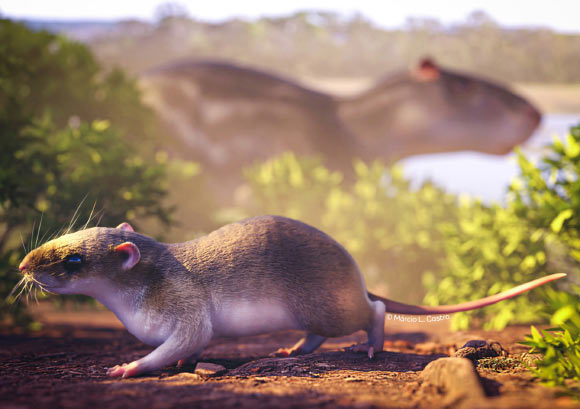
Hypothetical reconstruction of Acarechims Hunikuini. Image credit: Márcio Castro.
Acarechims Hunikuini Lived in what is now Brazilian Amazon about 10 million years ago (end of Miocene).
The ancient species belongs to Octodontoidea, a family of neotropical hysystricognotes rodents in the Caviomorpha Parcorder.
“The hysystricogous rodents of neotropics, that is to say Caviomorpha, are a group of mammals fascinating because of their astonishing taxonomic and ecological diversity, which reflects a complex evolving history,” said Dr. Emmanuelle Fontoura, a paleontologist with the Federal Maria and the Cappa-Centro of the Universida Colônia and colleagues.
“These rodents suddenly appear in the South American fossil record at the end of the eocene era, at least from what we know of the available record, especially that of the Peruvian Amazon.”
“At the start of the oligocene, they had already diversified themselves, with the first representatives of the crown groups.”
“Present caviomorphs included 266 Species, Structured Into Two Major Clades and Four Superfamilies: I) Erethicaviovioi Grouping Cavioidea (EG, Guinea Pig and Related Forms) and erethizontoidea (New World Porcupines), and II) octochinchilloi with chinchilloidea (chinchilla and Pacaranas) and Octodontoidea (EG, Spiny Rats and Related Forms).
“The Octodontoidea Superfamille includes existing families Abrocomidae, Echimyidae, Octodontidae and Ctenomyidae, plus the extinguished lines.”
“It is the richest and most diverse clade among the caviomorpha, both taxonomically and phenotypically in time.”
Dental remains of Acarechims Hunikuini were collected during the field trips in 2019 and 2022 in the pre-06 outcrop of the formation of Solimões near the city of Feijó in the Brazilian state of the acre.
“The formation of Solimões has given a great diversity of vertebrate fossils since the middle of the 19th century,” said paleontologists.
“The fossil localities of this training were recently dated, revealing a maximum of deposit ages within the Tortonian, that is to say of the superior Miocene.”
“Mammals are among the most diversified fossils found there, notably bats, cetaceans, litoprians, marsupials, notoungula, primates, rodents, sirenians and xenarthrans.”
“In addition, the fossil remains of birds, crocodilians, chélonians, fish, amphibians, invertebrates, ichnofossils and plants have also been documented.”
The discovery of Acarechims Hunikuini shows that several superfamilles of caviomorphic rodents coexisted in this region, in addition to many other groups of animals, highlighting the existence of a rich fauna in Brazilian Amazon.
“”Acarechimys Perhaps emerged at the end of the oligocene and diversified in the Patagonia region at the start of Miocene, “said the researchers.
“In the middle of Miocene, he spread to extra-Pathian regions, towards northern South America.”
“At the end of the Miocene, the line only remained in the extra-gone regions.”
“This new recording, which is the last appearance of the genre, supports the hypothesis of the late survival of rodent lines in the tropics, a model that has been documented in octodontoids, hydrochorines and neoepids.”
“Rapid diversification and the influence of AcarechimysAs well as the scarcity of data, the divergence of opinions between studies dedicated to this group, and the numerous isolated teeth reported for the Amazon region, make the search for this kind difficult. »»
“Additional research is necessary to improve our understanding of the diversification and the temporal variation of this large line of octodontoidea.”
The team’s article was published in the Journal of Vertebrate Paleontology.
_____
Emmanuelle Fontoura and al. 2024. A new octodontoid of the late Miocene rod (Rodentia: Caviomorpha: Octochinchilloi) of the formation of Solimões (Brazil): paleobiogeographic implications. Journal of Vertebrate Paleontology 44 (1): E2382822; DOI: 10.1080/02724634.2024.2382822


