Trump wants Venezuela’s oil. Will his plan work?


Archie Mitchell,Economic journalistAnd
Natalie Sherman,Economic journalist

 Reuters
Donald Trump pledged to exploit Venezuela’s oil reserves after seizing power from President Nicolas Maduro and saying the United States would “lead” the country through a “safe” transition.
The American president wants American oil companies to invest billions of dollars in this South American country, which has the largest crude oil reserves on the planet, in order to mobilize this largely unexploited resource.
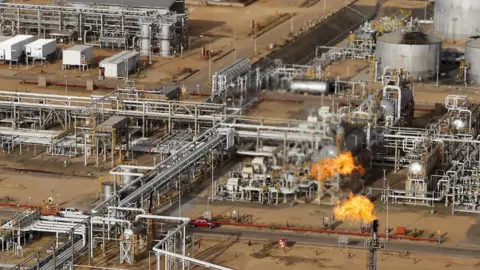
He said U.S. companies would repair Venezuela’s “badly damaged” oil infrastructure and “start making money for the country.”
But experts have warned of enormous challenges to Trump’s plan, saying it would cost billions and take up to a decade to produce a significant increase in oil production.
So, can the United States really take control of Venezuela’s oil reserves? And will Trump’s plan work?
How much oil does Venezuela have?
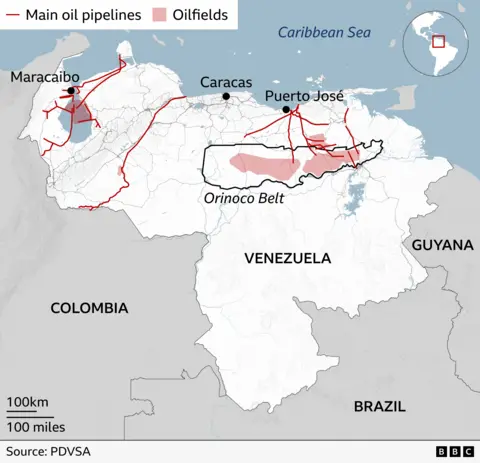
It is true that with approximately 303 billion barrels, Venezuela is home to the largest proven oil reserves in the world.
But the amount of oil the country produces today is tiny in comparison.
Production has fallen sharply since the early 2000s, when former President Hugo Chavez and then the Maduro administration tightened control over state oil company PDVSA, leading to an exodus of more experienced staff.
Although some Western oil companies, including US-based Chevron, are still active in the country, their activities have declined significantly as the United States has expanded sanctions and targeted oil exports, aiming to restrict Maduro’s access to a key economic lifeline.
The sanctions – which the United States first implemented in 2015 during President Barack Obama’s administration for alleged human rights abuses – have also left the country largely deprived of the investments and parts it needs.
“The real challenge they face is their infrastructure,” says Callum Macpherson, head of commodities at Investec.
In November, Venezuela produced about 860,000 barrels per day, according to the latest oil market report from the International Energy Agency.
This is barely a third of what it was a decade ago and represents less than 1% of global oil consumption.
The country’s oil reserves consist of so-called “heavy and sour” oil. It is more difficult to refine, but useful for making diesel and asphalt. The United States generally produces “light and sweet” oil used to make gasoline.
Before the strikes and Maduro’s capture, the United States also seized two oil tankers off the coast of Venezuela and ordered a blockade of sanctioned tankers entering and leaving the country.
What are the challenges for oil companies?
Homayoun Falakshahi, senior commodities analyst at data platform Kpler, said the main obstacles facing oil companies wanting to exploit Venezuela’s reserves are legal and political.
Speaking to the BBC, he said those hoping to drill in Venezuela would need a deal with the government, which won’t be possible until Maduro’s successor is in place.
Companies would then find themselves betting billions in investments on the stability of the future Venezuelan government, Falakshahi added.
“Even if the political situation is stable, it is a process that takes months,” he said. Companies hoping to take advantage of Trump’s plan should sign contracts with the new government once it is in place, before beginning the process of increasing infrastructure investment in Venezuela.
Analysts have also warned that it would take tens of billions of dollars – and potentially a decade – to restore Venezuela’s former production.
Could the plan lower global oil prices?
Neil Shearing, chief economist at Capital Economics, said Trump’s plans would have a limited impact on global supply, and therefore the price, of oil.
He told the BBC there were “an enormous number of hurdles to overcome and the timetable for what’s going to happen is so long” that oil prices in 2026 would likely see little change.
Mr Shearing said companies would not invest until a stable government was in place in Venezuela, and projects would not show results for “many, many years”.
“The problem has always been decades of underinvestment, mismanagement and extraction is very expensive,” he said.
He added that even if the country managed to return to previous production levels of around 3 million barrels per day, it would remain outside the world’s top 10 producers.
And Mr Shearing highlighted high production among OPEC+ countries, saying the world is currently “not suffering from an oil shortage”.
What did the oil companies say?
Chevron is the only US oil producer still active in Venezuela, having been granted an operating license under former President Joe Biden in 2022, despite US sanctions.
The company, currently responsible for about a fifth of Venezuela’s oil extraction, said it was focused on the safety of its employees and was complying “with all relevant laws and regulations.”
Other major oil companies have so far remained publicly silent on these plans, with only Chevron addressing the situation.
But Mr Falakshahi said oil bosses would be in internal talks over whether to take advantage of the opportunity.
He added: “The desire to go somewhere is linked to two main factors, the political situation and the resources on the ground.”
Despite the extremely uncertain political situation, Falakshahi said “the potential price could be deemed too great to avoid.”


