In Chicago, a Coalition of Unions, Community Organizers, and Drivers Have Forced Uber to Come to the Table


While the technology industry is increasingly aligning in the far right, the question of workers’ power has never been so important. The Chicago campaign offers some key lessons.
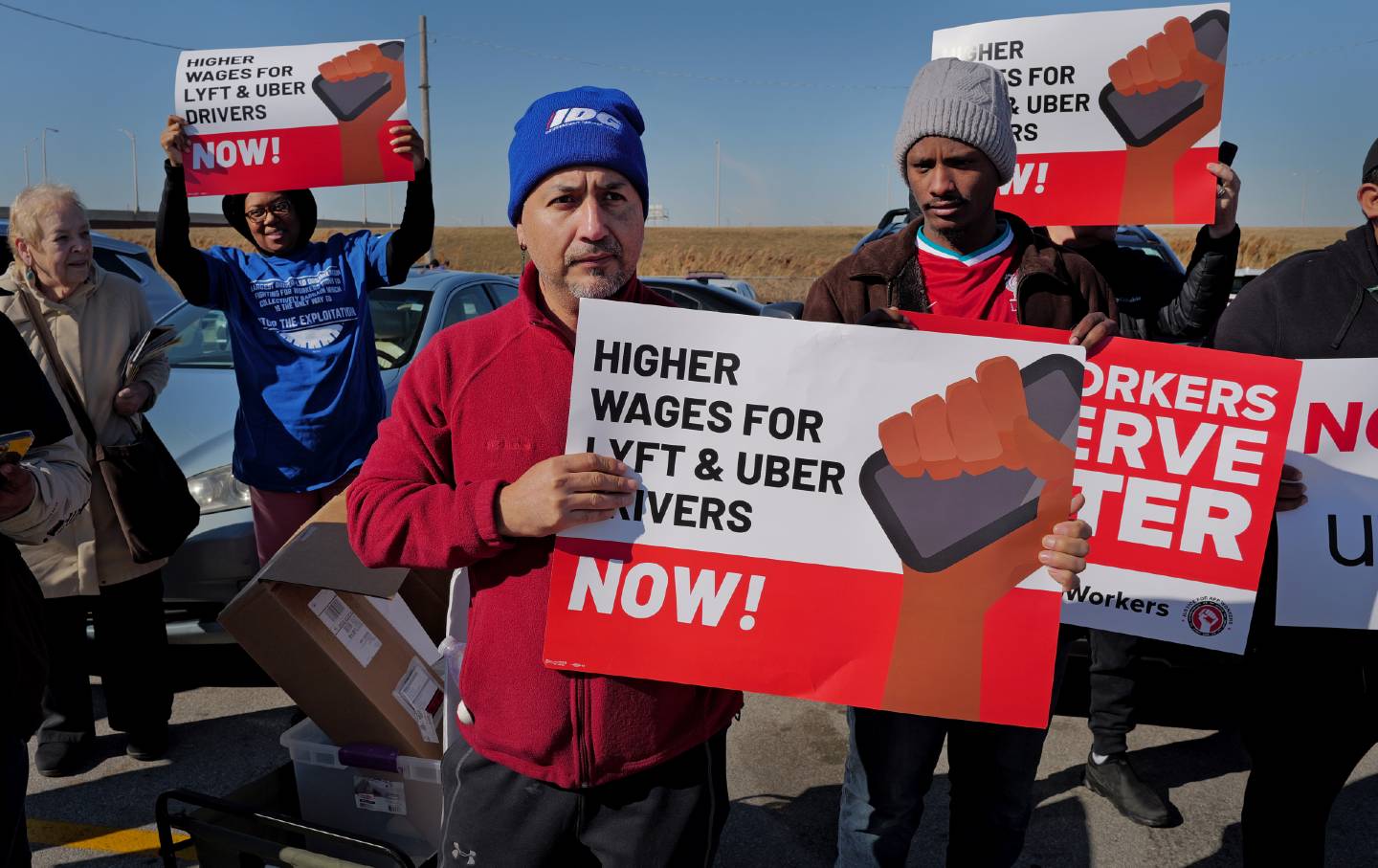
Chicago—M month, a coalition of carpooling engines, local organizations and unions announced an agreement with Uber declaring that the company would support the legislation of the State of Illinois allowing drivers to unionize, then to negotiate the conditions of remuneration and work in the carpooling industry. This agreement is the result of the organization of the drivers of Chicago for more than six years – a story that shows both the potential and the challenges of workers’ organization in the technology industry, because this industry takes a lively turn to the far right.
When Uber and Lyft were founded, drivers and passengers were excited by technology and its promise of low prices for passengers and decent wages and flexible working hours for drivers. For a certain time, these advantages overshadowed a commercial model of the industry which relied on a workforce of independent workers without protection of workers and a corporate culture which prioritized growth at all costs. Over the past decade, it has become clear that this early honeymoon period was only temporary and had been subsidized by venture capital to undermine competition and wedge the market. From 2017, the two companies gradually reduced the salary for drivers, who went from more than one dollar a mile in 2015 to $ 0.64 per mile in 2022, even when the cost of the possession of vehicles and maintenance is skyrocketing and the cost, companies have billed at passengers from 83 percent since the start of 2018 to the company, although Disch Reputation as a reputation as a Friendlier, more from Société Socialy, more having had a reputation as a friendlier, more social society, Disicor of vast similarities under the conditions of remuneration and work between the two societies. Today, none of the companies provides any type of remuneration rate in standard time or remote to Chicago drivers, and the cost of each journey as well as the quantity of total tariff that the driver receives is determined unpredictably by a mysterious algorithm. What has become clear is that these application companies are based on the exploitation of workers and the payment of workers below the minimum wage in order to be profitable.
Chicago drivers began to organize in 2017, directly after Uber’s announcement that workers would no longer receive the major part of their “overvoltage” salary (overload passengers pay when the platforms are occupied). Even then, the writing was on the wall, as Uber explicitly described itself as a “technology” company rather than a transport company – and the two companies have continuously tried to depart from the workforce on which they reluctantly rely until they hope to replace drivers with autonomous vehicles. The organization of drivers began through an informal self-organized group, then, from 2019, became a project of the people’s lobby called Chicago Gig Alliance. The drivers put pressure on the Town Hall and organized gatherings, demonstrations, acts of civil disobedience and watches for workers killed at work. We have shared heartbreaking stories to assault work, arbitrary layoffs by algorithm and payroll rates that have left poverty and even sometimes homeless engines.
In 2022, Chicago Gig Alliance worked with allies of the Chicago Municipal Council to write and introduce an order to increase wages and improve working conditions. The drivers organized meetings with the members of their council to ask them to support this order and organized rally and direct actions to draw attention to the considerable worsening of remuneration and conditions in industry – a campaign that has earned dozens of media tubes that have reached millions of chicagoans.
The people’s lobby included the support of this order as a condition of the organization’s approval process in 2023, which led the candidate at the time, Brandon Johnson, and a dozen members of the municipal council to undertake to support the Ridshare living wages before winning their elections. In response to the organization of current drivers as well as to the progressive momentum from the 2023 elections, the Mike Rodriguez alderman reintroduced the prescription at the first meeting of the new council in May 2023. During the following 18 months, the drivers and the Rodriguez failure built the list of copariners up to 29 allas.
Throughout this process, Chicago drivers were in constant communication with drivers from other cities fighting similar campaigns. PowerWitch Action and Action Center on Race and the Economy brought together driver organizations from a certain number of states to learn success and failure and provide research and legal support. Drivers of places such as California, Colorado and Seattle soon went to Chicago to participate in gatherings for our living salary prescription, and the drivers of Chicago walked on the headquarters of Uber in San Francisco to meet demands for fair salary and safe jobs.
Current number
While drivers initially focused on the need for an order of the city to regulate wages, we have also admitted that the organization of a union could allow workers to negotiate directly with companies while drawing workers’ power to put pressure for regulations such as the salary order for which we are fighting. To this end, we have worked to establish relations with unions that may be interested in supporting the order – and potentially organize a longer -term driver’s union. At the beginning of 2025, the Chicago Gig Alliance met with the local section 1 of the International Employee Service (SEIU) and the International Association of Machinists and Aerospace Workers (IAM) to push the prescription on the finish line, then work together to organize a union on the level of the state of carpooling pilots.
In March 2025, a competing union joined the scrum on the other side when the International Union of Operating Engineers cut 150 (which had given $ 1 million to the opponent of Brandon Johnson in the runoff of the town hall in 2023, Paul Vallas, and opposed affordable housing and environmental measures over the years) announced a “peace work” denigrate the order of the organization of the terms. IUOE is one of the greatest contributors to the City Municipal Council campaigns and had sufficiently close relations with a handful of key members of the Council who had spread the order that they were able to convince them to overthrow the course. Meanwhile, companies have threatened to dismiss 10,000 drivers and increase prices by 50% if the order is adopted.
While we are heading for a summer deadline for the displacement of the legislation before the Council focuses on a growing budgetary crisis in the fall, the drivers and alderman Rodriguez worked furiously to consolidate the votes we needed. After dozens of drivers, religious leaders and other allies wrapped a four -hour hearing of the municipal council committee – and some key members of the Council who had previously committed to supporting the order continued to vacillate – it has become clear that there were real questions about our bill on the finish line. At the same time, the growing campaign of Chicago Gig Alliance, of the Seiu and IAM represented a threat sufficiently credible for Uber to fear that we are able to pass the order, or at least so that we can continue to damage their interests in our city and our state. In response, the company came to the negotiating table and accepted an agreement which provides for a path for negotiation rights at the level of the State for the more than 100,000 carpooling engines through our state, but which also required the abolition of the city’s order.
It was a soft -maker moment for the pilots – who had been organized for years while working for less minimum wages and who needed an urgent increase. Given that independent entrepreneurs are legally prohibited from engaging in traditional collective negotiations, state legislation is necessary to allow unionization and negotiation by carpooling engines under the conditions of remuneration and work. This process could take one to two years to obtain workers the increases that have been expected for a long time. At the same time, this process offers the potential of the power of workers on a larger scale and the transformation of the industry.
The issue of workers’ energy in the technology industry is particularly important because the technology industry is increasingly complying with the far right. Carpooling engines are on the front line of the holding of the technological industry responsible for priority to the needs of workers, community and democracy rather than maximizing profits and fueling the boom in white nationalist authoritarianism. Although this stage of the Illinois carpooling campaign is bitterness, it is a reminder that the organization of workers has the potential to transform the industries which are increasingly important for the current moment of our economy and our policy.


