Newly discovered asteroid to pass closer to Earth than the moon on Monday

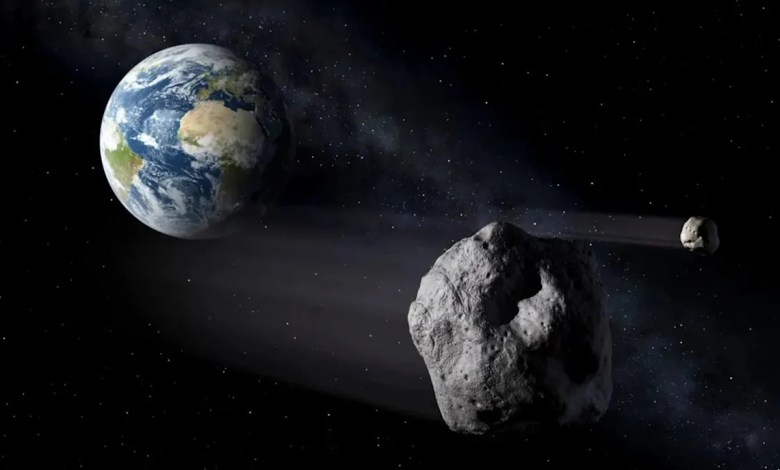
A newly discovered asteroid, estimated to be about 62 feet wide, will approach Earth on Monday, but it is not expected to pose a threat to the planet.
The asteroid, officially known as 2026 JH2, will be about 57,000 miles from Earth, according to the European Space Agency, a much closer distance than the Moon. The Moon is on average 238,855 miles from Earth.
The asteroid was discovered May 10 by astronomers with the Mount Lemmon Survey, an astronomical project based in Arizona’s Santa Catalina Mountains.
It’s rare for an object of this size to fly so close to Earth, but it’s not unprecedented.
The space rock will reach its closest approach around 6 p.m. ET, according to NASA’s Jet Propulsion Laboratory, which maintains a database of the physical characteristics and orbits of the best-known natural objects in the solar system. In doing so, the asteroid should reach its maximum brightness and could be visible to amateur astronomers equipped with small telescopes.
NASA did not immediately respond to a request for comment.

A map showing the path of asteroid 2026 JH2 through space. (Near-Earth Object Coordination Center / ESA)
(Near-Earth Object Coordination Center)
The Virtual Telescope Project, a website run by the Italian Bellatrix Astronomical Observatory that broadcasts views from several telescopes, is streaming the flyby live online.
Many asteroids smaller than this one frequently pass by the planet unnoticed, while others pass through Earth’s atmosphere as bright fireballs in the sky.
The famous Chelyabinsk meteor is the largest known space rock to enter Earth’s atmosphere in recent history. It exploded in the atmosphere over Russia in 2013, raining rock fragments on the Chelyabinsk district, causing broken windows and damage around the city and surrounding areas.
This explosion, caused by the friction of the meteor in the atmosphere, released 30 times more energy than the atomic bomb that destroyed Hiroshima, according to NASA. The agency estimated that the Chelyabinsk meteor, weighing 11,000 tons, was about 59 feet in diameter, slightly smaller than asteroid 2026 JH2, although its exact size is not yet known.
Astronomers regularly track asteroids and comets that may approach Earth using a network of telescopes on the ground and in space. NASA’s Near-Earth Object Observation Program is responsible for finding potentially dangerous asteroids and studying their orbits to determine if they pose a risk.
Astronomers are watching one large space rock especially closely because it is expected to pass much closer to Earth in a few years than asteroid 2026 JH2.
This asteroid, called Apophis, is about 1,200 feet in diameter and is expected to come within 20,000 miles of Earth on April 13, 2029.
NASA’s OSIRIS-APEX probe is scheduled to meet Apophis in June 2029 to study how close flyby of Earth affects the orbit and physical properties of space rock. The mission was designed as a follow-up to the OSIRIS-REx mission which collected the first ever samples from an asteroid and returned them to Earth in 2023.
The probe has been operating in space since its launch in 2016, but the Trump administration’s budget request for fiscal year 2027 would end the mission before the asteroid rendezvous — part of proposed sweeping cuts to NASA. If the White House proposal is adopted as is, OSIRIS-APEX would be among more than 50 canceled missions.
This article was originally published on NBCNews.com


