Thank Padres for Yoshinobu Yamamoto’s strong Dodgers season

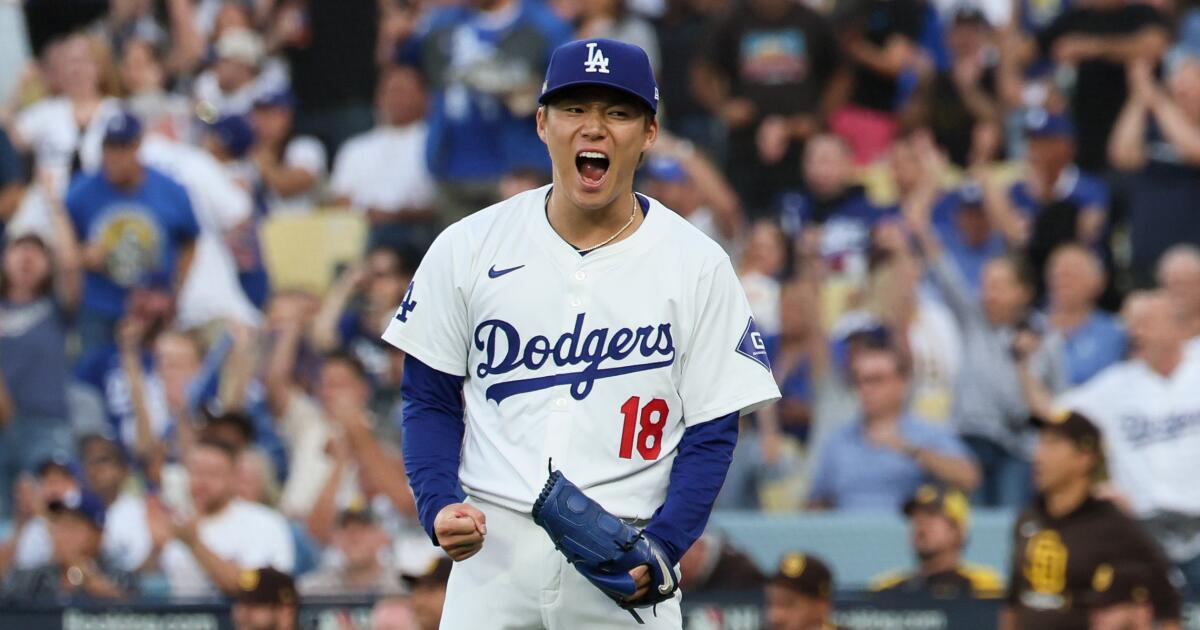
Blue towels turned in all sections of the Dodger stadium while his entrance song began to play.
Yoshinobu Yamamoto walked on the mound and in chaos carrying a mask of calm. His appearance was misleading.
Inside, he was terrified.
“I think it was the most nervous match of my entire baseball career,” Yamamoto said in Japanese.
Yamamoto can now laugh at his memories of match 5 of the series of the National League Division against the Padres of San Diego last season, knowing what was revealed the night of October and the path on which he put it.
He started this game as a stranger, even for himself. He left a hero. At the end of the month, he was World Series champion.
The momentum he took in the playoff series participated in this season, which explains why the 26 -year -old right -hander was in the star match in Atlanta earlier this week by reliving what could have been the most consecutive start of his career.
The Dodgers will return from the stars break on Friday with Yamamoto as the only reliable arm in their billion dollars rotation, and its new status as one of the best baseball launchers makes their probable starter 1 when they open the qualifying series.
“He is just to the point where he knows that he is a very good launcher, he is an All-Star and he has great expectations for himself,” said manager Dave Roberts.
The feeling of stability that Yamamoto provides was something that the Dodgers could not have dreamed of during his recruited season from top to bottom last year. Yamamoto encountered difficulties unknown to him as the most useful player in the Pacific Triple League with the Buffaloes of Japan Orix, missing three months with shoulder problems. Even when he launched, he played inconsistently, and in the NLDS match 1 against the paadres, he abandoned five points in just three rounds.
“The more I failed, the more I had the impression that things were accumulating,” said Yamamoto.
With a deficit of two games to one in the series, the Dodgers managed to win match 4 in San Diego to create a winner’s match 5 in Los Angeles. Yamamoto was assigned to start the decisive game.
Yamamoto had a hard time sleeping at night before his departure. When he tried to think about anything other than the game, he couldn’t.

The Dodgers launcher Yoshinobu Yamamoto delivers against the White Sox of Chicago on July 1.
(Gina Ferazzi / Los Angeles Times)
He felt the weight of his $ 325 million contract over 10 years, which was the most lucrative agreement signed by any launcher in any country. He also launched in front of Yu Darvish, which made it the first match in playoffs with two Japanese starters.
Its worst fears have never been made. He launched five short-lived rounds in a 2-0 victory, offering a performance that changed the way everyone considered it-the fans, the team, even himself.
“Being able to contain them there,” said Yamamoto, “has become a source of confidence.”
Yamamoto minimized his psychological force which was necessary to regroup following his calamity of game 1, describing his reversal according to his ability to identify the problems and remedy them.
“I am in no way mentally strong,” he said. “When I am touched, there are times when I really go down. But over time, things are clearing up. What I have to do becomes clear. “
Between the two NLDS departures, for example, Yamamoto adjusted the positioning of his glove, which, according to the Dodgers, revealed in match 1 which was about to throw.
His celebration, however, was short -lived.
“I felt like I was cleaning a mountain,” said Yamamoto. “But there was no time to relax before the start of the next game.”
Yamamoto started twice in the playoff series, in match 4 of the NL Championship Series against the New York Mets and the World Series match 2 against the New York Yankees. He abandoned three points combined in 10 rounds combined during the two games, both that the Dodgers won.
“I think it was a really precious experience,” he said. “Because of what I experienced, as well as the advances I have made from a technical point of view, I think I could grow.”
He also fired from the unpleasant era, especially the three months when he was sidelined with a head of tense rotators.
“I spent the time determined to grow from this,” he said. “I don’t want to forget how frustrated.”
The experiences gave him a knowledge base that he could take in his second season. As a recruit, he had reported his camp without any expectations.
“I did not know what my abilities were compared to everyone,” he said. “I lacked a basic understanding of:” If I do this, it will work, or if I do this, it is not the case “. So I didn’t think I would succeed and I didn’t think I wouldn’t be either. “”
This spring formation, he knew it. He knew he could succeed.
He also knew what he faced. Standing 5 feet 10 inches, Yamamoto was struck as a recruit by the imposing physical images of other players.
“More than that, when you arrive at the stadium, for example, Mookie [Betts] will end up hitting soaked with sweat, “he said.” I was surprised by the quantity of training, that players did not only count on their talent. It was a bit shocking.
Recognizing that he lost weight during last season, Yamamoto was determined to introduce himself to spring training this year with a stronger body. It also benefited from increased comfort with poor quality American baseball and pitch clock. He bought a house, the out -of -field stability allowing him to focus more on his work.
Placing once a week as he did in Japan, Yamamoto was 4-2 with an average of 0.90 made during his first seven departures of this season. He started resting for five days after that, and he was not so dominant. He first fought on a shorter cycle, but he said that the causes of these were disturbances of his routine between throws rather than something related to fatigue.

The launcher of the Dodgers Yoshinobu Yamamoto delivers against the Giants of San Francisco on June 13.
(Robert Gauthier / Los Angeles Times)
“I think there is absolutely no problem with this,” he said. “You are launching six days of rest in Japan, but you launch 120, 130 locations in seven or eight rounds. It was difficult. You have one day less to recover here, but you also launch less land, so you don’t feel the fatigue as much.
“There are things that arise between the two starts. For example, there could be two flights where you could arrive in a city in the middle of the night and have to launch the next day. You will not be able to spend each period of five days in the same way.”
Yamamoto said he had learned to better maximize his time between departures, which he stressed as the reason why he was able to find his shape leading to the stars. In his penultimate appearance before the intermission, he did not leave the first round and was accused of five points, three of them won. But in two of his last four departures, he did not give up any race. In another, he gave only one.
In fact, Yamamoto said that if the team asked, he thinks he could rest four days.
“This year, my body has recovered very well,” he said. “I often check with coaches after the match, and we are talking about the way it is like that, I could throw four days, or how if I feel like that, I could be a little later. We are going through different scenarios like that every week. I still haven’t started at four days of rest, but I think my preparation went well. ”
Yamamoto is entering the last 2 months of the regular season not only as a leader in Dodgers in victories (eight) but also matches began (19) and lanches launched (104 ⅓).
Its increased comfort extended to the clubhouse. He knocked on a somewhat improbable friendship with Hyeseong Kim South Korean, the two often conversing on the bench during the games.
“We are talking in English broken,” said Yamamoto with a little laugh. “I really like Korean cuisine, so he tends me about it. There are differences between Korean and Japanese baseball, and the major leagues are also a little different, so things like that. These are not deep conversations, but I think it is important to communicate, so we are talking a lot. ”
Yamamoto has also developed a particularly strong admiration of Clayton Kershaw.
“In him, you have a player in the team you can model,” said Yamamoto. “I also learn a lot to watch him throw. He is someone you can admire in all aspects. All my teammates think of him like that too. This is the kind of player I would like to be. ”
The kind of player on whom could be counted to take his turn in the rotation. The kind of player who can deliver for his team in great times.
Yamamoto is on the way.


