US military used laser to take down Border Protection drone, lawmakers say : NPR

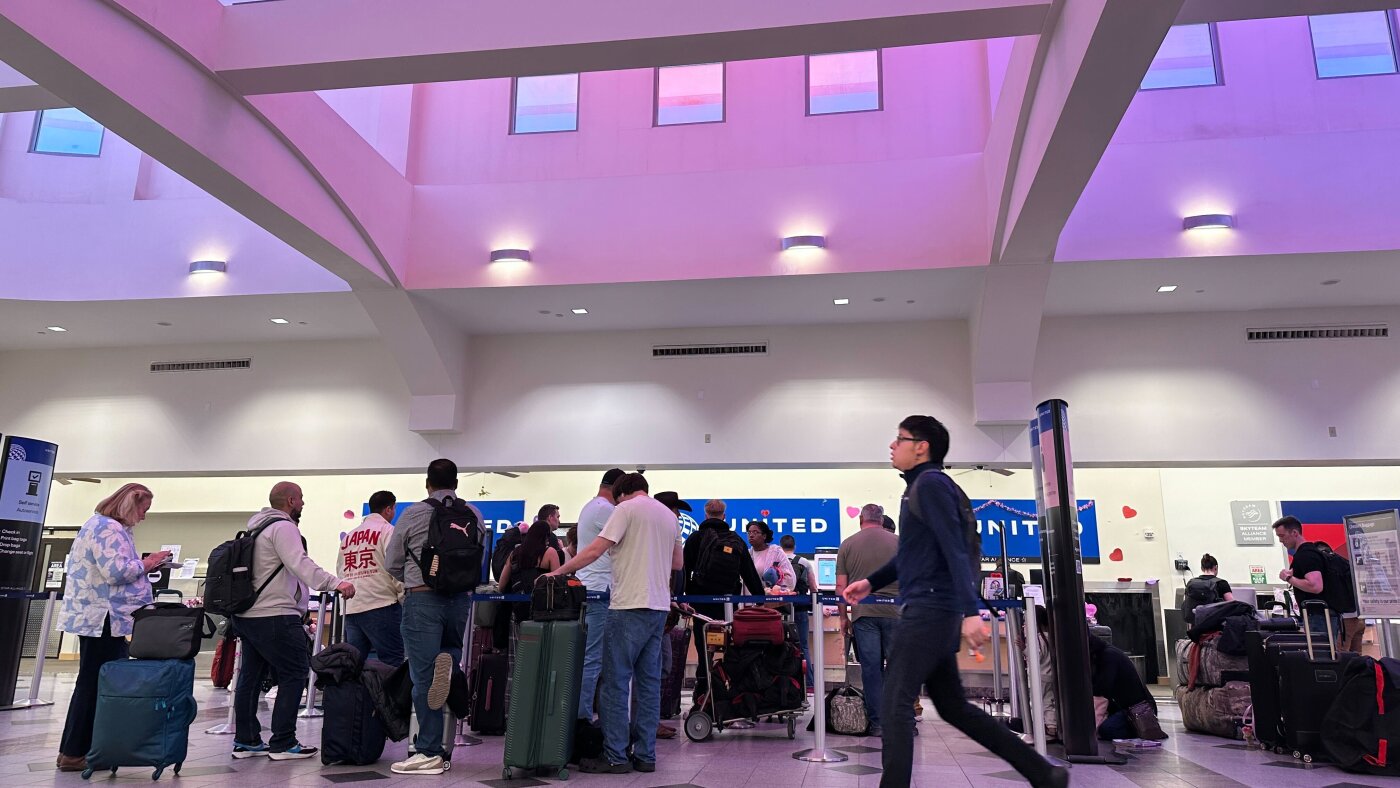

FILE – People line up at check-in counters at El Paso International Airport, Wednesday, Feb. 11, 2026, in El Paso, Texas.
Morgan Lee/AP
hide caption
toggle caption
Morgan Lee/AP
The U.S. military used a laser to shoot down a Customs and Border Protection drone, members of Congress said Thursday, and the Federal Aviation Administration responded by further closing airspace near El Paso, Texas.
It is unclear why the laser was deployed, but it is the second time in two weeks that a laser has been fired into the area. The military is required to formally notify the FAA whenever it takes action against drones in U.S. airspace.

The previous laser shot did not hit a target. This was carried out by CBP near Fort Bliss, about 50 miles (80 kilometers) to the northwest, and prompted the FAA to halt air traffic at and around the El Paso airport. This time, the closure was smaller and commercial flights were not affected.
U.S. Rep. Rick Larsen and two other prominent Democrats on the House Transportation, Infrastructure and Homeland Security committees said they were stunned when they were officially briefed.
“Our heads are exploding at the news,” the lawmakers said in a joint statement. They criticized the Trump administration for “circumventing” a bipartisan bill aimed at training drone operators and improving communication between the Pentagon, the FAA and the Department of Homeland Security.
“Now we see the result of his incompetence,” they said.
The government defends the use of anti-drone laser
The FAA, CBP and Pentagon issued a joint statement late Thursday acknowledging that the military “employed counter-unmanned aircraft system authorities to mitigate an apparently threatening unmanned aerial system operating in military airspace.”
The statement said this occurred far from populated areas and commercial flights, part of the administration’s efforts to strengthen protections at the border.
“Under the leadership of President Trump, the War Department, FAA, Customs and Border Patrol are working together in an unprecedented manner to mitigate drone threats from Mexican cartels and foreign terrorist organizations at the U.S.-Mexico border,” the statement said. “Ultimately, the Trump administration is doing more to secure the borders and crack down on cartels than any other administration in history.”
This is the second time these laser systems have closed Texas airspace this month.
El Paso’s shutdown two weeks ago lasted only a few hours, but it raised alarms and led to numerous flight cancellations in the city of nearly 700,000, not far from the Mexican border.
In this case, an anti-drone laser was deployed by CBP near Fort Bliss without coordination with the FAA, which then decided to close El Paso airspace to ensure commercial aviation security, according to sources familiar with the matter who were not authorized to discuss it.
Afterward, members of Congress said it was another example of dysfunction in government, with different agencies failing to coordinate with each other.
Transportation Secretary Sean Duffy said he plans to brief members of Congress this week about what happened. He said at an unrelated news conference last Friday that it was not a mistake for the FAA to close El Paso airspace and that he did not believe it was a miscommunication that led to the problems.
Lawmaker calls for investigation
Democratic Sen. Tammy Duckworth, ranking member of the Senate Aviation Subcommittee, said the alarming situation demands independent investigations.
“The incompetence of the Trump administration continues to wreak havoc in our skies,” Duckworth said.

The investigation into last year’s mid-air collision near Washington, D.C., between a jetliner and an Army helicopter that killed 67 people highlighted how the FAA and Pentagon did not always work well together.
The National Transportation Safety Board said the FAA and the military failed to share safety data on the alarming number of near misses around Reagan National Airport and failed to consider the risks.
Concern grows over drone threats
Two months ago, Congress agreed to give more law enforcement agencies — including some state and local departments — the authority to shoot down rogue drones provided they are properly trained. Previously, only a few select federal agencies had this authority.
Armed drones carry out devastating attacks in Ukraine on a daily basis and have also enabled Ukraine to strike deep into Russia. The U.S. government has distributed more than $250 million to help states prepare to respond to drones before hosting World Cup matches and this summer’s planned celebrations for America’s 250th birthday.
An additional $250 million in grants will be awarded later this year to strengthen the nation’s defenses against drones.
Drones are already causing problems
Drones are already causing problems along the border. Cartels regularly use drones to deliver drugs to the Mexican border and surveil Border Patrol agents. Officials told Congress last summer that more than 27,000 drones were detected within 500 yards of the southern border in the last six months of 2024.
The threat posed by drones to aircraft continues to rise, along with the number of near misses around airports. Homeland Security estimates there are more than 1.7 million registered drones flying in the United States, and that number is growing.
Anti-drone systems can use radio signals to jam drones, or high-powered microwaves or laser beams, like those used in Texas, that can disable the machines. Others station small drones to quickly take flight and ram threatening drones. And there are systems that use bullets, but these are more common on battlefields than in domestic use.


