Alaskan evacuees describe fleeing their storm-ravaged coastal communities: “We’re all thankful that we’re all alive”


The house shook as if an earthquake had struck, and suddenly it floated. Water seeped through the front door and waves hit the large window.
From the isolated, dry room where Alexie Stone and his brothers and children gathered, he could look out and see underwater, like an aquarium. A shed was drifting towards them, threatening to shatter the glass, but it turned away before it hit.
The house came to rest just a few meters from where it previously stood, after another building blocked its path. But it remains uninhabitable, along with much of the rest of the Kipnuk Native Village in Stone, Alaska, following a massive storm surge that flooded coastal parts of western Alaska, leaving one dead and two missing and prompting a massive evacuation effort to airlift more than 1,000 residents to safety.
“In our village, we would say we are Native strong, we have Native pride and nothing can break us. But this is the hardest we have been through,” Stone said Thursday outside the Alaska Airlines Center, an arena in Anchorage, where he and hundreds of others were staying. “Everyone takes care of everyone in there. We’re all grateful to all be alive.”
Keith C. Horen/Alaska Geological and Geophysical Survey Division via AP 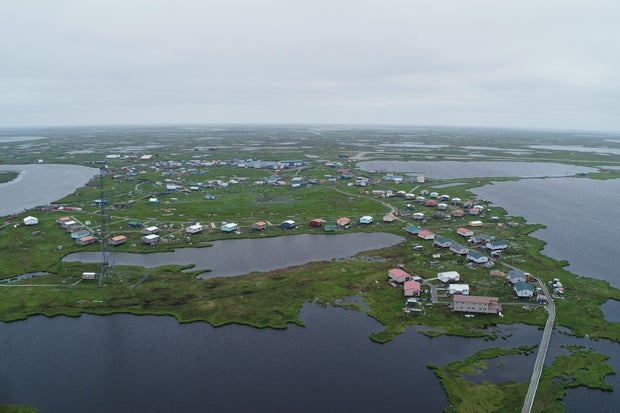
The remains of Typhoon Halong brought record water levels in low-lying Alaska Native communities last weekend and swept away homes, some with people inside. Makeshift shelters were quickly established and multiplied to accommodate around 1,500 peoplean extraordinary number in a sparsely populated region where communities are only accessible by air or sea at this time of year.
Bryan Fisher, director of the Alaska Division of Homeland Security and Emergency Management, told CBS News on Thursday that it was one of the largest disasters the state has ever faced.
Alaska Governor Mike Dunleavy announced on social media Thursday evening that he had submitted a request to the White House requesting that President Trump issue a disaster declaration for the region.
Many evacuees were first flown to Bethel, a regional center of 6,000 people. But authorities sought to relocate them as shelters approached capacity. Stone and his family spent several nights sleeping on the floor of the Kipnuk school library before being flown to Bethel and then to Anchorage, about 500 miles east of the villages. They arrived strapped to the floor of a huge military transport plane with hundreds of other evacuees.
Another military plane carrying evacuees was scheduled to arrive at Joint Base Elmendorf-Richardson Thursday evening.
The hardest hit communities, Kipnuk and Kwigillingok, saw water levels rise more than six feet above the highest normal tide line. Some 121 houses were destroyed in Kipnuk, a village of around 700 inhabitants, and in Kwigillingok, three dozen houses were missing.
Cell phone service had been restored in Kwigillingok on Thursday, authorities said, and toilets were working again at the school, where about 350 people had taken shelter overnight Tuesday.
The damage was also significant in other villages. Water, sewer and well systems were unusable in Napaskiak, according to a statement from the Federal Emergency Management Agency.
Jeremy Zidek, a spokesman for the State Emergency Management Office, said he did not know how long the evacuation would take and said authorities were seeking additional shelter. The goal is to move people from collective shelters to hotel rooms or dormitories, he said.
Fisher also told CBS News on Thursday that while some flooding was at record levels, the weather forecasts were accurate and that they received the normal weather forecasts and had the right data regardless of the timing. outages reported in weather balloons or other projects.
Fisher said the cuts to public radio and television have not affected communication. He acknowledged that communication was hampered after the storm, but that Alaska’s KYUK and KOTZ public radio stations were up and broadcasting.
While still at Kipnuk, Stone spent his days trying to help, he said. He would go to the airport to collect water or food sent from other villages and deliver it to the school. He worked to rebuild the boardwalks on which residents travel. And when he had time, he would return to his dilapidated house, trying to clean some of the waterlogged clothes and electronics that the floodwaters had thrown around.
But the damage is considerable. Fuel and oil have leaked from the tanks, and the smell of oil permeates the entire city, he said. Like other villagers in the region, his family lost food supplies intended to help them get through the winter: the refrigerator and three freezers full of halibut, salmon, moose and goose.
Stone’s mother, Julia Stone, is a police officer in the village of Kipnuk. She was working at the school last weekend when the winds suddenly picked up, people suddenly began streaming into the building and her police cellphone on duty began ringing with calls from people in need — some reporting their homes were floating.
She tried to reach search and rescue teams and others to determine if there were any boats available to help, but the situation was “chaotic,” she said.
Her voice cracked during an interview Thursday in Anchorage as she thanked people at the school who contributed to the response. “It’s a nightmare what we went through, but I thank God that we are together,” she said.
Stone said he evacuated with the clothes on his back. Most of the rest of his possessions were soaked and reeked of fuel. The Red Cross has provided cots, blankets and hygiene supplies to Anchorage, he said, and he went to a thrift store Thursday to buy more clothes: two shirts, a sweater, two pairs of pants and tennis shoes.
He doesn’t know exactly when it would be safe for him to return to Kipnuk.
“Everyone that comes from Kipnuk is pretty strong,” Stone said. “If we have to start again, we have to start again.”


