U.S.-Israeli strikes in Iran continue into 2nd day : NPR

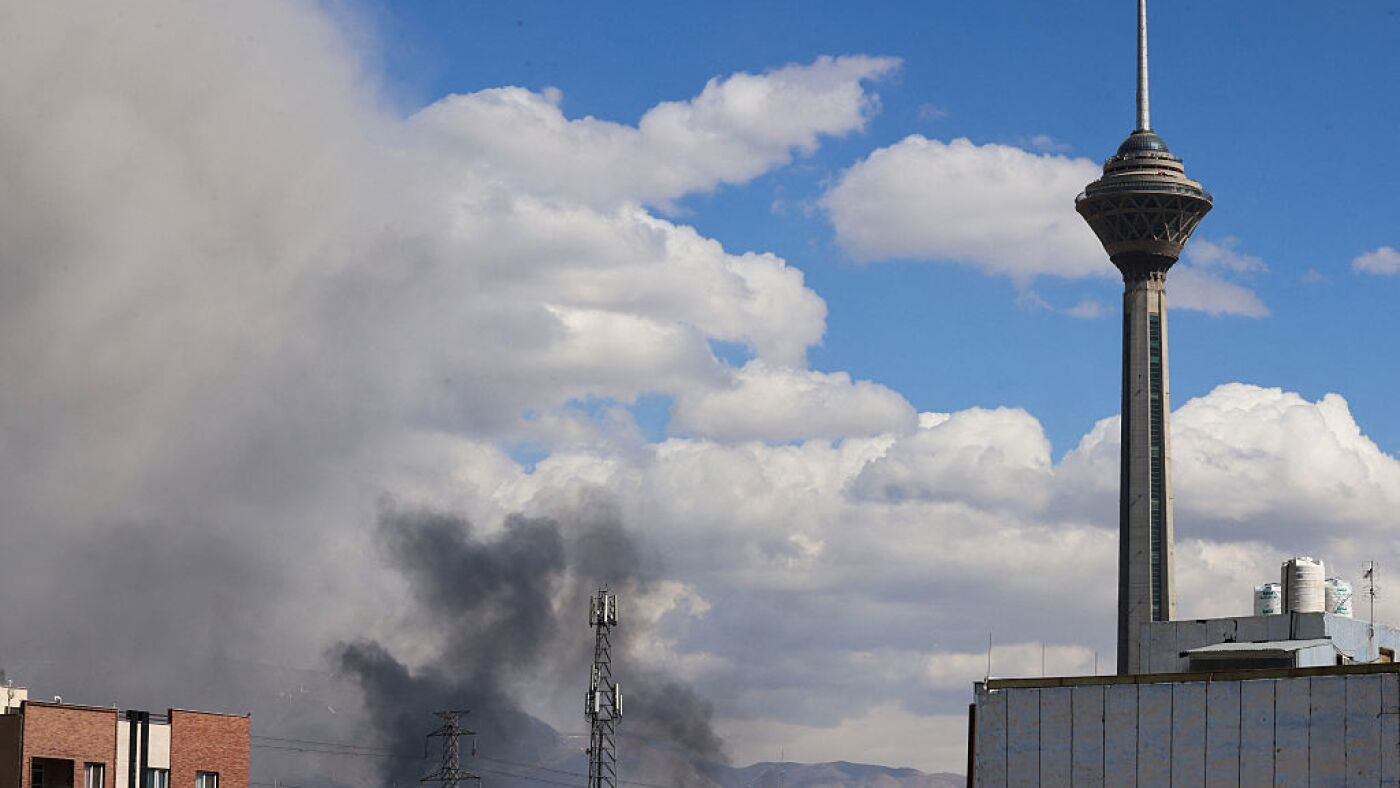

A plume of smoke rises following explosions reported in Tehran on March 1, 2026.
Atta Kenaré/AFP via Getty Images
hide caption
toggle caption
Atta Kenaré/AFP via Getty Images
AMMAN, Jordan — Iranians and others across the Middle East woke up Sunday to a region gripped by unrest following the killing of Iran’s supreme leader in U.S. and Israeli airstrikes.
The Iranian government, now without a spiritual leader of the country but with a military command structure apparently intact, continued its strikes against Israel and against American targets in the Gulf states, Iraq and Jordan.
The Israeli military said it had launched a new wave of attacks in Iran. Explosions were heard in the Iranian capital on Sunday morning. The Israeli military said it was striking targets belonging to the “Iranian terrorist regime” located “in the heart of Tehran.” The Israeli Air Force said it carried out large-scale strikes to establish air superiority and “pave the way for Tehran”.
Iranian state media on Saturday confirmed the death of Ayatollah Ali Khamenei, 86, in airstrikes targeting his office in Tehran. An Iranian state television channel announced the news in tears. Khamenei assumed the position of spiritual leader after the 1989 death of Ayatollah Ruhollah Khomeini, leader of Iran’s Islamic Revolution.
Iran said it had created a three-person temporary leadership council to govern the country under Islamic law before a group of Shiite clerics chose a new spiritual leader.
On Sunday, mourners gathered in Tehran’s Enghelab Square and public spaces in other cities to commemorate what they see as Khamenei’s martyrdom.

In the southwestern town of Yasuj, videos posted on social media showed large crowds chanting “The lion of God has been killed.” NPR could not independently verify the videos.
Iran said the attack also killed Khamenei’s daughter, grandchild, daughter-in-law and son-in-law. Armed Forces Chief of Staff Abdolrahim Mousavi and Major General Shahid Rezaian, a senior intelligence official, were also killed in airstrikes.
There were no apparent signs of a resumption of the protests that rocked Iran starting in December.
Iranian security forces then reportedly killed thousands of protesters, after anger over Iran’s financial crisis turned into anti-regime demonstrations. US Treasury Secretary Scott Bessent said the US caused this financial crisis.
A Tehran resident said she and her friends, who have participated in protests over the years, shouted from the rooftops with joy when they learned that Khamenei had been killed.
She said a friend of hers from the town of Karaj, near Tehran, was later shot dead while dancing in the streets with other young people.
“The basiji have come,” she said, referring to the paramilitary internal security forces. “He was shot in the back and leg.” The woman, who asked to be identified only as Roxana for fear of reprisals from the regime, said her friend could not go to the hospital for fear of arrest.
In Lebanon, the Iran-backed militant group Hezbollah announced a commemoration in the southern suburbs of Beirut to mark the death. Hezbollah had warned that it would not let Khamenei’s death go unpunished, but it has so far stayed away.
In Iraq, where Iran-backed paramilitaries are part of the government’s official security forces, the government has blocked entrances to Baghdad’s Green Zone to protect the United States and other embassies based there. They deployed riot police against a group of militiamen who were trying to break through the barricades.

In Jordan, which is quietly home to major US military bases, residents were awakened by air raid sirens and the thud of intercepted missiles.
The oil-rich Gulf, long seen as a haven for expatriates and the economic engine of countries that provide the bulk of its skilled and unskilled labor, has faced perhaps the biggest shocks.
Iran targeted luxury hotels and apartment buildings believed to house U.S. personnel on Saturday and Sunday. Instead of the usual flood of posts from social influencers enjoying the winter sunshine of Dubai and its neighboring emirates, videos of drones hitting high-rise buildings have dominated social media feeds. Some footage showed smoke filling part of the lobby as staff fled the building.
The attacks prompted the closure of several major airports in the Middle East, including Dubai International Airport, one of the busiest in the world. The airport and the emirate’s famous Burj Al Arab hotel were damaged in the Iranian attacks. Other projectiles also hit airports in Abu Dhabi and Kuwait.
Iran on Sunday threatened its largest wave of attacks against Israel and US military bases. Since the start of its retaliation for Saturday’s strikes, its projectiles have hit 27 American bases in the region, as well as an Israeli base and the headquarters of the general command of the Israeli army. There has been no confirmation of these strikes from the United States or Israel.
“There will be neither mercy nor forgiveness in the ruler’s revenge,” Iran’s Defense Ministry said in a statement.
Iran also made clear on Saturday that it would also attack shipping vessels and other commercial interests, and announced the closure of the strategic Strait of Hormuz, a vital waterway for Gulf oil exports.
The OPEC group of oil-producing countries was due to meet on Sunday to decide whether to increase production, hoping to avoid a sharp rise in oil prices if supplies from the Gulf are limited by the conflict.

President Trump, in announcing the attacks Saturday, told the Iranians they would have to withdraw their government once the strikes ended. The assassination of Khamenei and the expansion of Iranian targets have sidelined Iran’s nuclear facilities – the US administration’s original reason for attacking Iran.
On Sunday, President Trump, in an article on “Truth Social,” warned Iran against further retaliation, writing “THEY BETTER NOT DO THIS, HOWEVER, BECAUSE IF THEY DO, WE WILL HIT THEM WITH A FORCE THAT HAS NEVER BEEN SEEN BEFORE!”
Trump also told media outlet Axios in a brief phone interview: “I can take the time to get everything back together, or I can end it in two or three days and say to the Iranians, ‘We’ll see you in a few years if you start rebuilding.’ [nuclear and missile programs]”.
Carrie Kahn contributed to this report from Istanbul.


