U.S., Japan flex military might amid Japan-China feud : NPR

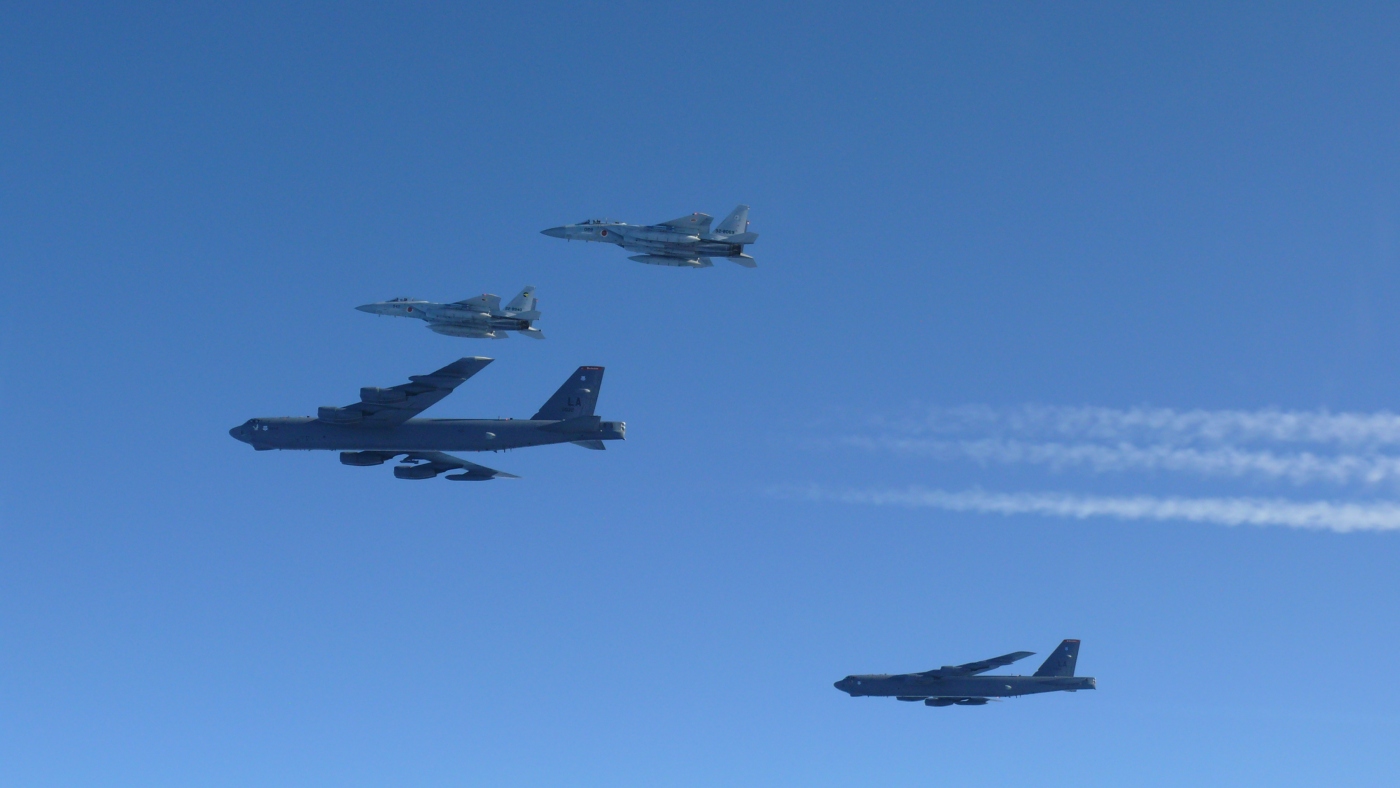

This photo provided by the Japanese Defense Ministry shows Japan Air Self-Defense Force F-15 fighters conducting a joint military exercise with U.S. B-52 bombers near Japanese airspace on Wednesday.
Japanese Ministry of Defense/PA
hide caption
toggle caption
Japanese Ministry of Defense/PA
SEOUL, South Korea — The United States sent nuclear-capable bombers, accompanied by Japanese warplanes, over the Sea of Japan in the first show of military force by the two allies since a bitter feud erupted between Japan and China last month.
The exercises included two US B-52 strategic bombers and six Japanese F-35 and F-15 fighter jets, according to the Joint Staff of the Japanese Defense Ministry.
“This bilateral exercise reaffirms the firm commitment between Japan and the United States not to tolerate unilateral changes to the status quo by force,” Japan’s Joint Chiefs of Staff said in a statement – language Japan often uses to refer to the status of Taiwan, a self-governing island that China claims as part of its territory.
It follows joint Chinese and Russian strategic bomber and fighter exercises on Tuesday that prompted Japan and South Korea to dispatch planes to monitor them. South Korea lodged a diplomatic protest following the incident.
Japan and China have also recently exchanged accusations that the other side locked weapons-targeting radars on its planes, during Chinese aircraft carrier exercises in waters near Japan.
The busy Chinese navy
Japan has noted an increase in Chinese military activity around Okinawa Prefecture in southwest Japan, which includes several islands near Taiwan. “China’s naval operations are unusually active and we have seen an expansion in the regions where they operate,” Akira Saito, chief of staff of the Japan Maritime Self-Defense Force, told reporters.
Japan fears that some of these exercises are a pressure tactic linked to a months-long feud between Beijing and Tokyo.

The dispute erupted after Prime Minister Sanae Takaichi said on November 7 that a Chinese naval blockade of Taiwan could justify mobilizing the Japanese military.
Chinese Foreign Ministry spokesman Guo Jiakun countered that the Chinese exercises were routine and in line with international law. “The Japanese side does not need to make a fuss or take this personally,” Guo told a news briefing.
Trump focuses on China deal
The United States is currently focused on implementing what Washington describes as a trade deal reached in late October by President Trump and Chinese leader Xi Jinping.
Until this week, the Trump administration had not criticized China over the dispute with Japan. In a statement to NPR on Thursday, the State Department said, “China’s actions are not conducive to regional peace and stability.”
“The U.S.-Japan alliance is stronger and more united than ever,” the State Department said. “We remain steadfastly committed to our ally Japan and are in close contact.”
The Japanese Defense Ministry said in a statement published on its website that its Defense Minister, Junichiro Koizumi, was scheduled to speak by telephone with his American counterpart Pete Hegseth on Friday.
NPR’s Jackie Northam contributed reporting.