U.S. skier balances Paralympic training and research : NPR

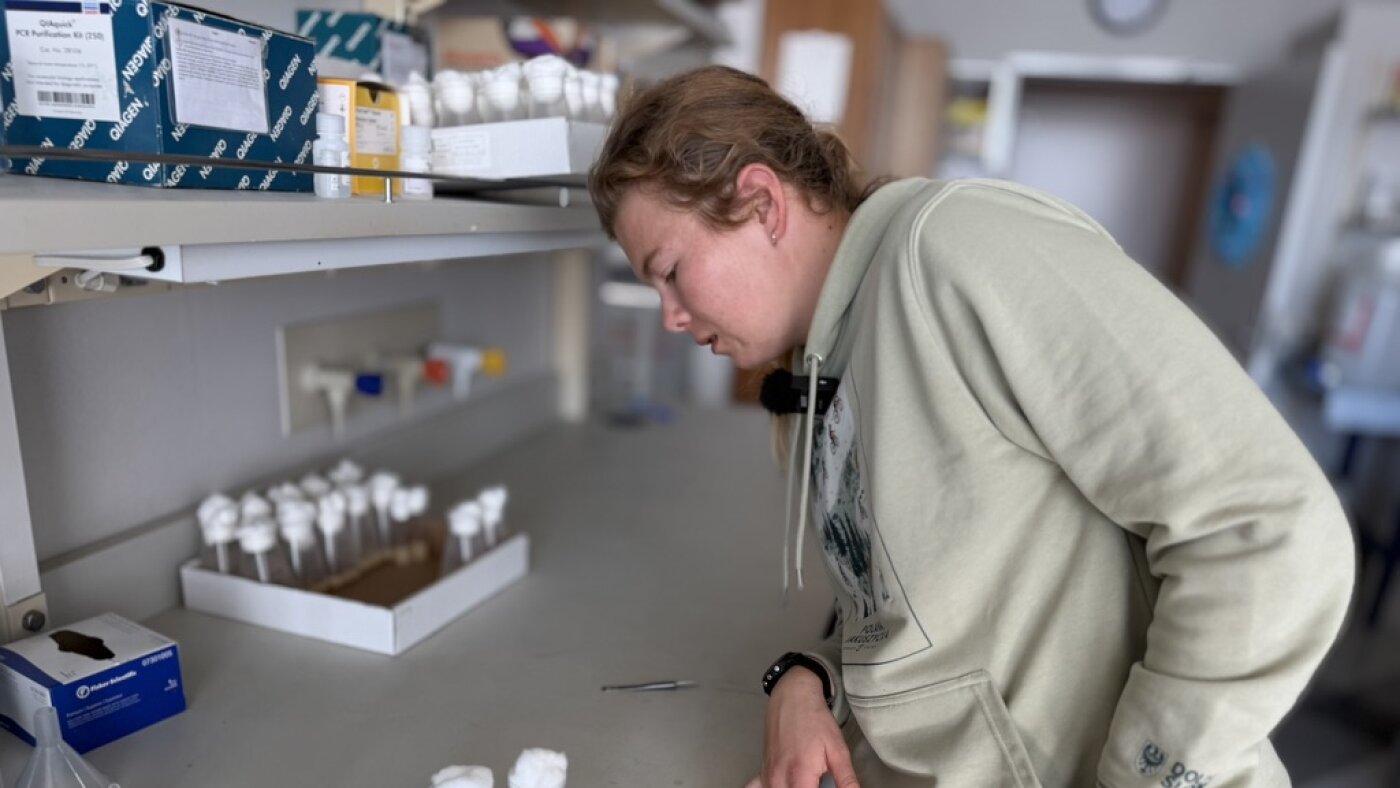

In a University of Utah lab, Sydney Peterson inspects containers of fruit flies. As part of his doctoral research, the Paralympic athlete uses fruit flies to test the effectiveness of different drugs on certain genetic movement disorders.
Emily Chen-Newton
hide caption
toggle caption
Emily Chen-Newton
SALT LAKE CITY — With the 2026 Paralympic Winter Games set to open Friday in Milan and Cortina, athletes are busy preparing for their Games. One of those athletes is Sydney Peterson, a member of the U.S. Paralympic ski team. She is also working on her doctorate in neuroscience at the University of Utah, focusing on movement disorders, similar to her condition. Peterson’s days are a balancing act between the lab and his skis.

Peterson, who began cross-country skiing at age five, suffers from a neurological condition known as dystonia that causes involuntary muscle contractions in his left arm and leg. So typically, she skis with just one pole. With a custom left ankle brace and a ski pole in her right hand, she glides across the snow, evenly from side to side.
As a multi-medal Paralympic athlete (she won gold, silver and bronze at the 2022 Beijing Paralympics), she is at the top of her game.
But when she was 13, just beginning to experience symptoms, skiing became her physical therapy.
“It’s a lot more fun to be able to do this after school with your friends than alone in a clinic,” she said.
Peterson credits her friends and staff for helping her cope with her worsening symptoms in college. Over time, muscle contractions forced his left hand and ankle into fixed positions.
“But I was very fortunate to still have all my teammates and my college coach. I was able to show up to practice every day. I still had that continuity.”
Now 23 and working toward his doctorate, Peterson’s days revolve around two communities: on the slopes and in the lab. So after her first workout of the day, she heads to the University of Utah to check out the experiments she’s conducting in a rare disease lab.

Sydney Peterson, who typically skis with one pole due to her neurological condition, is shown during a training session at the 2022 Winter Paralympic Games, March 2, 2022 in Zhangjiakou, China.
Alex Davidson/Getty Images
hide caption
toggle caption
Alex Davidson/Getty Images
They use fruit flies to test the effectiveness of different drugs on certain genetic movement disorders. Entering the “fly room,” Peterson raises his voice to speak over the buzz of the lab’s many incubators. She opens the door to one of them: “These are flies that are currently undergoing an experiment, and so they are kept at the right humidity, at the right temperature… with lighting adapted to the sleep/wake cycles.”
Peterson and his colleagues are testing drugs already approved by the Food and Drug Administration. They’re not specifically investigating his condition, but there is some overlap.
“A lot of the drugs we test here, I’ve taken them before,” she said with a laugh.
Peterson then points to rows of small plastic bottles filled with tiny flies on the counter. “These are sick, these are healthy. And if I hit them…”
She explains that once the diseased flies fall to the bottom of the container, she looks to see if they come up the sides, which indicates that the medication might help.

Paralympic athlete Sydney Peterson shows off an ankle brace she uses for skiing.
Emily Chen-Newton
hide caption
toggle caption
Emily Chen-Newton
While her This disease cannot be cured, but she notes that she has benefited from research like this. And Peterson said she benefits from pursuing both ski racing and higher education.
“You’re not always going to be successful in skiing, and grad school obviously has its hurdles as well, where experiments work, and experiments don’t work. And obviously it’s frustrating, but it’s nice to be able to put that aside and just do your training. I think they can feed off each other if you structure it correctly.”
She is coping with physical setbacks by focusing more on her experiences and hopes to pursue a career in clinical research. Although she says she would never want to work on her own illness.
“I think that would hit way too close to home. But I think from a broader perspective, it’s nice and rewarding to know, from a macro perspective, that what we’re doing can have a positive impact on patients’ lives.”
But for now, Peterson just needs to start his second workout of the day, preparing to compete in several Paralympic ski events in Italy, including all three cross-country distances.


