U.S. tariffs on European goods threaten to shake up the world’s largest trade relationship


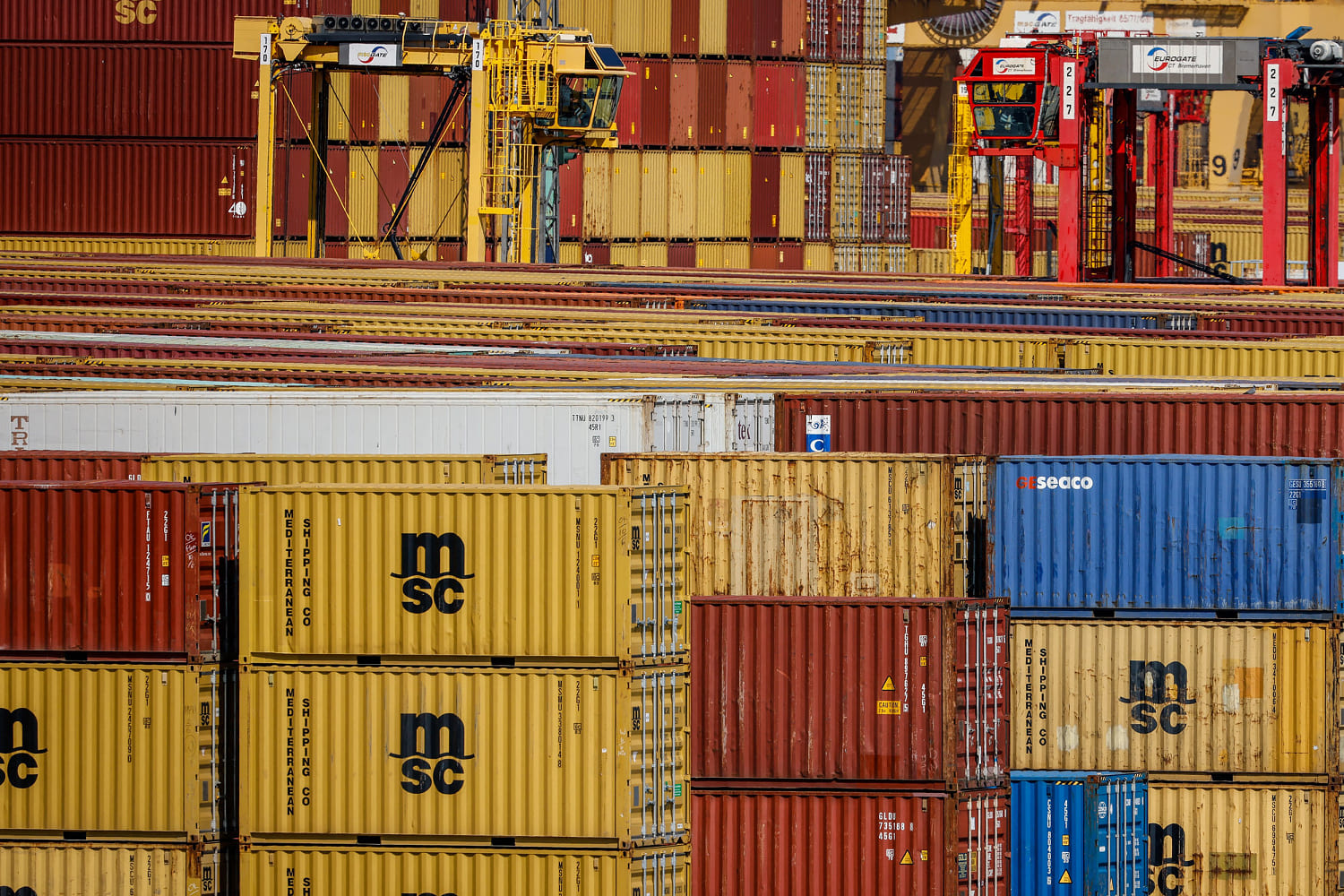
Frankfurt, Germany (AP) – The European Union plans to discover on Monday if President Donald Trump will impose punistent prices on the largest American trading partner in a decision that economists would have warned that the repercussions for businesses and consumers on both sides of the Atlantic.
Trump imposed an import tax of 20% on all products manufactured by the EU at the beginning of April as part of a set of prices targeting the countries with which the United States has a commercial imbalance. A few hours after the tasks specific to the nation entered into force, it suspended them until July 9 at a standard rate of 10% in the silent financial markets and to give time for negotiations.
Expressing the dissatisfaction of the EU position in commercial talks, however, Trump said that he would increase the rate rate of European exports to 50%, which could make everything from French cheese and Italian leather to German electronics and Spanish pharmaceutical products – much more expensive in the United States
The EU Executive Board, which manages the commercial problems of the 27 Bloc members, said its leaders hoped to conclude an agreement with the Trump administration. Without one, the EU said that it was ready to retaliate with prices on hundreds of American products, ranging from beef and car to beer and Boeing aircraft.
The American secretary of the Treasury, Scott Bessent, said on Sunday on the “State of the Union” program of CNN that “the EU was very slow to come to the table”, but that the talks were now making “very good progress”.
Here are important things to know about trade between the United States and the European Union.
US EU trade is huge
The European Commission describes trade between the United States and the EU as “the most important commercial relationship in the world”.
The value of the EU-US trade in goods and services amounted to 1.7 Billion of euros (2 billions of dollars) in 2024, an average of 4.6 billion euros per day, according to the Eurostat EU Statistics Agency.
The largest American export to Europe was crude oil, followed by pharmaceutical products, planes, cars and medical and diagnostic equipment.
The largest exports from Europe to the United States were pharmaceutical products, cars, planes, chemicals, medical instruments and wine and spirits.
The EU sells more in the United States than vice versa
Trump complained about the 198 billion euros in the EU on goods, which shows that Americans buy more things in European companies than the reverse.
However, American companies fill part of the gap by existing the EU in terms of services such as cloud computing, travel reserve and legal and financial services.
The surplus of services in the United States has lowered the country’s trade deficit with the EU to 50 billion euros ($ 59 billion), which represents less than 3% of the overall trade in the United States.
What are the problems that divide both parties?
Before Trump returned to functions, the United States and the EU maintained a generally cooperative commercial relationship and low rate levels on both sides. The American rate was on average 1.47% for European products, while the EU was on average 1.35% for American products.
But the White House has taken a much less friendly posture towards the long-standing ally of the United States since February. In addition to the fluctuating rate rate on European products that Trump has floated, the EU was subject to the 50% rate of its administration on steel and aluminum, and a 25% tax on cars and imported parts.
Trump administration officials have raised a series of problems they wish to see, including agricultural barriers such as EU health regulations which include bans on chicken in chlorine and beef treated with hormone.
Trump has also criticized value added taxes in Europe, which EU countries take the point of sale this year at rates from 17% to 27%. But many economists consider VAT as a commercial neutral because they apply to national goods and services as well as those imported. Because national governments have established taxes through legislation, the EU said that they are not on the table during commercial negotiations.
“On thorny issues of consumer regulations, standards and taxes, the EU and its Member States cannot give a lot of ground,” said Holger Schmieding, chief economist of Germany Berenberg. “They cannot change the way they manage the vast EU internal market according to American demands, which are often rooted in an erroneous understanding of the functioning of the EU.”
“Consequence for many companies”
Economists and companies say that higher prices will mean higher prices for American consumers on imported goods. Importers must decide how much additional tax costs to be absorbed through lower profits and the quantity to be transmitted to customers.
The Mercedes-Benz dealers in the United States said they were holding the line on the prices of the 2025 model year “until further notice”. The German car manufacturer has a partial price shield because it is 35% of Mercedes-Benz vehicles sold in the United States in Tuscaloosa, Alabama, but the company said that it expects prices to undergo “significant increases” in the years to come.
Simon Hunt, CEO of the Italian producer of wine and Campari Group spirits, told investment analysts that prices could increase for certain products or remain the same according to rival companies. If competitors increase prices, the company could decide to hold its prices on Skyy Vodka or Aperol Aperitif to gain market share, said Hunt.
Trump argued that making foreign companies more difficult to sell in the United States is a way to stimulate a rebirth of American manufacturing. Many companies have rejected the idea or have declared that it would take years to produce positive economic advantages. However, some companies have proven to be moved to moving production in the United States.
The luxury group based in France LVMH, whose brands include Tiffany & Co., Luis Vuitton, Christian Dior and Moet & Chandon, could move a certain production in the United States, said Bernaud Arnault, CEO billionaire, during the annual meeting of the company in April.
Arnault, who attended the inauguration of Trump, urged Europe to conclude an agreement based on reciprocal concessions.
“If we end up with high prices, … We will have to increase our production based in the United States to avoid prices,” said Arnault. “And if Europe does not negotiate intelligently, it will be the consequence for many companies. … It will be Brussels’s fault, if it happens.”
“ Road could be rocky ‘
Some forecasts indicate that the US economy would be more at risk if negotiations fail.
Without an agreement, the EU would lose 0.3% of its gross domestic product and American GDP would drop 0.7%, if Trump slaps the goods imported from Europe with prices of 10% to 25%, according to a Research Review of Bruegel, a group of reflection in Brussels.
Given the complexity of some of the problems, both parties can only arrive in a framework of the deadline of Wednesday. This would probably leave a basic price of 10%, as well as the automotive, steel and aluminum prices in place until the details of an official commercial agreement are calculated.
The most likely result of commercial talks is that “the United States will accept the agreements in which it will resume its worst threats of” reprisals “rates far beyond 10%,” said Schmieding. “However, the road to get there could be difficult.”
The United States offering exemptions for certain goods could smooth the way to an agreement. The EU could offer to facilitate certain regulations that the White House considers as commercial barriers.
“While Trump could be able to sell such a result as a” victory “for him, the ultimate victims of his protectionism would, of course, be mainly American consumers,” said Schmieding.


