Animal Study Sheds New Light on How Sleep and Growth Hormone Regulation Interact


Neuroscientists from the University of California, Berkeley and Stanford University have explored the cerebral circuits that control the release of growth hormones during sleep and have discovered a new brain feedback mechanism which maintains the levels of finely balanced growth hormones. This mechanism could open ways to treat people with sleep disorders linked to metabolic conditions such as diabetes, as well as degenerative diseases such as Parkinson and Alzheimer.
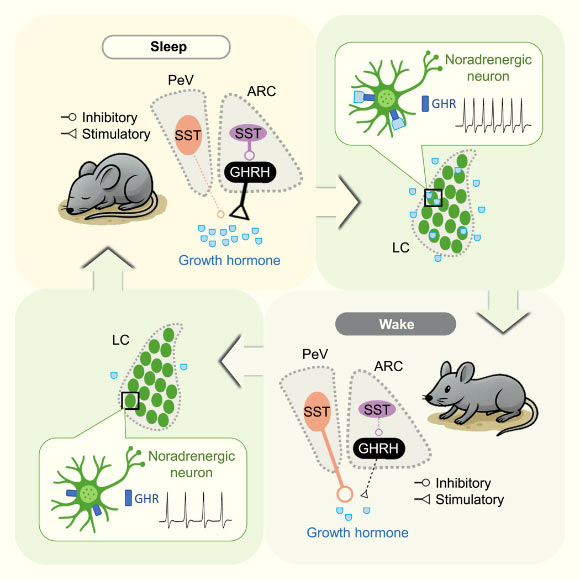
Sleep is known to promote tissue growth and regulate metabolism, in part by improving the release of growth hormones (GH), but the mechanism of the underlying circuit is unknown. Ding and al. Demonstrate how the release of GH, which is improved during the rapid movement of the eyes (REM) and Sleep Non Rem (Nrem), is regulated by the dependent activity of the distinct hypothalamic neurons expressing the GH liberation hormone (GHRH) and Somatostatin (SST). SST neurons in the arched nucleus remove the release of GH by inhibiting the neurons of nearby GHRH which stimulate the release of GH, while the periventricular SST neurons inhibit GH’s release by projecting the median eminence. The release of GH is associated with strong increases in GHRH and SST activity during REM sleep, but has moderately increased GHRH and a decrease in SST activity during NREM sleep. In addition, ding and al. has identified a negative feedback in which GH improves the excitability of locus coeruleus neurons and increases awakening. Image credit: Ding and al., DOI: 10.1016 / J.Cell.2025.05.039.
“People know that the release of growth hormones is closely linked to sleep, but only by doing blood levels and checking the levels of growth hormones during sleep,” said Dr. Xinlu Ding, postdoctoral researcher at the University of California in Berkeley.
“We actually record a neuronal activity in the mouse directly to see what is going on.”
“We provide a basic circuit to work in the future to develop different treatments.”
The neurons that orchestrate the release of growth hormones during the sleep -watch cycle – hormone growth hormones of growth hormones (GHRH) and two types of somatostatin neurons – are buried deep in the hypothalamus, an old brain hub kept in all mammals.
Once released, the growth hormone increases the activity of neurons in the locus coeruleus, an area of the brainstem involved in excitement, attention, cognition and the search for novelty.
The deregulation of locus coeruleus neurons is involved in many psychiatric and neurological disorders.
“Understanding the neural circuit for the release of growth hormones could possibly point to new hormonal therapies to improve the quality of sleep or restore the normal balance of growth hormones,” Daniel Silverman said, also from the University of California in Berkeley.
“There are certain experimental gene therapies where you target a specific type of cell.”
“This circuit could be a new handful to try to resume the excitability of Locus Coeruleus, which has never been discussed before.”
The authors explored the neuroendocrine circuit by inserting electrodes into the brain of mice and measuring changes in activity after stimulating neurons in the hypothalamus with light.
Mouses sleep for short periods – several minutes at a time – throughout the day and night, offering many opportunities to study changes in growth hormones during sleepy sleep cycles.
Using advanced circuit tracing, the researchers found that the two hormones in small peptide who control the release of growth hormone in the brain – GHRH, which promotes liberation, and somatostatin, which inhibits release – works differently during REM sleep.
Somatostatin and GHRH increase during paradoxical sleep to increase growth hormone, but somatostatin decreases and GHRH increases only during sleep not REM to increase growth hormone.
The released growth hormone regulates the activity of Locus Coeruleus, as a feedback mechanism to help create a homeostatic Yin-Yang effect.
During sleep, the growth hormone accumulates slowly to stimulate the locus coeruleus and promote awakening, revealed the new study.
But when the Locus coeruleus becomes overexcited, it paradoxically promotes drowsiness.
“This suggests that the sleep and growth hormone form a closely balanced system: too little sleep reduces the release of growth hormones, and too much growth hormone can in turn push its brain towards awakening,” said Dr. Silverman.
“Sleep leads to the release of growth hormones and growth hormones are restored to regulate awakening, and this balance is essential for growth, repair and metabolic health.”
Since the growth hormone acts in part by the Locus Coeruleus, which governs the overall excitation of the brain during awakening, an appropriate balance could have a broader impact on attention and thought.
“Growth hormone helps you not only build your muscles and bones and reduce your adipose tissue, but can also have cognitive advantages, promoting your overall excitement level when you wake up,” said Dr. Ding.
The study was published in the journal Cell.
_____
Xinlu Ding and al. 2025. Neuroendocrine circuit for the release of growth hormones dependent on sleep. Cell 188 (18): 4968-4979; DOI: 10.1016 / J.Cell.2025.05.039


