Menopause spotlight on women from ethnic minority communities


Jenny ReesHealth Correspondent in Wales

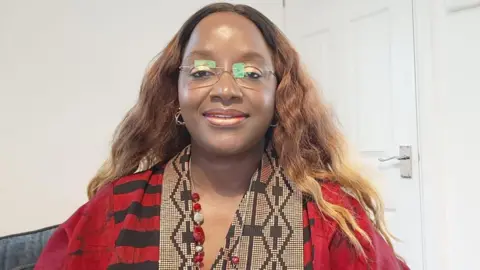 Bami Adenipekun
“When menopause enlightenment happened, non-white women still weren’t part of the conversation,” says Bami Adenipekun.
The 49-year-old stock consultant said she considers her brain now “more fantastic than it has ever been” and is celebrating its “most powerful season”.
But she said it took her a long time to realize that symptoms such as memory problems were due to menopause, after cancer treatment in her mid-30s.
Although research is limited, studies have shown that ethnic minority women experience the menopause differently to white women – and this will be explored at a ‘marginalised and menopausal’ event in Cardiff later this month.
Dr Amara Naseem will speak at the World Menopause Day event in Cardiff on October 18.
In her experience as a GP in one of the Welsh capital’s most diverse areas, women from ethnic minorities are also less likely to seek help for their symptoms than her white patients.
This is of particular concern to her given the prevalence of diabetes in South Asian communities, as a lack of estrogen can cause insulin resistance, meaning people in perimenopause increase their risk of developing diabetes.
“That’s why I would tell women to be prepared, because our bodies are different and, because of our ethnicity, our risks are different as well,” she said.
What is menopause?
Menopause refers to the end of a woman’s reproductive years and normally occurs around age 51.
The period before this event is known as perimenopause. It starts on average at age 46.
This is when many women notice that their periods are becoming unpredictable – heavier, lighter, longer or shorter – and experience sensations or physical problems that they have never felt before.
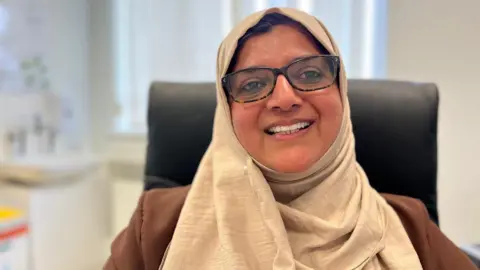
Project manager for the event, Sahir Ahmed-Evans, said she hopes the event will help disseminate reliable information to women in minority ethnic communities, but especially to women who look like them.
The 47-year-old menopause coach said she now realizes her perimenopause symptoms began in her 30s, but going through medical menopause two years ago was a shock to the system.
“I thought I was dying,” she said.
“But after a few months, it was like a ray of hope for me.”
She had been living with undiagnosed endometriosis and adenomyosis for years, so the injections to put her into menopause felt like “a release” from the symptoms and a chance to reset and focus on her well-being.
“As a Pakistani and Asian woman, I’m a mother, I’m a grandmother, I’m a wife, I’m a business owner, a content creator, and you give, give, give,” she said.
“Then your body says ‘but there’s nothing left, when are you going to give yourself?’
“So I feel like it’s a natural way of saying ‘now it’s time to step back and take something for yourself’.”
She added that in addition to different physical symptoms, there may be cultural pressures and stigmas at play within some Black and Asian communities, where the topic of women’s health can be a taboo.
Bami agreed, saying, “If we talk about it as just a rite of passage, then what do you do?
“The older generation will say you just have to be strong, because they were never told there was help available.”
But she believes systemic racism – a point recognized in the Race Equality Action Plan for Wales – only further disadvantages women.
Her own experience in the workplace led her to feel “vilified and severely punished” when symptoms affected her cognition, pain level or emotions.
Dr Naseem said creating a trusting space to discuss topics such as vaginal dryness, itching or loss of libido was also crucial.
“Women from marginalized societies may not be very open to talking about these things,” she said.
“It’s very important for us to provide a safe space for these women.”


