Hubble revisits stunning Trifid Nebula after 30 years, and spots a growing jet of energy — Space photo of the week


Quick facts
What is this : Trifid Nebula (Messier 20)
Where it is: 5,000 light years from Earth in the constellation Sagittarius
When it was shared: April 20, 2026
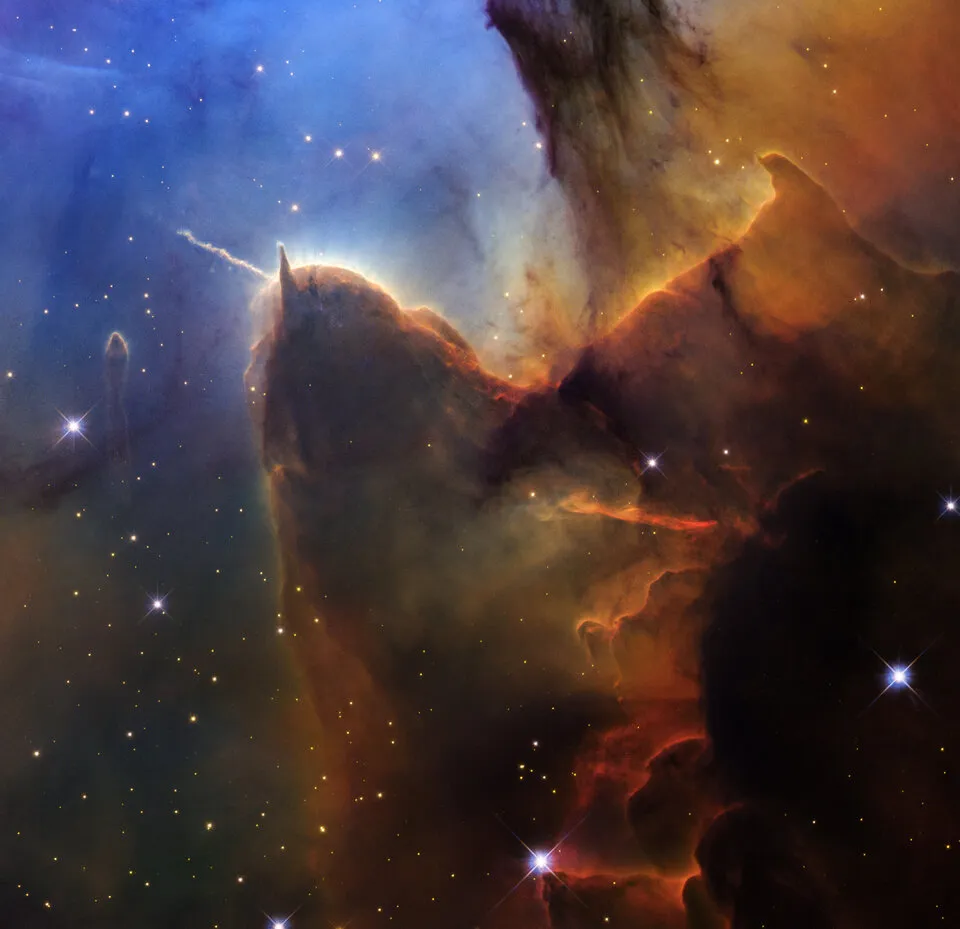
In the new image, the clouds’ fascinating orange edges show where powerful ultraviolet radiation from massive stars has stripped electrons from nearby gas, making it glow. Their stellar winds have dispersed some of the surrounding dust, as shown by the bright blue area where the dust is finest. The far right corner – almost black – is where the dust is densest.
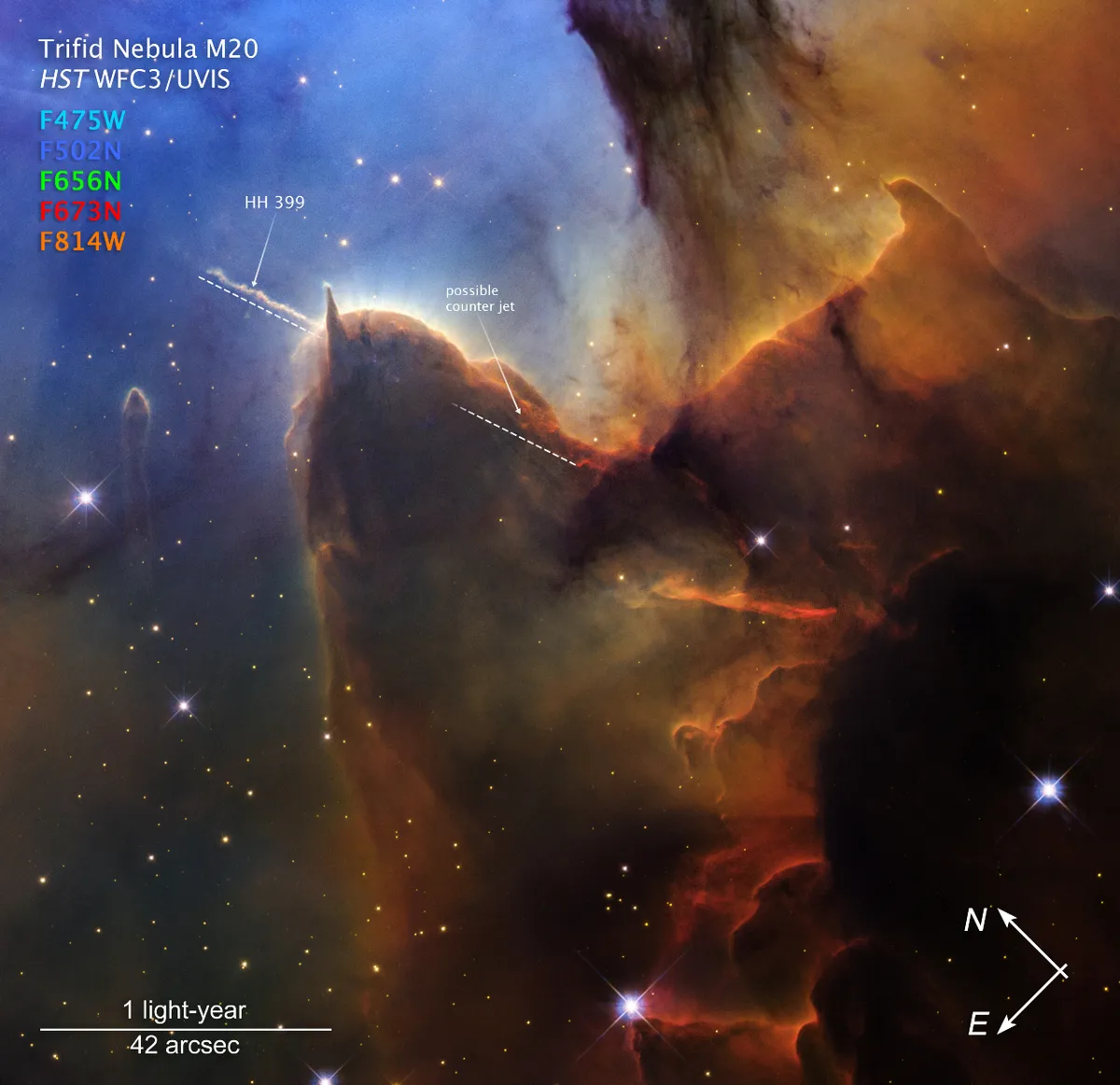
The prominent brown-shaped structure in the center left of the image is the “head” of the cosmic sea lemon. Its “body” is a cloud of rust-colored gas. Between two “horns,” yellow gas gushes outward like the glow of lava from a volcano, almost as if something is being destroyed there. And that’s exactly what’s happening; these are regions where ultraviolet light erodes gases and dust, according to the European Space Agency.
The main peak, visible to the left of the lemonfish’s head, is accompanied by a jet of energetic gas. This region is part of the Herbig-Haro (HH) object called HH-399, and the jet is ejected by a baby star located in the lemon sea’s head. (HH objects are bright regions of nebulosity created by the powerful jets of newborn stars.)
Comparison According to the new observations of the 1997 image, researchers actually observed the jet expanding. This change will allow scientists to estimate the speed of the jet, revealing how much energy the young star is injecting into its environment. There is also a thick trail of bright orange and flaming red material that appears to extend to the right – potentially a jet shooting from another newly formed star.
The bright orange stars scattered across the scene have already won their battle against the nebula. They are fully formed and their light, stellar winds have cleared the space around them. Over the next few million years, the remaining stars buried in the nebula will do the same. The gas and dust will slowly disappear and only the stars will remain.
With this image, Hubble not only celebrates 36 years of activity but also highlights its enhanced full screen capabilities. The new operational Vera C. Rubin Observatorylocated in the Atacama Desert in Chile, also captured the Trifid Nebula, looking like a giant cloud of cotton candyin his first batch of images.


