Unanimous vote in key risk assessment has moon mission crew barreling toward a new launch date

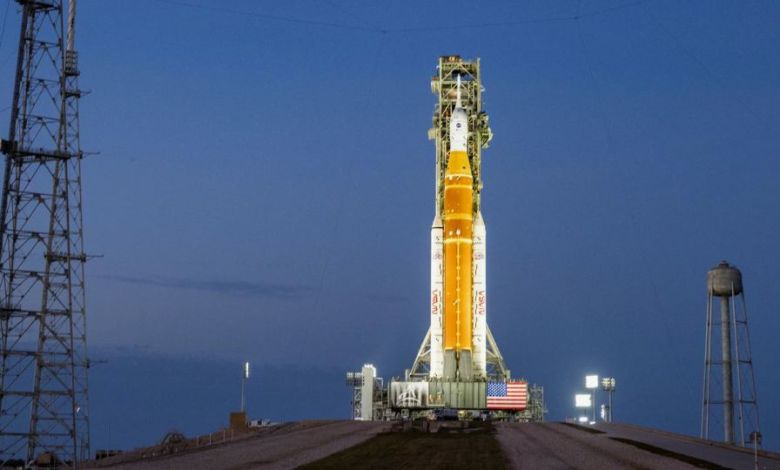
NASA has completed a crucial risk assessment ahead of its upcoming Moon flyby mission, and in a news conference Thursday, the agency revealed a new target launch date and discussed how officials have assessed the dangers the mission’s four-person crew will face.
The agency now aims to launch the historic mission, called Artemis II, on April 1 at 6:24 p.m. ET. In the event of a delay, there are six additional windows for takeoff next month, April 2, 3, 4, 5, 6 and 30.
The assessment – known as the Flight Readiness Review, or FRR – took place over two days this week and is a crucial step toward liftoff in which mission leaders meet to determine whether the rocket, spacecraft and ground systems are ready for launch.
However, John Honeycutt, chairman of the Artemis II mission management team, did not share a specific, quantitative estimate of the risks associated with this rocket and spacecraft.
The numbers that characterize the probability of “mission loss” or “crew loss” are two data points that the agency shared with the public during the Space Shuttle era, and similar analyzes have since been offered for many missions. Ahead of an uncrewed test flight called Artemis I in 2022, NASA assessed that there was a 1 in 125 chance that the Orion spacecraft – the same type of vehicle that will carry the Artemis II crew – would be lost.
“I know we’ve continued to evaluate the mission loss and crew loss numbers, but I’m not sure we understand what they actually mean,” Honeycutt said, explaining that such numbers usually involve guesswork.
Honeycutt noted that, given that Artemis II will mark only the second flight of NASA’s Space Launch System (SLS) rocket, there is not much data to rely on to calculate such a figure for this flight.
“We’re probably not 1 in 50 going on the mission exactly the way we want, but we’re probably not 1 in 2 like we were on the first flight,” Honeycutt said of the SLS rocket, which propels the Orion capsule into orbit. “I think we’re very careful not to really put any probabilistic numbers on the table for this mission.”

New Artemis II conference from NASA on Thursday. -NASA/YouTube
“I wouldn’t put a number on it,” added Lori Glaze, acting associate administrator for NASA’s Exploration Systems Development Mission Directorate.
“An incredible amount of work has gone into preparing for this test flight by thousands of people across our integrated team,” added Glaze.
“We had extremely in-depth, very open and transparent discussions,” she said. “We talked a lot about our risk posture and how we mitigate those risks.”
Glaze noted that all four members of the Artemis II crew – NASA’s Reid Wiseman, Victor Glover and Christina Koch and Canadian Space Agency astronaut Jeremy Hansen – joined the FRR virtually from their base in Houston, Texas.
“Having them join us in this review really reinforced the importance of having open and honest discussions,” Glaze added.
No dissenting concerns
Glaze said the astronauts listened to how mission managers evaluated the Orion spacecraft’s heat shield. The heat shield is a crucial piece of hardware designed to protect the crew when their capsule re-enters Earth’s atmosphere upon returning from its 10-day journey around the Moon.
As CNN previously reported, NASA spent more than a year understanding why the Orion heat shield didn’t perform as expected during the 2022 Artemis I test flight, returning home with pits and cracks throughout the material. Artemis II flies with a similar heat shield, but the agency has announced plans to mitigate risks by changing the Orion capsule’s return trajectory — an assessment that some critics have called inadequate.
Glaze said NASA, however, has internal consensus that the heat shield is safe and that Artemis II is ready to fly.
“I think we can all agree that we have a good heat shield,” she said. The astronauts were “listening to make sure we got it right,” including details about how the group would stay in touch with mission controllers on the ground during reentry.
Historically, some flight readiness review meetings have been controversial. In the space shuttle era, for example, events could give rise to tense disagreements between experts.
“A good FRR for the Space Shuttle could last two days or more, with long presentations, probing questions, sometimes acrimonious debates, and finally a resolution: fly or retire and repair,” recalled Wayne Hale, former Space Shuttle program manager and NASA flight director.
A NASA spokesperson said this week’s FRR lasted all day Wednesday and concluded Thursday afternoon before the 3 p.m. ET briefing.
“We had some quiet time, giving people plenty of time to come to the table and share their dissenting concerns, and there were none,” Honeycutt said.
Technical questions
Still, Artemis II mission managers had many technical questions to discuss.
Before the meeting, the SLS rocket suffered a series of setbacks. These included problems with liquid hydrogen – a super-cooled propellant that is notorious for leaking – leaking from the rocket at higher than acceptable rates during an initial fueling test. Hydrogen is very energetic and easy to ignite, posing a risk of explosion if there are too many aggregates in one area.
While NASA seemed to have the fuel leak problem under control, the agency ran into a new problem in late February: helium was not flowing properly to the top of the rocket. Helium is crucial because it is used to clean propellant lines and help pressurize fuel tanks.
The problem ruled out possible March liftoff dates and prompted NASA to remove the rocket from the launch pad for maintenance. In fact, the spacecraft is still in NASA’s Vehicle Assembly Building, located about 6 kilometers from the launch pad.
The space agency now plans to return the SLS rocket to its launch site on March 19. The journey is a slow process that takes around 10 to 12 hours.
Additionally, the rocket’s initial journey to the launch pad may have been responsible for some hydrogen leaks, Amit Kshatriya, NASA associate administrator, revealed during a February 3 press conference.
It is not yet clear whether these hydrogen problems could reappear as the SLS returns to launch position.

SLS and Orion are seen at the start of the Artemis II press conference on Thursday. -NASA/YouTube
The space agency confirmed Thursday, however, that it was able to resolve the helium flow problem by repairing a blocked joint in a cable that connects the rocket to nearby ground systems.
NASA said it chose not to hold another wet dress rehearsal — a test in which launch controllers fill the rocket with fuel and conduct a full workout in preparation for launch.
The last wet dress rehearsal, at the end of February, was a success. But it ended just before NASA identified the helium flow problem.
Glaze said one reason for forgoing another wet-suit test is to preserve the fuel tanks: Every time NASA fills them with propellant, “it takes a little bit of life out of those tanks.”
She added: “We don’t want to give up any days of our April launch window for a wet dress rehearsal.”
NASA’s Artemis program is sending humans into deep space for the first time in more than five decades. Sign up for the Countdown newsletter and receive updates from CNN Science on extraordinary expeditions as they unfold.
For more CNN news and newsletters, create an account at CNN.com


