Under fire from the sea, families in Odesa try to escape Russian barrage

From Mariia’s apartment on the 16th floor, the calm waters of the Black Sea stretch to the horizon in the fading twilight.
“Here you can see and hear when the drones are coming,” she said, standing near a floor-to-ceiling window. When they hit buildings and homes in the city of Odessa below, “we also see all the fires.”
His nine-year-old daughter Eva learned the shapes and sounds of the objects that zoom across the sky daily. She proudly shows off a list of social media that she checks when air raid alerts go off.
“She knows if what is happening is a risk or a threat, and that calms her,” explains her father Sergii.
There is virtually no place in Ukraine that has not been targeted since Russia launched its full-scale invasion almost four years ago.
But in recent weeks, Odessa – Ukraine’s third largest city – has been the target of sustained attacks. By striking port and energy infrastructure, Russia is trying to paralyze the region’s economy and undermine the morale of the population.
But Moscow is not only attacking the installations. Its drones, many as large as a motorcycle, regularly crash into high-rise buildings like Masha’s, exploding on impact and throwing glass and debris inward. The consequences are often fatal.
“A few months ago, Eva said that she was afraid that the drone would come too quickly and that we would not have time to hide,” says Mariia. “But I explained that if he came towards us, he would get stronger and stronger and then we would know we had to run.”
Mariia, Sergii and Eva are from Kherson, a region 200 km (125 m) east of Odessa and today largely occupied by Russia.
They left as soon as the invasion began in 2022 and mother and daughter briefly moved to Germany as refugees. But Sergii and Mariia could not stand the distance, so the family reunited in Ukraine and moved to Odessa.
Now, as attacks on the region intensify, Sergii wonders if the family should prepare to leave again. “War is only about economics, and Odessa, for the Russians, is about infrastructure. So they will do their best to conquer it,” he says.

Sergii, Mariia and Eva’s apartment in Odessa suffers from frequent power cuts [BBC]
Nestled in southwest Ukraine, Odessa was an economic powerhouse before the war. But now that Russia occupies the majority of Ukraine’s coastline, the region has become even more vital. Its three ports are the largest in Ukraine and include the country’s only deep-water port. With land crossings disrupted, 90% of Ukraine’s exports last year were shipped by sea.
But in times of war, the region’s importance is also its weakness.
Last month, Vladimir Putin threatened to cut off Ukraine’s access to the sea in retaliation for Ukrainian strikes against the “ghost fleet” that Russia uses to circumvent sanctions.
This threat translated into a concrete impact. For two years, Russia’s attempts to thwart Odessa’s economy have been almost incessant – but the last few weeks have been particularly difficult.
Air attacks on ports have destroyed cargo and containers and damaged infrastructure; crew members of foreign merchant ships operating in the Gulf of Odessa have been injured or killed by drones; and 800 air raid alerts in one year repeatedly disrupted port operations.

Power outages have plunged much of Odessa into darkness since December [Getty Images]
The result last year was a 45% decrease in exports of agricultural products, vital to Odessa’s economy.
In the wake of a drone strike this week that set a Panama-flagged ship on fire and seriously injured one of its crew members, regional government head Oleh Kiper said shipowners entering Odessa ports “clearly understand that they are entering a war zone” and that the ships were insured.
But if such attacks continue, in the long term, foreign businesses could be discouraged from trading with the port.

“After a strike like last night, people who live here go to shelters for a while, then they relax again,” says Maryna Averina of the state emergency service. [BBC]
As the strikes increase, air sirens go off frequently, but not everyone pays attention. Standing outside a destroyed gymnasium the morning after a nighttime drone strike that injured seven people, Maryna Averina of the state emergency service acknowledges that people have become “very careless about their own safety.”
A recent air raid alert lasted most of the day. “Sitting in a shelter for 16 hours is just unrealistic,” Averina says, as gym staff emerge from the destroyed building with all the items they managed to salvage from the rubble and mangled metal inside.
While many Ukrainians are now sadly accustomed to drone and missile strikes, they are increasingly frightened by the relentless attacks that cut off electricity and heating in the midst of a particularly harsh winter.
In December, almost a million residents of Odessa were left without electricity. “We were among the first regions to experience what it means to go through the winter period without electricity and heating,” explains Oleh Kiper.

“I live in hope that all this will end soon,” says Yana. “We have all been living like this for four years now, but unfortunately, for now, it is like this.” [BBC]
A month later, while temperatures hover around -1°C, supplies remain severely disrupted.
Ada, 36, walks on the beach, indifferent to the howl of air alert sirens mixed with the cries of seagulls. Drone attacks have intensified but, she said, “the bombings are not as scary as this cold”.
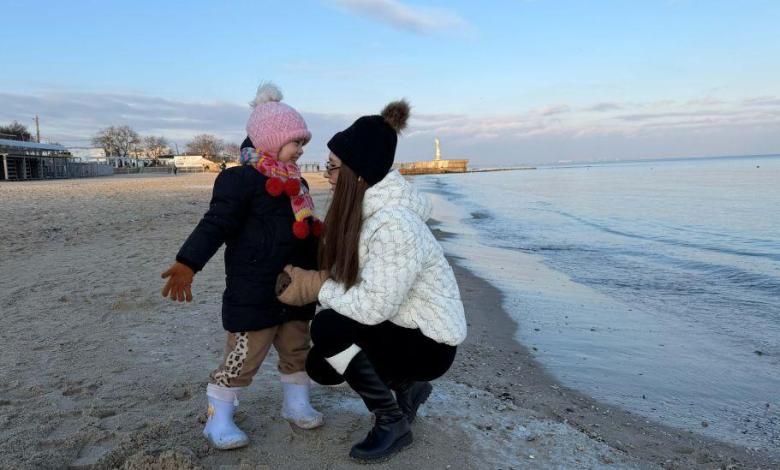
Nearby, a young mother named Yana agrees. Recently, she said, the situation in all areas “has been really very difficult.” At one point, a drone crashed into his apartment, and another hit the block shortly after.
Then came the power cuts. She and her family bought an expensive generator, but running it for seven hours costs around $10 – a significant expense in a country where the average monthly salary is around $500 (£375).
“Unfortunately, we have all been living like this for four years. We are as helpless as flies and everything is decided by the authorities,” she said, while trying to keep her screaming toddler out of the icy water.
“Maybe we are being punished for something – the whole nation, not just a few, but everyone.”
Further down the beach, Kostya fishes on a pier that extends into the sea. He says he is not worried about the Russians advancing toward the town. “I don’t think they will succeed here. [The Ukrainians] they will break their legs first. »
But, he adds, things are painful and scary. And like many Ukrainians, he still seems to have difficulty accepting that war broke out in his country four years ago, led by a neighbor he once knew so well.
In his youth, Kostya served in the army and took an oath to the Soviet Union. “I never imagined I would see something like this in my old age,” he says.
While Russian propagandists have long insisted that Ukraine’s independence since 1991 is a historical mistake, Odessa’s past role as the crown jewel of the Russian empire means that it still holds particularly strong symbolic importance for Moscow.
Vladimir Putin has repeatedly referred to Odessa as a “Russian city” and frequently invoked the idea of “liberating Novorossiya,” a historic region of the Russian empire that encompassed parts of modern-day southern and eastern Ukraine, including Odessa.
“They wanted and still want to seize Odessa, like many other regions, but today our military is doing everything possible and impossible to prevent this from happening,” insists the head of the regional government.

A statue of Russian Empress Catherine the Great, founder of Odessa, was among the first to be dismantled [Getty Images]
Oleh Kiper has made it his personal mission to sever any remaining ties between Odessa and Russia. He is a strong supporter of a 2023 decolonization law, which requires local authorities to rid their towns of any street names, monuments or inscriptions that may be linked to Russia’s imperial past.
Among the statues that were removed was a monument to Odessa’s founder, Russian Empress Catherine the Great, while streets named after Russian and Soviet figures were renamed. Pushkin Street has become Italian Street and Catherine Street is now European Street. Kiper also defends the use of Ukrainian in a city where Russian is still widely spoken.
Asked about the resistance he encountered from Odesians proud of their heritage as a multicultural port on the world, he was provocative.
“The enemy is doing much more than we are to ensure that a Russian-speaking city becomes Ukrainian,” Kiper says. “It forces people to understand who the Russians are and whether we really need them.”
The next day, as temperatures dropped to -6°C, the city experienced a month of partial blackouts and air raid warnings were in effect for four hours. The port of Chernomorsk, east of Odessa, was again hit by a ballistic missile, injuring a crew member of a civilian ship.
As is the case with the rest of Ukraine, if Russia cannot have Odessa, it seems determined to continue to cripple it.
Additional reporting by Liubov Sholudko


