AI reveals 800 never-before-seen ‘cosmic anomalies’ in old Hubble images


January 27, 2026
1 min reading
 Add us on GoogleAdd SciAm
AI reveals 800 never-before-seen ‘cosmic anomalies’ in old Hubble images
Scientists analyzed more than 100 million image slices from the Hubble Space Telescope archive and discovered hundreds of previously unknown objects.
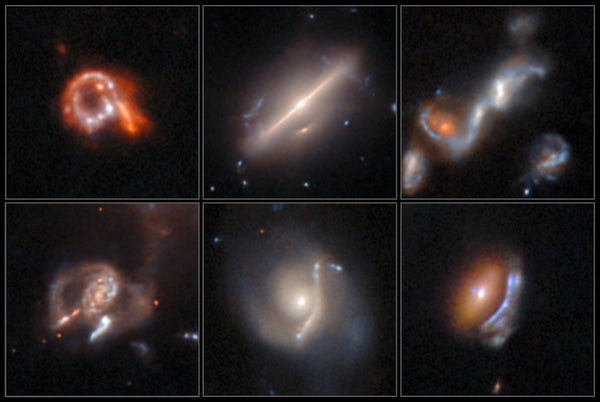
Six never-before-seen astrophysical objects from a Hubble Space Telescope data archive.
ESA/Hubble/NASA/D. O’Ryan/P. Gómez/European Space Agency/Mr. Zamani/ESA/Hubble
The universe is so vast and the difficulty of discovering everything in the cosmos is so great that we might as well count all the grains of sand in the Sahara. But now, with the help of artificial intelligence, astronomers have revealed more than 800 previously unknown “cosmic anomalies” hidden in archival data from the Hubble Space Telescope.
Researchers at the European Space Agency (ESA) developed an AI tool that sifted through nearly 100 million image cutouts in the Hubble Legacy Archive, a collection of data dating back 35 years. Incredibly, the AI took just two and a half days to search through the entire archive, a task that would have taken a human research team much longer.
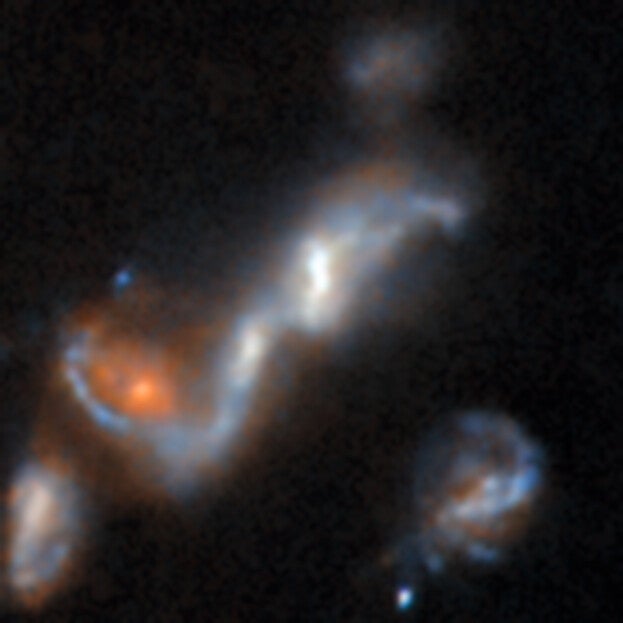
Merging galaxies from the Hubble archives.
ESA/Hubble/NASA/D. O’Ryan/P. Gómez/European Space Agency/Mr. Zamani/ESA/Hubble
On supporting science journalism
If you enjoy this article, please consider supporting our award-winning journalism by subscription. By purchasing a subscription, you are helping to ensure the future of impactful stories about the discoveries and ideas shaping our world today.
The hunt revealed more than 1,300 “anomalous objects,” including galaxy mergers, jellyfish galaxies (so named because of their gas tentacles), and other unusual features. Among these were dozens of possible gravitational lenses – places where a massive object, like a galaxy, bends light from a given source, like another galaxy – as well as dozens of other strange objects that defied easy explanation. Of all the objects found, around 800 had never been described before.
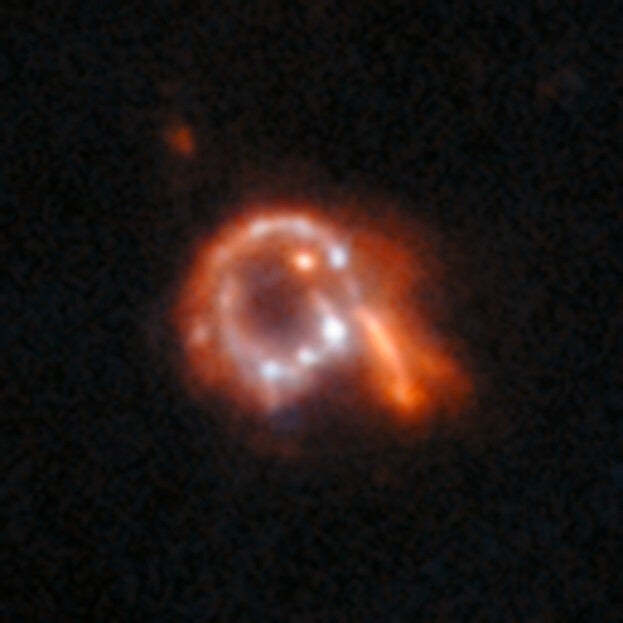
A collisional ring galaxy from the Hubble archives.
ESA/Hubble/NASA/D. O’Ryan/P. Gómez/European Space Agency/Mr. Zamani/ESA/Hubble
The work was published last month in the journal Astronomy and astrophysics.
In a statement, Pablo Gómez, ESA data scientist and co-author of the paper, said the AI approach could offer a model for exploring other space science archives. “He [shows] how useful this tool will be for other large datasets,” he said.
It’s time to defend science
If you enjoyed this article, I would like to ask for your support. Scientific American has been defending science and industry for 180 years, and we are currently experiencing perhaps the most critical moment in these two centuries of history.
I was a Scientific American subscriber since the age of 12, and it helped shape the way I see the world. SciAm always educates and delights me, and inspires a sense of respect for our vast and beautiful universe. I hope this is the case for you too.
If you subscribe to Scientific Americanyou help ensure our coverage centers on meaningful research and discoveries; that we have the resources to account for decisions that threaten laboratories across the United States; and that we support budding and working scientists at a time when the value of science itself too often goes unrecognized.
In exchange, you receive essential information, captivating podcasts, brilliant infographics, newsletters not to be missed, unmissable videos, stimulating games and the best writings and reports from the scientific world. You can even offer a subscription to someone.
There has never been a more important time for us to stand up and show why science matters. I hope you will support us in this mission.


