Uranus may have a 29th moon


Uranus seems to have another moon. The observations made with the James Webb space telescope (JWST) detected the presence of this small satellite earlier this year, carrying the number of satellites known to the ice giant up to 29. The data always make its way through the peer examination process for final confirmation, but everything points to a new addition to the family.
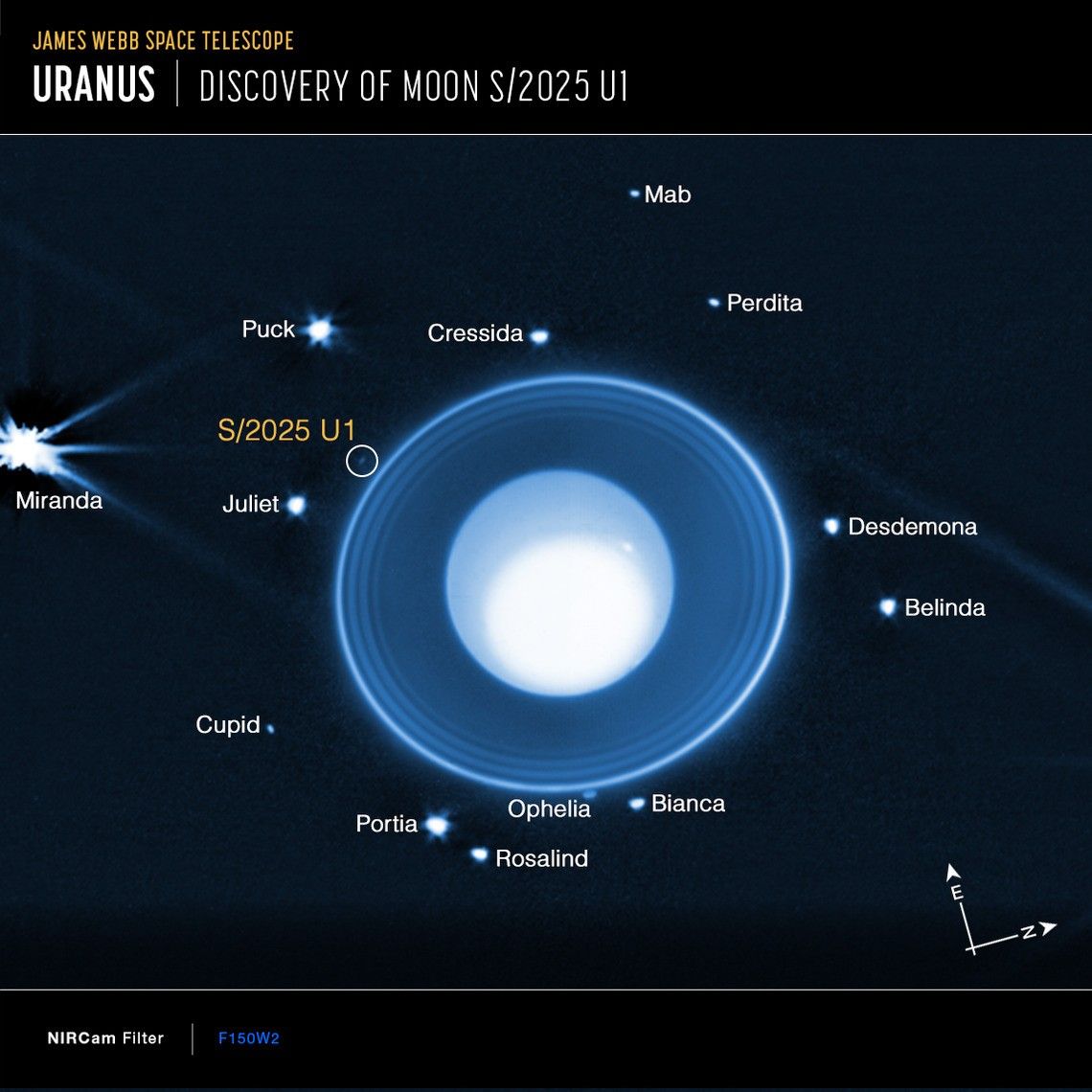
The first indications of an additional moon arrived on February 2, when JWST targeted its near infrared camera in Uranus for a series of 10 exposure images of 10 minutes. Subsequent analysis seems to confirm that the diminutive satellite is part of the complex system of 14 moons located inside the largest moons of Ariel, Miranda, Oberon, Titania and Umbriel.
“No other planet has as much interior moons as Uranus, and their complex inter-processes with the rings refer to a chaotic history that blurs the border between a ring system and a system of moons,” said the researcher at the Seti Matthew Tiscareno Institute in a press release for NASA.
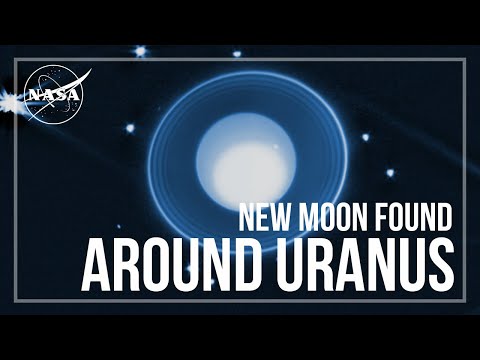
Temporarily designated as S / 2025 U1, the Moon is estimated only six miles wide. For reference, it is less than the width of New York. Its solar reflectivity (or Albédo) is also much less brilliant than the small similar moons on the planet. These details probably explain how to travel 2 missed it when the space probe carried out its investigation on the flight plan almost 40 years ago on January 24, 1986.
According to the scientist of the Southwest Research Institute solar system, the scientist of the Science and Exploration Division Maryame El Moutamid, S / 2025 U1 is located about 35,000 miles from the center of Uranus. It orbit its equatorial plan between Ophelia and Bianca, just outside the limits of the planet’s main ring system.
“Its almost circular orbit suggests that it can have been formed near its current location,” added El Moutamid.
There is not much information available at the moment, but astronomers think that there is still a lot to learn about this last Uranian moon.
“The new moon is smaller and much lower than the smallest of previously known interior moons, which makes it likely that even more complexity remains to be discovered,” said Tiscareno.
Uranus’ most recent moon was discovered in 2023 and designated as S / 2023 U1. Like its predecessor, this new known satellite will keep its title dry of S / 2025 U1 for the moment. However, the two moons will eventually receive new names once they are approved by the international astronomical union. And if the previous history is an indication, there is a good chance that they referent the characters of the works of William Shakespeare or Alexander Pope.

More offers, reviews and purchasing guides


:max_bytes(150000):strip_icc()/HDC-GettyImages-2194878655-57a31994800d4bfdbcec1443f17025a1.jpg?w=390&resize=390,220&ssl=1 "3 Dietitians Agree on the Healthiest Nut You Can Eat")

